Economic Pulse Net | Sources: World Bank World Development Indicators, Government Sources | 2026
🇬🇷 Greece 2025: The Quiet Resilience of a Post-Crisis Economy
Key Takeaways
* Steady Growth: According to World Bank data, Greece is projected to achieve a GDP growth rate of approximately 2.07% in 2025, signaling a return to positive economic momentum.
Price Stability: Inflation, measured by the Consumer Price Index (CPI), stands at roughly 2.48%, suggesting that price increases are manageable and not eroding purchasing power rapidly.
Labor Market Recovery: The unemployment rate has settled at 8.54%, reflecting a labor market that, while not perfect, is significantly healthier than during the peak of the debt crisis.
Diverse Corporate Landscape: The business sector is anchored by a mix of consumer services, utilities, and industrial giants, including prominent names like Aegean Airlines and ADMIE.
Stable Political Framework: The country operates under a parliamentary republic system established in 1975, providing a consistent legal and political structure for economic activity.
The Numbers Behind the Narrative: A Return to Normalcy
The economic heartbeat of Greece in 2025 is best understood through the lens of steady, if modest, expansion. According to the World Bank, the country’s GDP is projected to grow by 2.07306882481713% this year. This figure is significant because it marks a departure from the volatile, often negative growth rates that characterized the nation during its most turbulent financial years.
For an economy with a total GDP of approximately $280.6 billion, this growth rate represents a tangible increase in national output and income. The stability is further underscored by inflation, which the World Bank records at 2.48209745378857%. In practical terms, this means that the cost of goods and services is rising at a rate that is relatively contained, allowing wages to keep pace with prices without the severe erosion of purchasing power seen in high-inflation environments.
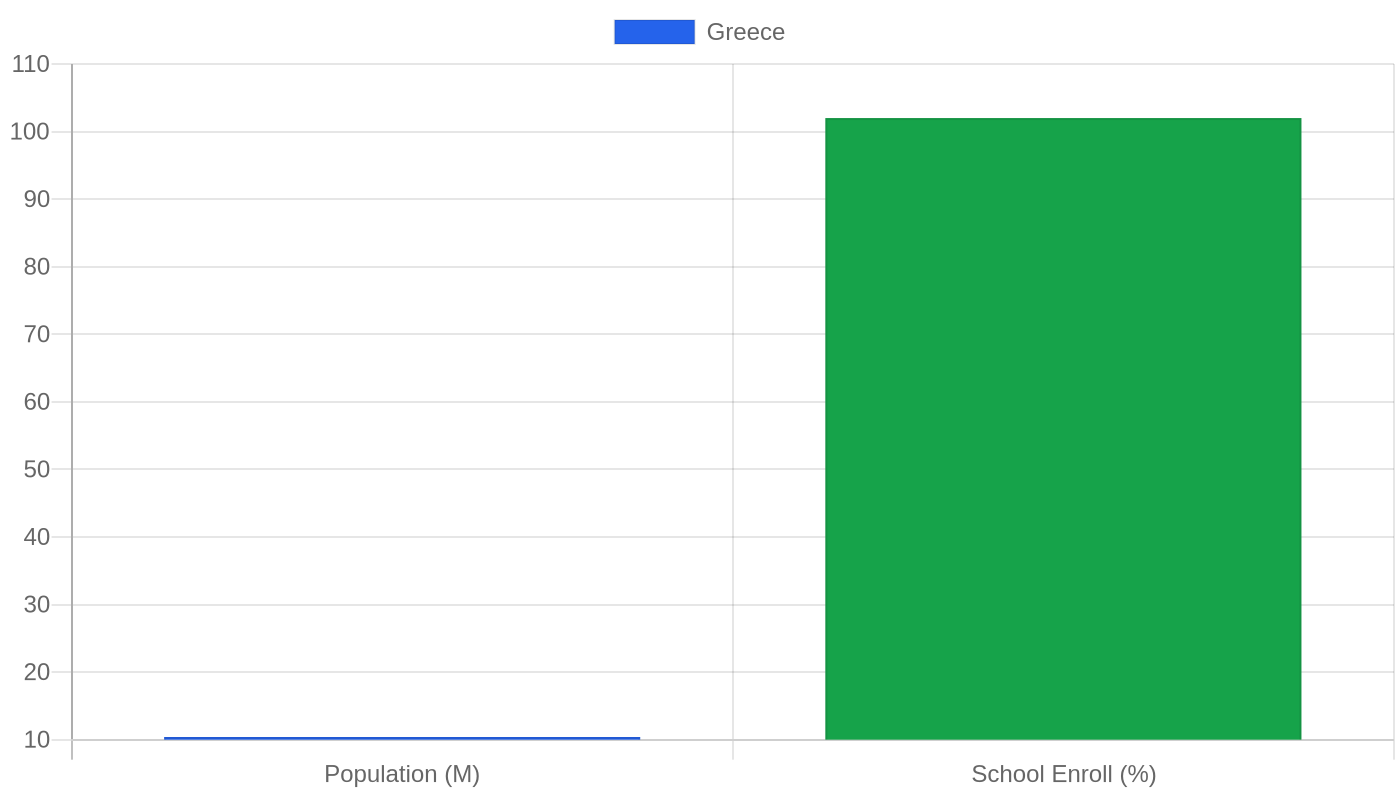
The labor market provides further evidence of this stabilization. With an unemployment rate of 8.54%, Greece has moved away from the double-digit unemployment figures that plagued the country for over a decade. For a population of 10,413,962 people, this employment rate suggests that a significant portion of the workforce is engaged in productive economic activity. The World Bank data also highlights the country’s purchasing power, with a GDP per capita (PPP) of $45,263.65 and a GNI per capita of $25,360.
These figures indicate that while Greece may not be a high-income powerhouse compared to some of its Northern European neighbors, it has maintained a level of living standards that supports a robust domestic consumer base. The combination of positive growth, controlled inflation, and improving employment rates paints a picture of an economy that has successfully navigated the immediate shocks of the past and is now operating in a more predictable, sustainable rhythm.
Living Costs and Domestic Spending Power
While specific housing and rent data are not provided in the current dataset, the macroeconomic indicators offer a clear window into the daily financial reality for Greek residents. The inflation rate of 2.48%, as recorded by the World Bank, suggests that the cost of living is not spiraling out of control.
For the average citizen, this means that essential expenses, from groceries to utilities, are increasing at a rate that is likely manageable within the context of wage growth associated with the 2.07% GDP expansion. The GNI per capita of $25,360 serves as a baseline for understanding the average income available to households, providing a reference point for how much disposable income is left after taxes and basic necessities.
Although detailed breakdowns of rent versus buy scenarios are absent from the provided data, the overall economic stability implies a housing market that is less volatile than in periods of high inflation or economic crisis. The fact that the economy is growing at a steady 2% suggests that demand for housing and services is being driven by organic economic activity rather than speculative bubbles or panic buying.
For residents, the key takeaway is that the financial environment is stable enough to plan for the long term, whether that involves saving for a home purchase or managing monthly utility bills. The absence of extreme inflationary pressure is a crucial factor in maintaining the quality of life, as it prevents the sudden, sharp increases in daily expenses that can destabilize household budgets.
Corporate Giants and the Business Ecosystem
The business landscape in Greece is dominated by a diverse array of companies that span critical sectors of the economy. Among the top listed companies, consumer services and goods play a pivotal role, with entities like 4E TV, Abea, and Achaia Clauss holding significant market presence. These firms reflect the strength of the domestic consumer market, which is supported by the stable purchasing power indicated by the national income data.
In the industrial sector, companies such as Aegean Speed Lines and Aegek SA contribute to the country’s manufacturing and logistics capabilities, ensuring that Greece remains integrated into broader supply chains.
The utility sector is anchored by ADMIE, a key player in managing the electricity grid, highlighting the infrastructure backbone that supports both residential and commercial activities. The financial sector is represented by Aeolian Investment Fund S.A., indicating a mature market for investment and capital allocation. Notably, the tourism and transportation sector is well-served by major players like Aegean Airlines and Air Mediterranean, which are crucial for a country where tourism is a vital economic driver.
This concentration of major companies across consumer, industrial, utility, and financial sectors suggests a diversified economy that is not overly reliant on a single industry. The presence of these established firms provides a layer of stability to the business environment, offering employment opportunities and contributing to the tax base that supports public services.
Political Stability and the Rule of Law
The political environment in Greece is defined by a constitutional framework that has remained largely consistent since 1975. The current Constitution, enacted after the fall of the military dictatorship in 1974, establishes Greece as a parliamentary republic. This document, which has been amended four times since its inception, consists of 120 articles that provide for a clear separation of powers among the executive, legislative, and judicial branches.
This structural clarity is vital for economic confidence, as it ensures that policy changes are subject to legal oversight and democratic process rather than arbitrary executive action.
The Constitution also grants extensive guarantees of civil liberties and social rights, which were further reinforced in 2001. This legal foundation fosters an environment where individual rights and social protections are enshrined in law, contributing to a sense of security for both citizens and foreign investors. While specific crime and safety indices are not available in the current data, the stability of the political system and the rule of law provide a strong baseline for public safety.
The continuity of this parliamentary system over nearly five decades suggests a political culture that values institutional stability, which is a key factor in maintaining long-term economic growth. For businesses and residents alike, the predictability of the legal and political landscape reduces uncertainty, allowing for more confident long-term planning and investment.
Current Dynamics and Economic Outlook
The current economic climate in Greece is characterized by a cautious optimism, driven by the steady growth figures provided by the World Bank. The 2.07% GDP growth rate for 2025 indicates that the economy is moving forward, albeit at a moderate pace. This growth is supported by a stable inflation rate of 2.48%, which helps to preserve the value of wages and savings.
The unemployment rate of 8.54% reflects a labor market that is still recovering but is clearly improving, with more people finding employment and contributing to the economy.
There are no immediate signs of crisis in the data provided; instead, the numbers point to a period of consolidation. The economy is not experiencing boom-and-bust cycles but rather a steady, predictable expansion. This stability is crucial for maintaining investor confidence and encouraging domestic consumption. The presence of major companies in key sectors ensures that economic activity is distributed across various industries, reducing the risk of sector-specific shocks.
As Greece continues to navigate its post-crisis recovery, the focus will likely remain on sustaining this moderate growth while addressing any remaining structural challenges. The data suggests that the country is on a stable trajectory, with the political and legal framework providing the necessary support for continued economic development.
The Bottom Line
Greece in 2025 presents a compelling case for those interested in stable, mid-sized European economies. The combination of positive GDP growth, controlled inflation, and a recovering labor market creates a favorable environment for both residents and investors. The strength of its corporate sector, led by established names in consumer, industrial, and utility fields, provides a solid foundation for economic activity.
For international observers, Greece offers a model of successful post-crisis recovery, where institutional stability and legal continuity have supported a return to normal economic rhythms. While it may not offer the high-growth rates of emerging markets, Greece provides a reliable, predictable, and legally sound environment that is increasingly attractive in a volatile global landscape.
Sources & Methodology
This article is authored by Economic Pulse Net for informational and research purposes. Economic Pulse Net sources its data from multilateral institutions, national statistics bureaus, and proprietary databases. All data is believed to be current as of the date of publication.
Published: September 09, 2026 | Category: Research — Greece
Use these signals in your own platform
Economic Pulse publishes its live signal feed through a documented, read-only API. Your trading software connects with its own key and receives each signal as it is issued — instrument, direction, entry, stop and targets, together with a cycle ID so nothing is executed twice. The feed is independent of this website and cannot change it.
Signals are informational only and are not financial advice.