Economic Pulse Net | Sources: World Bank World Development Indicators, Government Sources | 2026
Key Takeaways
* Steady Economic Expansion: Greece is projected to achieve a GDP growth rate of approximately 2.07% in 2025, signaling a continued recovery trajectory post-crisis.
Moderate Inflationary Pressure: With CPI inflation holding at roughly 2.48%, price stability remains a priority for policymakers and consumers alike.
Labor Market Challenges: Despite growth, unemployment remains elevated at 8.54%, indicating that job creation has not yet fully matched the pace of economic expansion.
Robust Corporate Sector: Key players in utilities, aviation, and consumer goods are driving domestic activity, with major entities like ADMIE and Aegean Airlines anchoring the industrial landscape.
Democratic Stability: The country operates under a stable parliamentary republic framework established in 1975, providing a predictable political environment for long-term investment.
Economic Momentum Amid Structural Adjustments
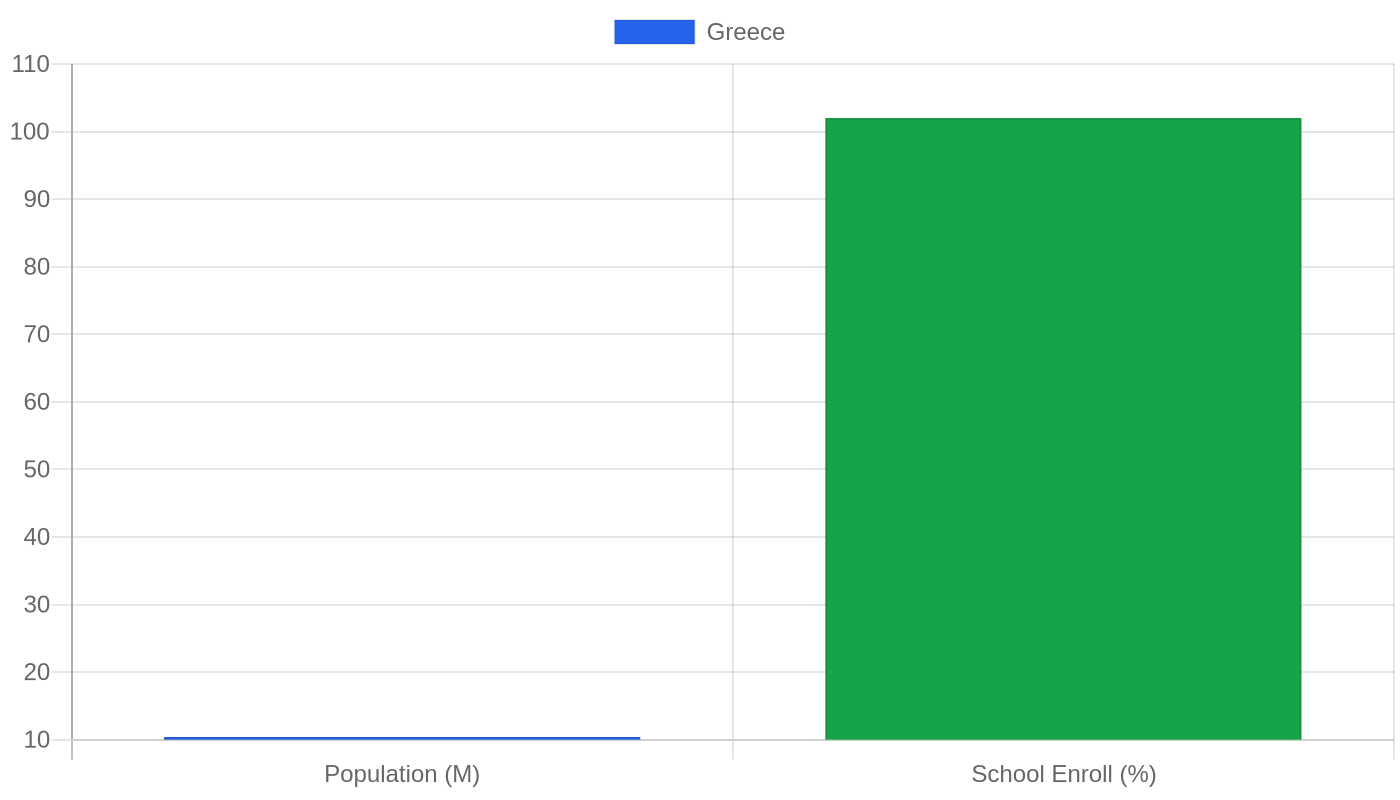
Greece’s economic performance in 2025 reflects a nation carefully balancing growth targets with structural reforms. According to World Bank data, the country’s GDP is projected to grow by 2.073% this year, a figure that underscores a steady, albeit cautious, return to pre-crisis vitality. This growth is supported by a total GDP value of approximately $280.6 billion USD, demonstrating the sheer scale of the economy relative to its population of over 10.4 million people.
However, the human element of this macroeconomic success story requires nuance; while the aggregate numbers are positive, the unemployment rate stands at 8.54%, suggesting that labor market absorption has not kept pace with overall output expansion. For investors and citizens alike, this discrepancy highlights a critical area for future policy focus: translating corporate and sectoral growth into widespread employment opportunities.
Furthermore, inflation remains relatively contained at 2.481%, which helps preserve purchasing power but also indicates that the central bank must remain vigilant against external shocks. The GDP per capita in PPP terms reaches $45,263, offering a glimpse into the standard of living, though the GNI per capita sits lower at $25,360, reflecting income flows to foreign entities or remittances.
These figures collectively paint a picture of an economy that is growing but still navigating the complex aftermath of previous fiscal constraints.
Cost of Living and Daily Expenses
For residents and expatriates, the cost of living in Greece is shaped by its position as a premium Mediterranean destination, where daily expenses can vary significantly between urban centers like Athens and rural islands. While specific housing indices are not detailed in the current dataset, the broader economic indicators suggest a moderate inflationary environment that impacts household budgets.
With CPI inflation at 2.48%, the annual increase in the cost of goods and services is manageable, allowing for some predictability in financial planning. However, the disparity between GDP per capita ($45,263 PPP) and GNI per capita ($25,360) may imply that net income available for discretionary spending is tighter than gross domestic metrics might suggest.
Consumers in key sectors such as utilities, represented by companies like ADMIE, face operational costs that trickle down to household bills, influencing the overall affordability of living in the country. Compared to other Eurozone nations, Greece often offers a lower baseline cost for real estate and tourism-related services, yet essential goods and imported items remain subject to global price fluctuations.
This dynamic creates a unique economic reality where wealth accumulation can be challenging despite a growing national output, requiring careful budgeting for both locals and foreign investors looking to establish residency.
Investment Landscape and Corporate Powerhouses
The Greek business ecosystem is anchored by a diverse array of top-tier companies that span utilities, aviation, and consumer services, providing a robust foundation for foreign direct investment. Major entities such as ADMIE, the independent power transmission operator, play a critical role in the energy sector, ensuring grid stability and facilitating renewable energy integration.
In the transportation sector, Aegean Airlines and Air Mediterranean dominate consumer services, leveraging Greece’s strategic geographic location to connect Europe with the Middle East and beyond. The consumer goods industry is equally vibrant, with Abea and Achaia Clauss representing significant local brands that cater to both domestic demand and export markets. Additionally, firms like Alfa-Beta Vassilopoulos have carved out strong positions in retail, reflecting the resilience of local supply chains.
Industrial players such as Aegean Speed Lines and Aegek SA contribute to the logistical backbone of the economy, supporting trade and manufacturing activities. Financial services are also well-represented by institutions like Aeolian Investment Fund S.A., which provides capital solutions for various sectors. These companies operate within a legal framework that guarantees civil liberties and social rights, offering a degree of regulatory certainty that appeals to international partners.
The concentration of these major players suggests that investment opportunities are likely to cluster around infrastructure, tourism-linked services, and domestic consumption, rather than high-tech manufacturing alone.
Political Framework and Social Stability
Greece’s political landscape is defined by its enduring commitment to democratic principles, rooted in the Constitution enacted in 1975 following the fall of the military dictatorship. This foundational document establishes a parliamentary republic with a clear separation of powers among the executive, legislative, and judicial branches, ensuring checks and balances that protect against authoritarian drift.
The Constitution consists of 120 articles and has been amended four times, most notably in 2001, to reinforce civil liberties and social rights. This legal structure provides a stable backdrop for economic activity, reducing political risk for long-term investors. However, specific crime and safety indices are currently listed as N/A, meaning that granular data on public safety levels is not available for immediate comparison.
Despite this data gap, the historical context of transitioning from dictatorship to democracy suggests a society that values institutional stability and rule of law. The emphasis on social rights in the constitutional framework also implies that labor laws and worker protections are likely stringent, which can impact business flexibility but enhances social cohesion.
For residents, this political maturity translates into a predictable civic environment, even if specific metrics on personal safety remain unquantified in the current dataset.
Current Affairs and Policy Directions
In the current economic climate, Greece is navigating a period of consolidation where growth targets are being met through sustained reform efforts. The projected 2.07% GDP growth for 2025 indicates that recent policies aimed at improving competitiveness and attracting foreign investment are yielding results. However, the persistent 8.54% unemployment rate signals that labor market reforms are still in progress, with the government likely focusing on vocational training and incentives for hiring.
Inflation at 2.48% suggests that monetary policy is effectively anchored, preventing the overheating that often accompanies rapid post-crisis recoveries. Companies like Aegean Airlines and ADMIE are expanding their operations, reflecting increased confidence in the domestic market and regional connectivity. Meanwhile, consumer-focused firms such as Alfa-Beta and Abea are adapting to changing consumer preferences, potentially shifting towards digital commerce and sustainable sourcing.
The political stability provided by the 1975 Constitution continues to serve as a bedrock for these developments, ensuring that policy shifts are gradual and legally sound. As the country moves forward, the interplay between maintaining fiscal discipline and addressing social inequalities will likely define the next phase of its economic narrative.
The Bottom Line
Greece presents a compelling case for investors seeking exposure to a stable, emerging European market with strong tourism and utility sectors. While the growth outlook is positive, potential stakeholders must weigh the benefits against the realities of a moderately high unemployment rate and complex labor regulations. The country’s democratic stability and constitutional safeguards offer a secure environment for long-term capital deployment.
Ultimately, Greece is a nation in transition, balancing its rich heritage with modern economic ambitions, making it a watchlist candidate for those interested in Mediterranean resilience.
Sources & Methodology
This article is authored by Economic Pulse Net for informational and research purposes. Economic Pulse Net sources its data from multilateral institutions, national statistics bureaus, and proprietary databases. All data is believed to be current as of the date of publication.
Published: October 28, 2026 | Category: Research — Greece
Use these signals in your own platform
Economic Pulse publishes its live signal feed through a documented, read-only API. Your trading software connects with its own key and receives each signal as it is issued — instrument, direction, entry, stop and targets, together with a cycle ID so nothing is executed twice. The feed is independent of this website and cannot change it.
Signals are informational only and are not financial advice.