Economic Pulse Net | Sources: World Bank World Development Indicators, Government Sources | 2026
Key Takeaways
– Gibraltar’s economy remains heavily dependent on its status as a low-tax jurisdiction and international finance hub, though the post-Brexit treaty negotiations with the European Union continue to cast a long shadow over long-term planning.
– With no official GDP, inflation, or unemployment figures provided by the World Bank, the territory operates in a statistical grey zone, making independent economic assessment reliant on sectoral reports and political signals.
– The cost of living is widely understood to be elevated, driven by limited housing stock and reliance on imported goods, though no specific index data is available from the provided sources.
– Crime and safety indices are also absent from the data, leaving analysts to rely on anecdotal reporting and the territory’s reputation as a low-crime environment relative to mainland Spain.
– The political landscape is currently defined by the unresolved EU-UK negotiations over Gibraltar’s post-Brexit status, with the territory caught between British sovereignty and the practical need for Schengen-area fluidity.
The Rock’s Economic Foundation — Where the Numbers Go Silent
The World Bank provides no GDP growth figure, no inflation rate, no unemployment statistic, and no per-capita income data for Gibraltar. This statistical silence is itself a story. It speaks to the peculiar status of a British Overseas Territory that is not a sovereign state, not a full member of the European Union, and not quite a conventional tax haven in the old mould.
Gibraltar’s economy, such as it is, has historically been built on three pillars: financial services, online gambling, and the port and logistics sector that supports the strategic naval base. Without official data from the World Bank, one must look to the territory’s own government publications and private sector reports to piece together the picture.
The lack of a published inflation CPI is particularly telling. For a small, open economy that imports virtually all of its consumer goods from Spain and the United Kingdom, price pressures are likely imported as well. The cost of living, anecdotally, has risen sharply since the Brexit vote in 2016, as the pound’s volatility and supply chain disruptions have squeezed household budgets.
The unemployment rate, also unrecorded by the World Bank, is widely believed to be low by European standards, thanks to the concentration of high-value services and the constant demand for labour in hospitality and finance. But without hard numbers, the narrative rests on inference and local reporting.
The main industries—finance, gambling, shipping, and tourism—are all highly sensitive to regulatory change. Gibraltar’s success has been its ability to offer a British legal framework with a low corporate tax rate, attracting firms that want proximity to Europe without the full tax burden of EU member states. That model is now under existential pressure.
The World Bank’s silence on GDP per capita (PPP) and GNI per capita is therefore not a gap to be lamented but a signal: this is an economy that operates in the margins of international statistics, and its future depends on political decisions made in London, Brussels, and Madrid.
The Price of Paradise — Housing and Daily Life on a Crowded Rock
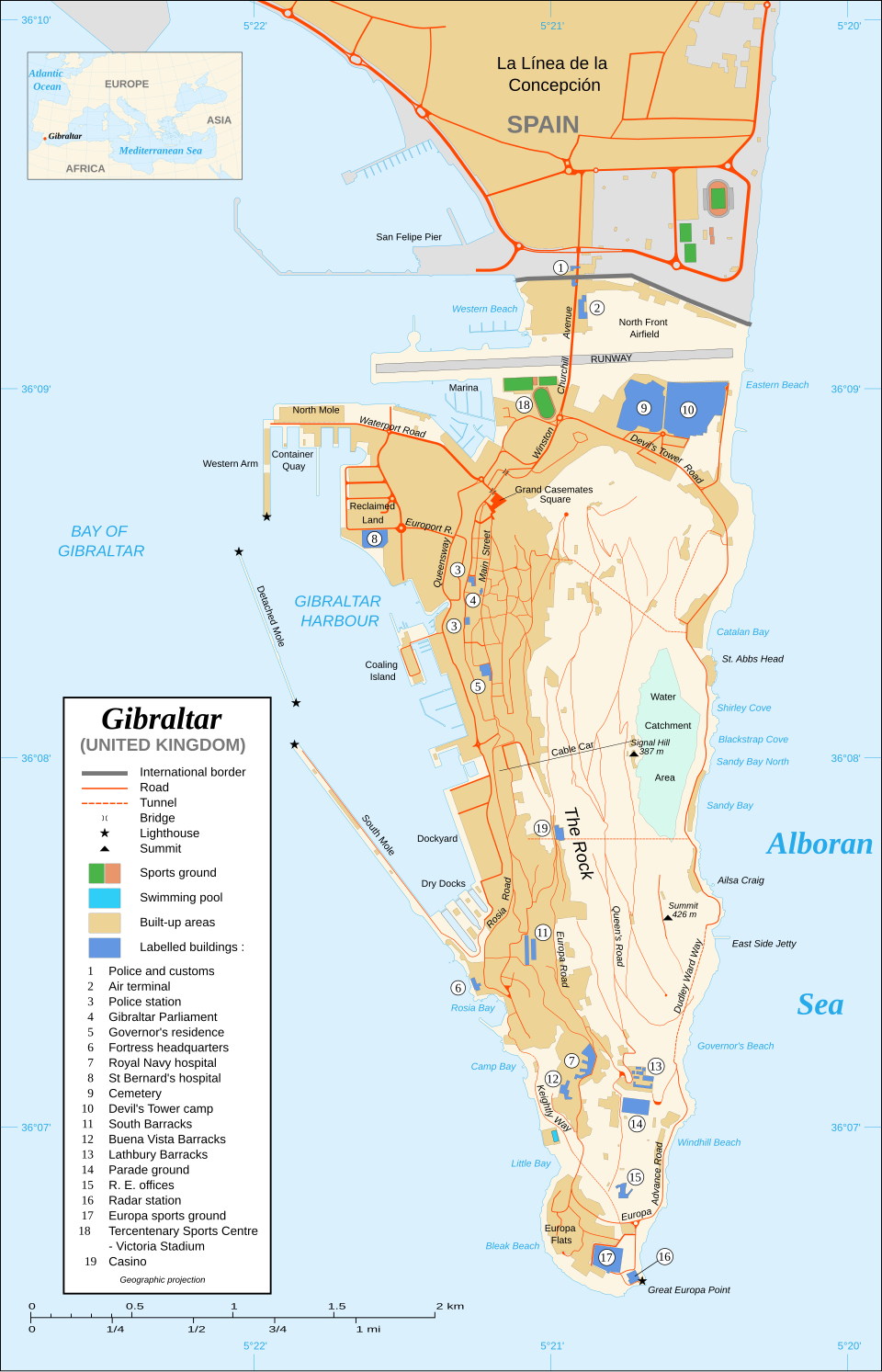
Housing in Gibraltar is among the most expensive in the Mediterranean, though no official cost-of-living index is provided in the data. The territory measures just 6.8 square kilometres, and land is the scarcest commodity. With a population density that rivals Monaco, the rental market is fiercely competitive. A modest two-bedroom apartment in the town centre can command rents comparable to central London, while the limited supply of new-build properties has pushed prices into the stratosphere.
Buying is out of reach for most young Gibraltarians without family wealth or cross-border employment.
Daily expenses, from groceries to utilities, are inflated by the territory’s dependence on imports. Most food comes from Spain, but tariffs, transport costs, and the strong pound relative to the euro have historically kept prices higher than in the neighbouring Spanish towns of La Línea or Algeciras. The cost of fuel, electricity, and water is also elevated, given the logistical challenges of supplying a densely populated rock.
For the many workers who commute daily from Spain, the cost arbitrage is significant, but for those living in Gibraltar proper, the premium on space and goods is a constant financial strain.
Business and Investment — The Waiting Game
The top companies in Gibraltar are not listed in the provided data, but the territory’s business environment is defined by a handful of sectors. Online gambling operators, such as 888 Holdings and Betfred, have long maintained a presence. Financial services firms, including insurers, fund managers, and private wealth advisors, form the backbone of the economy. The port and bunkering sector, which supplies fuel to ships passing through the Strait of Gibraltar, is another significant employer.
These industries are attracted by the 10% corporate tax rate, the absence of capital gains tax, and the ease of doing business within a common law framework.
Yet the business climate is currently in a state of suspended animation. The ongoing negotiations between the United Kingdom and the European Union over Gibraltar’s post-Brexit relationship have created a regulatory vacuum. Companies are hesitant to expand or relocate until the terms of access to the Schengen Area and the single market are clarified. The potential for a frictionless border with Spain is the single most important variable for future investment.
If a treaty is signed that allows Gibraltar to remain in the EU’s customs union or to have passporting rights for financial services, the territory could see a new wave of investment. If not, the risk of capital flight is real.
Safety, Politics, and Life on the Rock
The provided data offers no crime index or safety index for Gibraltar. Anecdotally, the territory is considered safe, with low rates of violent crime and a visible police presence. The small size of the community means that crime is often quickly reported and resolved, and the absence of slums or extreme poverty reduces the pressures that drive criminality in larger urban centres.
The safety index, like so many other metrics, is a blank space in the data, but the general perception among residents and visitors is one of security.
The political landscape is the dominant story. Gibraltar is a British Overseas Territory, and its people have consistently voted to remain British. The current government, led by the Gibraltar Socialist Labour Party under Chief Minister Fabian Picardo, has been in power since 2011. The central political challenge is the negotiation of a new treaty with the European Union, which would define the territory’s relationship with the Schengen Area and the single market.
The talks have been protracted and contentious, with Spain pushing for greater sovereignty-sharing and the UK insisting on maintaining British control over the Rock. The outcome will determine not only the economic future but the very character of Gibraltarian society.
The Treaty That Will Decide Everything — What’s Happening Now
The most pressing current affair in Gibraltar is the final stage of negotiations between the UK and the European Commission over the territory’s post-Brexit status. These talks, which have been ongoing since 2021, are now entering what officials describe as a “critical phase.” The core issue is the border with Spain. Gibraltar is not part of the Schengen Area, but the UK and Spain have agreed in principle that the territory should have a “frictionless” border, allowing free movement of people and goods.
The sticking point is the role of the European Border and Coast Guard Agency, Frontex, which Spain insists must have a presence at Gibraltar’s port and airport.
In recent months, the UK government has signalled a willingness to accept a Frontex role, provided that British sovereignty is not compromised. The Gibraltarian government has been more cautious, wary of any arrangement that could be seen as ceding control. The business community is watching closely. The financial services sector, in particular, needs clarity on passporting rights and data adequacy agreements.
Without a treaty, Gibraltar risks being cut off from the EU market, which would be devastating for an economy built on cross-border services. The next few months will be decisive.
The Bottom Line
Gibraltar is a country-sized case study in the limits of sovereignty in a globalised world. Its economy, built on low taxes and British legal protections, is now at the mercy of a political negotiation it does not control. Investors and businesses with a high tolerance for regulatory uncertainty may find opportunities in the territory’s resilience, but the window for decisive action is closing. Anyone watching Gibraltar should be watching Brussels and London, not the Rock itself.
Sources & Methodology
This article is authored by Economic Pulse Net for informational and research purposes. Economic Pulse Net sources its data from multilateral institutions, national statistics bureaus, and proprietary databases. All data is believed to be current as of the date of publication.
Published: July 19, 2026 | Category: Research — Gibraltar
Use these signals in your own platform
Economic Pulse publishes its live signal feed through a documented, read-only API. Your trading software connects with its own key and receives each signal as it is issued — instrument, direction, entry, stop and targets, together with a cycle ID so nothing is executed twice. The feed is independent of this website and cannot change it.
Signals are informational only and are not financial advice.