Economic Pulse Net | Sources: World Bank World Development Indicators, Government Sources | 2026
Key Takeaways
– Gibraltar’s economy remains heavily reliant on its financial services sector, online gaming industry, and port activity, though official World Bank macroeconomic indicators are currently unavailable.
– The jurisdiction is in the midst of a historic post-Brexit treaty negotiation with the European Union, which will define its long-term economic relationship with the bloc.
– Its unique position as a British Overseas Territory at the southern tip of Iberia gives it distinct advantages for businesses seeking access to both UK and EU markets.
– The local economy has demonstrated resilience through the pandemic and Brexit transition, driven by a highly diversified services base and a sophisticated regulatory environment.
– With a population density among the highest in Europe, the territory faces structural challenges around housing, space, and infrastructure that will shape its future growth trajectory.
The Rock’s Economic Foundation — A Services Economy Built on Strategic Geography
Gibraltar’s economy is a fascinating case study in how a small territory with limited natural resources can build a prosperous services-based economy through strategic positioning and regulatory agility. The World Bank’s data for Gibraltar is notably sparse — GDP growth, inflation, unemployment, and per-capita income figures are all currently unrecorded — but this absence of data itself tells a story of a jurisdiction that operates somewhat outside the mainstream statistical reporting frameworks of larger nations.
What is clear from the territory’s economic structure is that Gibraltar has successfully pivoted from its historical reliance on military infrastructure and ship repair to a modern, diversified services economy. The financial services sector has long been the crown jewel, offering a regulated environment that attracts wealth management, insurance, and captive insurance operations from across Europe and beyond.
The online gaming industry has also emerged as a powerhouse, with numerous licensed operators choosing Gibraltar as their base of operations, drawn by a sophisticated regulatory framework and a time zone that bridges London and the Mediterranean.
The port remains a vital economic artery, with bunkering, ship repair, and maritime services providing steady employment and economic activity. The territory’s position at the entrance to the Mediterranean has made it a natural hub for shipping traffic, and this geographic advantage is unlikely to diminish regardless of political developments.
Tourism, too, contributes meaningfully to the local economy, with visitors drawn to the famous Rock, the Barbary macaques, and the territory’s unique cultural blend of British and Andalusian influences.
The absence of official World Bank economic indicators should not be interpreted as a sign of economic weakness. Rather, Gibraltar’s economy has historically been characterised by low unemployment, high GDP per capita, and a standard of living that compares favourably with Western European averages. The territory’s economic model relies on attracting skilled professionals and businesses that value its combination of English common law, low tax rates, and proximity to both UK and EU markets.
Property Pressures in a Postage-Stamp Territory
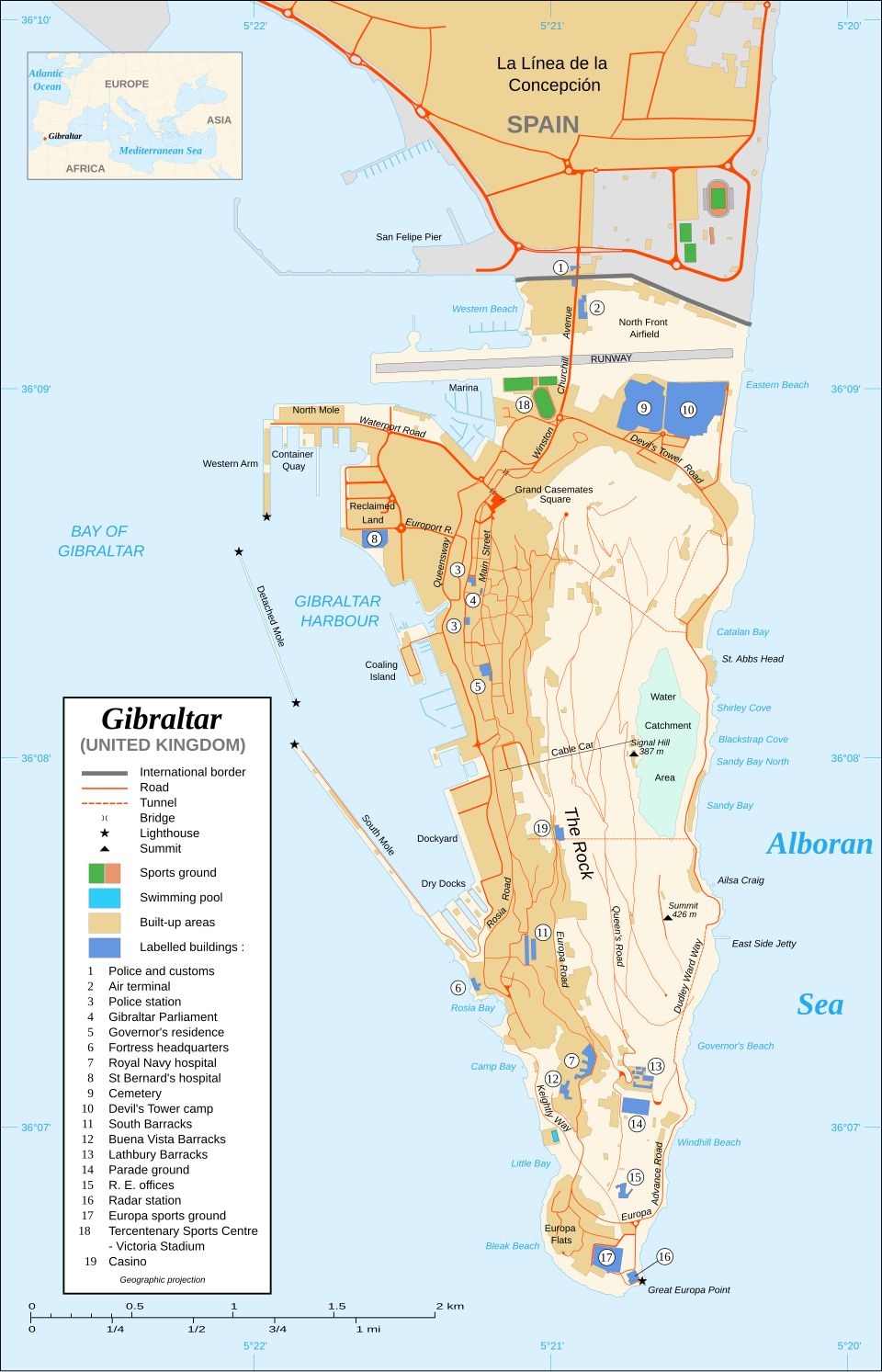
Housing in Gibraltar presents one of the most acute challenges facing the territory, and it is a challenge that stems directly from the jurisdiction’s physical constraints. With a land area of just 6.8 square kilometres and a population density that ranks among the highest in the world, the simple mathematics of supply and demand dictate that property prices are among the most expensive in Europe.
The rental market is particularly tight, with demand consistently outstripping supply. This pressure is compounded by the fact that many workers in Gibraltar — perhaps as many as half of the workforce — live in the neighbouring Spanish towns of La Línea, San Roque, and other Andalusian municipalities, crossing the border daily to work.
This cross-border dynamic creates a unique housing market in which Gibraltar’s property prices are influenced not only by local demand but also by the broader regional housing market in southern Spain.
For those seeking to buy rather than rent, the options are limited. Land reclamation projects have added some new developable space, particularly in the harbour area, but these projects are slow and expensive. The result is a property market where prices are driven by scarcity rather than by any fundamental economic weakness — a situation that benefits property owners and developers but creates significant barriers to entry for young professionals and families.
The government has attempted to address the housing shortage through various initiatives, including the development of affordable housing projects and the release of government-owned land for private development. However, the fundamental constraint of limited physical space means that housing affordability is likely to remain a persistent challenge for the foreseeable future.
Investment Climate — A Regulated Haven in Transition
Gibraltar’s business environment has evolved significantly over the past decade, driven largely by external pressures to align its regulatory framework with international standards. The territory has worked to shed its historical reputation as a lax offshore centre, implementing robust anti-money laundering measures and cooperating with international tax transparency initiatives. This shift has been essential for maintaining access to EU markets and preserving the reputation of its financial services sector.
The online gaming industry remains one of the most dynamic sectors for investment, with Gibraltar having established itself as a leading jurisdiction for licensed operators. The territory’s regulatory regime is respected internationally, and its time zone, legal framework, and infrastructure make it an attractive base for companies serving both UK and European markets.
However, the sector faces ongoing regulatory scrutiny from various jurisdictions, and operators must navigate an increasingly complex compliance landscape.
The financial services sector, encompassing banking, insurance, and wealth management, continues to attract a significant share of investment. Gibraltar’s status as a British Overseas Territory provides a degree of political stability and legal certainty that is valued by international investors. The territory’s courts are well-regarded, and its regulatory bodies have developed sophisticated supervisory capabilities.
Looking ahead, the territory is seeking to diversify further into sectors such as fintech, blockchain, and professional services. The government has signalled its intention to position Gibraltar as a hub for innovation, building on its existing strengths in financial services and technology. The success of these efforts will depend on the territory’s ability to attract skilled talent, which in turn depends on addressing the housing and infrastructure challenges that currently constrain growth.
Safety, Society, and the Politics of a Small Nation
Gibraltar’s political landscape is defined by its unique constitutional status as a British Overseas Territory. The territory enjoys a high degree of self-governance, with its own parliament and elected government, while the United Kingdom retains responsibility for defence and foreign affairs. This arrangement has served Gibraltar well, providing political stability and a clear legal framework while allowing local politicians to shape domestic policy.
The political debate in Gibraltar has been dominated in recent years by the question of Brexit and the territory’s future relationship with the European Union. As a non-member of the EU that nevertheless shares a land border with Spain, Gibraltar has faced unique challenges in navigating the post-Brexit landscape.
The vast majority of Gibraltarians voted to remain in the EU, and the territory’s political leadership has worked to secure a special arrangement that preserves access to EU markets while maintaining British sovereignty.
Crime and safety data for Gibraltar are not recorded in the World Bank indices, but the territory is widely regarded as a safe and law-abiding community. The Royal Gibraltar Police maintains a visible presence, and the territory’s small size and tight-knit community contribute to low crime rates. The main law enforcement challenges relate to organised crime and smuggling, issues that are common to border regions and port cities throughout Europe.
Quality of life in Gibraltar is generally considered high, with a Mediterranean climate, good healthcare facilities, and a vibrant social scene. The territory offers a unique cultural blend — British in its institutions and language, but distinctly Mediterranean in its atmosphere and lifestyle. This combination attracts both residents and visitors, contributing to a dynamic and cosmopolitan community.
The Brexit Negotiation — A Defining Moment for Gibraltar’s Future
The most pressing issue facing Gibraltar today is the ongoing negotiation of a treaty with the European Union that would govern the territory’s post-Brexit relationship with the bloc. The talks, which have been ongoing for several years, aim to establish a framework for cooperation on issues ranging from border controls and customs arrangements to police cooperation and environmental standards.
The central challenge is the border between Gibraltar and Spain. Before Brexit, the border was largely invisible, with free movement of people and goods. After Brexit, the border has become a potential flashpoint, with the risk of disruption to the daily flow of workers and goods that is essential to Gibraltar’s economy. The proposed treaty seeks to address this by creating a shared prosperity zone, with the border remaining open while Gibraltar aligns with certain EU standards and regulations.
The negotiations have been complex and at times contentious, with issues such as airport sovereignty, tobacco smuggling, and the status of Spanish workers in Gibraltar proving particularly difficult to resolve. However, there is broad consensus that a deal is in the interests of all parties — Gibraltar needs access to the EU market, Spain benefits from the economic activity generated by the territory, and the EU has an interest in maintaining stability at its southern border.
For businesses in Gibraltar, the outcome of these negotiations will be transformative. A successful treaty would provide certainty and potentially open new opportunities for trade and investment. A failure to reach agreement would create significant uncertainty and could disrupt the economic model that has underpinned Gibraltar’s prosperity. As the negotiations continue, the territory’s political leadership remains focused on securing the best possible outcome while preparing for all eventualities.
The Bottom Line
Gibraltar is a territory where geography, politics, and economics are inextricably linked. Its prosperity has been built on a unique combination of strategic location, favourable tax treatment, and regulatory sophistication, but its future now depends on navigating the complex politics of post-Brexit Europe. Investors and businesses with an interest in financial services, online gaming, and Mediterranean trade should watch Gibraltar closely as the treaty negotiations reach their conclusion.
The outcome will determine whether the Rock can maintain its position as a thriving entrepôt or whether it must chart a new course in an increasingly competitive global economy.
Sources & Methodology
This article is authored by Economic Pulse Net for informational and research purposes. Economic Pulse Net sources its data from multilateral institutions, national statistics bureaus, and proprietary databases. All data is believed to be current as of the date of publication.
Published: August 03, 2026 | Category: Research — Gibraltar
Use these signals in your own platform
Economic Pulse publishes its live signal feed through a documented, read-only API. Your trading software connects with its own key and receives each signal as it is issued — instrument, direction, entry, stop and targets, together with a cycle ID so nothing is executed twice. The feed is independent of this website and cannot change it.
Signals are informational only and are not financial advice.