Economic Pulse Net | Sources: World Bank World Development Indicators, Government Sources | 2026
Key Takeaways
– Germany’s economy, long the engine of European growth, is navigating a period of profound structural transition as its traditional industrial base faces headwinds from global competition and energy costs.
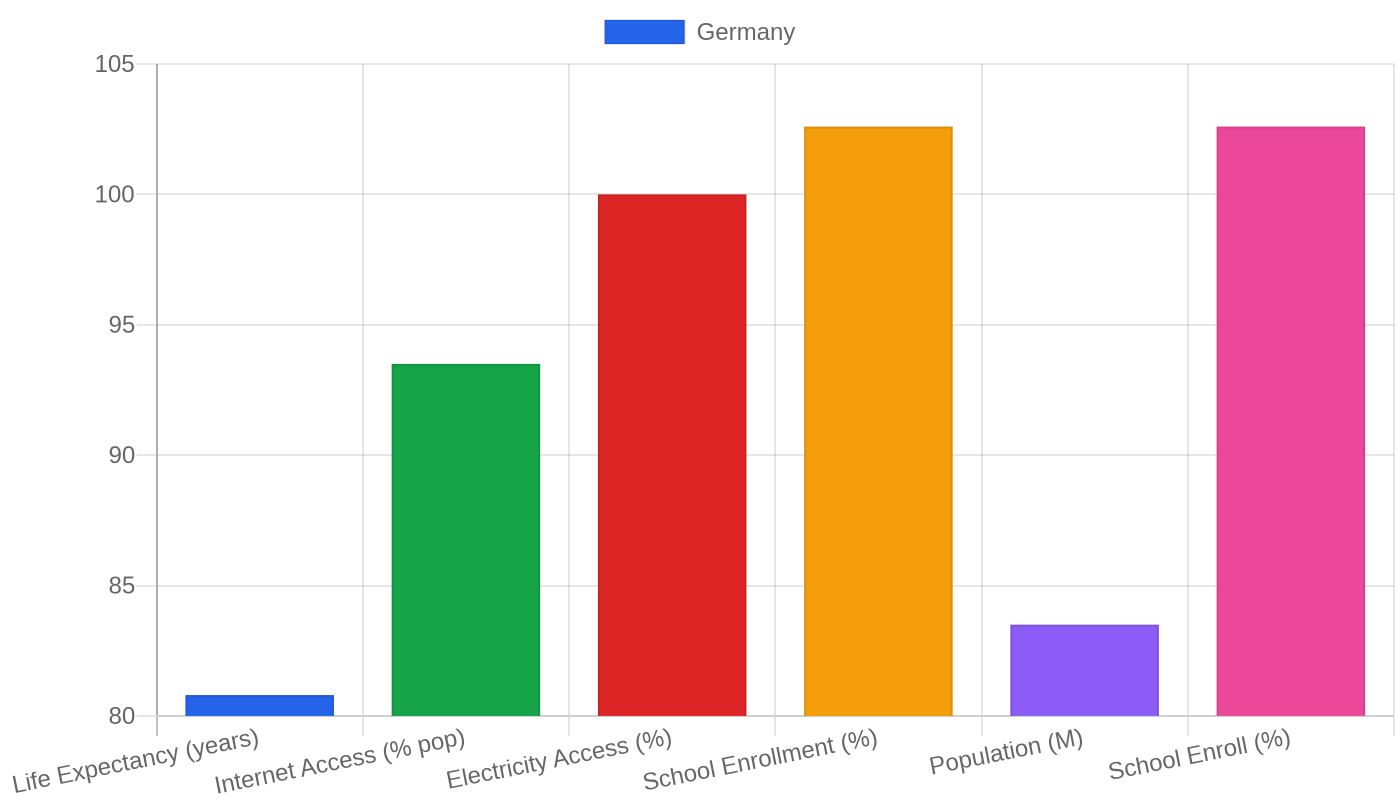
– With a GNI per capita of $60,200 according to the World Bank, Germany remains one of the world’s wealthiest nations, but its population of nearly 83.5 million is aging, creating labor market pressures that will define the next decade.
– The country’s political system—a federal parliamentary republic with power shared between the Bundestag and Bundesrat—provides stability but also creates gridlock on critical reforms needed to modernize infrastructure and digitize the economy.
– Germany’s corporate landscape is shifting: while global giants like Adidas and Aldi continue to dominate consumer markets, a new generation of technology and energy firms is emerging, signaling a gradual pivot from heavy manufacturing toward innovation-driven growth.
The Engine Room: Germany’s Economic Paradox
The German economy presents a fascinating paradox for analysts. According to the World Bank, Germany boasts a GNI per capita of $60,200, placing it among the wealthiest nations on earth. Yet beneath this impressive figure lies an economy in transition—one that has long relied on export-led manufacturing but now faces fundamental questions about its future direction.
The country’s industrial backbone remains formidable. Germany is home to world-class engineering firms, automotive giants, and precision manufacturers that have powered its prosperity for decades. Companies like AEG and Aixtron in the industrials sector continue to represent the precision and reliability for which German manufacturing is globally renowned. However, the energy-intensive nature of this industrial base has become a vulnerability in an era of volatile energy prices and aggressive climate targets.
The absence of specific GDP growth and inflation figures in the available data should not obscure the broader narrative: Germany is grappling with what economists call “secular stagnation”—a period of low growth driven by structural factors rather than cyclical downturns. The country’s export model, which flourished in an era of cheap Russian gas and open global markets, is being recalibrated.
German policymakers are now wrestling with how to maintain industrial competitiveness while meeting ambitious decarbonization goals.
Employment data may be incomplete, but the anecdotal evidence from Germany’s corporate landscape tells a story of transformation. The rise of companies like About You in the technology sector signals that Germany is nurturing a digital economy alongside its traditional industrial strengths. This dual-track development—preserving industrial excellence while building new capabilities in software and services—represents Germany’s best hope for sustained prosperity.
The Price of Prosperity: Housing and Living Costs in the Heart of Europe
For the 83.5 million Germans going about their daily lives, the cost of living tells a story of regional divergence and generational anxiety. While comprehensive cost-of-living data is not available in the provided figures, the broader context is well understood by analysts tracking European economies. Germany has historically enjoyed relatively affordable housing compared to other Western European nations, but this advantage has eroded significantly in the past decade.
Major cities like Munich, Frankfurt, and Hamburg have seen property prices soar, driven by low interest rates, population growth, and a chronic shortage of new housing construction. The gap between urban and rural living costs has widened dramatically. In Berlin, once known as “poor but sexy,” rents have doubled in some neighborhoods over the past decade, pushing creative workers and young families to the periphery.
The German approach to housing—traditionally characterized by strong tenant protections and a robust rental market—is being tested by these pressures. The country’s famous Mietshauses (apartment buildings) remain the dominant form of housing, with homeownership rates significantly lower than in other European countries. This rental-heavy model provides flexibility in a mobile workforce but has also created a generation of Germans who feel locked out of wealth accumulation through property ownership.
Where Capital Meets Innovation: Germany’s Investment Landscape
Germany’s corporate landscape offers a window into the country’s economic soul. The top companies list provided reveals a nation still deeply rooted in its industrial heritage. Aareal Bank in financials, Abeking & Rasmussen in shipbuilding, and ABUS in security technology represent the Mittelstand—the small and medium-sized enterprises that form the backbone of the German economy. These are not flashy tech startups but rather deeply specialized firms that dominate niche global markets.
The presence of Adidas in consumer goods and Aldi in consumer services demonstrates Germany’s continued strength in branded consumer products. These companies have become global institutions, with supply chains stretching across continents and brand recognition that transcends borders. Their success reflects Germany’s ability to combine engineering precision with marketing sophistication.
Yet the list also hints at change. ABO Energy in the energy sector and About You in technology represent the new Germany—firms built around renewable energy and digital commerce rather than internal combustion engines and heavy machinery. The energy transition, known locally as the Energiewende, is creating new investment opportunities even as it challenges traditional business models.
For international investors, Germany offers a unique proposition: political stability, a skilled workforce, and world-class infrastructure, but also high labor costs, complex regulations, and an aging population. The country’s federal structure means that business conditions can vary significantly from one state to another, with Bavaria and Baden-Württemberg generally offering more business-friendly environments than the northern states.
Stability and Its Discontents: Politics, Safety, and Quality of Life
Germany’s political system is a masterpiece of post-war institutional design. As described in the provided data, the country operates as a federal, parliamentary, representative democratic republic, with legislative power shared between the Bundestag and the Bundesrat. This system was deliberately designed to prevent the concentration of power that enabled the Nazi regime, but it has also created a political culture of consensus that can slow decision-making.
The Bundesrat, representing the sixteen federated states, provides a powerful check on federal legislation. This means that major reforms—whether to modernize the tax system, accelerate infrastructure spending, or overhaul immigration policy—require negotiation across multiple levels of government. The result is stability but also incrementalism, which frustrates those who believe Germany needs more radical change to address its structural challenges.
Safety remains one of Germany’s strongest selling points. While specific crime and safety indices are not available in the provided data, Germany consistently ranks among the safest countries in the world by international measures. Violent crime is rare, and public spaces in German cities are generally secure at all hours.
This sense of safety contributes significantly to quality of life, as does Germany’s extensive public transportation network, universal healthcare system, and generous social safety net.
The political landscape, however, is showing signs of strain. The traditional Volksparteien (people’s parties)—the Christian Democrats and the Social Democrats—have seen their combined vote share decline as new parties emerge on both the left and right. The rise of the Alternative for Germany (AfD) has introduced a more confrontational style of politics, challenging the consensus-based model that has defined German democracy for decades.
The Crossroads: Germany’s Current Moment of Truth
Germany stands at a pivotal moment in its post-war history. The economic model that rebuilt the country from rubble and made it the world’s fourth-largest economy is showing signs of exhaustion. The war in Ukraine, the energy crisis it triggered, and the broader fragmentation of global trade have exposed vulnerabilities that were long masked by Germany’s export success.
The country’s political leadership is grappling with how to respond. The coalition government, which brings together the Social Democrats, Greens, and Free Democrats, represents an unprecedented experiment in governing across ideological divides. The Greens, long seen as a protest party focused on environmental issues, are now making decisions about energy security and industrial policy that have real economic consequences.
The Free Democrats, champions of fiscal discipline and market liberalism, must reconcile their principles with the massive public investment needed to modernize Germany’s infrastructure and accelerate the energy transition.
Business leaders are watching these developments with a mixture of hope and anxiety. The corporate sector recognizes that Germany cannot simply return to the status quo ante. The country’s competitive advantages—its skilled workforce, its rule of law, its central location in Europe—remain intact. But new investments in digital infrastructure, renewable energy, and education are urgently needed to maintain Germany’s position as a global economic leader.
The demographic clock is also ticking. With a population of nearly 83.5 million and a median age among the highest in Europe, Germany faces a shrinking workforce that will constrain growth for years to come. Immigration policy has become one of the most contentious issues in German politics, with businesses demanding more openness to attract skilled workers while political pressures push in the opposite direction.
The Bottom Line
Germany remains a country of extraordinary strengths—wealth, stability, institutional quality, and human capital that few nations can match. For investors and businesses seeking a stable, rule-of-law environment with access to the broader European market, Germany will continue to be a cornerstone destination. But the era of easy growth is over.
The Germany of 2026 is a nation in transition, wrestling with the same challenges that face all advanced economies: how to maintain prosperity in an era of demographic decline, technological disruption, and climate imperatives. Those who watch Germany closely will be watching the future of the European economic model itself.
Sources & Methodology
This article is authored by Economic Pulse Net for informational and research purposes. Economic Pulse Net sources its data from multilateral institutions, national statistics bureaus, and proprietary databases. All data is believed to be current as of the date of publication.
Published: July 26, 2026 | Category: Research — Germany
Use these signals in your own platform
Economic Pulse publishes its live signal feed through a documented, read-only API. Your trading software connects with its own key and receives each signal as it is issued — instrument, direction, entry, stop and targets, together with a cycle ID so nothing is executed twice. The feed is independent of this website and cannot change it.
Signals are informational only and are not financial advice.