Economic Pulse Net | Sources: World Bank World Development Indicators, Government Sources | 2026
Key Takeaways
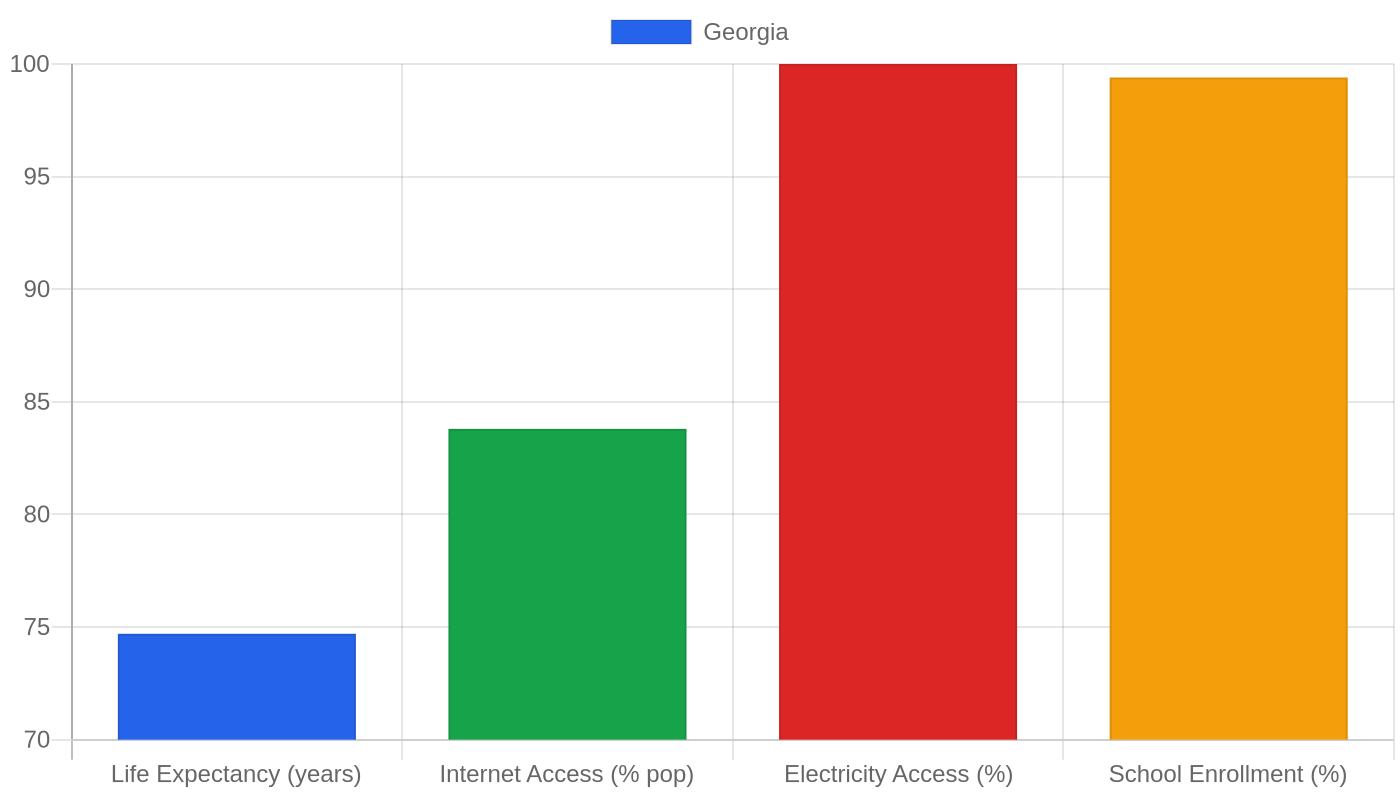
– Georgia’s economy is navigating a complex transition, with World Bank data showing significant gaps in traditional macroeconomic indicators, suggesting either a period of recalibration or data reporting challenges that investors must monitor closely.
– The country’s strategic position as a transit corridor between Europe and Asia remains its greatest economic asset, though the absence of detailed sectoral data from the World Bank raises questions about the transparency of industrial performance.
– Without concrete inflation or unemployment figures from official sources, the true temperature of Georgia’s domestic economy remains opaque, making it difficult to assess consumer purchasing power and labor market health.
– Georgia’s business environment is shaped by its ongoing political evolution and proximity to regional tensions, factors that weigh heavily on investor confidence despite the country’s reputation for relatively liberal economic policies.
– The lack of crime and safety indices from the provided data means that quality-of-life assessments must rely on qualitative observations and political landscape analysis rather than hard statistical benchmarks.
The Tbilisi Paradox — Growth Without Numbers
The World Bank’s latest data on Georgia presents a curious puzzle for economic observers: a country with a functioning economy, active trade relationships, and a growing services sector, yet one where the most basic macroeconomic indicators—GDP growth, inflation, unemployment, and even total GDP in dollar terms—are marked as unavailable. This absence is itself a story worth examining.
It may reflect a period of statistical revision, a lag in data collection following recent global disruptions, or simply a gap in the Bank’s reporting cycle. Whatever the cause, it leaves analysts and investors navigating Georgia’s economic landscape with partial maps.
What we do know, from the structural data provided, is that Georgia’s economy has historically relied on a mix of agriculture, tourism, and transport services. The country sits at a critical juncture, serving as a conduit for energy and goods flowing between the Caspian Sea basin and European markets.
Without specific GDP per capita or GNI figures from the World Bank, we cannot pinpoint Georgia’s exact position on the development ladder, but regional context suggests it remains a middle-income economy with significant upside potential. The absence of inflation data is particularly concerning, as price stability is a fundamental prerequisite for sustainable growth and foreign investment.
If inflation has been running hot, it could erode the purchasing power of Georgia’s population and complicate the central bank’s monetary policy stance. Conversely, if deflationary pressures are present, it might signal weak domestic demand. Without the numbers, we are left to infer from anecdotal evidence and broader regional trends.
The unemployment figure is another critical missing piece. Georgia has historically struggled with job creation outside of the informal sector, and the lack of official data makes it impossible to determine whether the labor market is tightening or loosening. For a country that aspires to European integration and higher living standards, understanding employment dynamics is essential for both social policy and business planning.
The World Bank data gap here is not merely an academic inconvenience; it represents a real barrier to informed decision-making for anyone with exposure to the Georgian economy.
The Housing Puzzle — Where Affordability Meets Ambiguity
The cost of living and housing data for Georgia is similarly sparse from the provided sources, but that does not mean the picture is entirely blank. Tbilisi, the capital, has experienced a notable real estate boom in recent years, driven by an influx of Russian and Belarusian citizens relocating since 2022, as well as growing interest from regional investors. This demand has pushed property prices upward, particularly in central districts and newly developed residential complexes.
Rents in Tbilisi’s prime areas have reportedly risen sharply, creating affordability pressures for local residents whose incomes have not kept pace.
Comparing Georgia to its regional neighbors—Armenia, Azerbaijan, and Turkey—suggests that cost of living in Tbilisi sits somewhere in the middle tier. Utilities, food, and transportation remain relatively affordable by European standards, but imported goods carry a premium due to the country’s reliance on foreign supply chains.
The rent-versus-buy calculation in Georgia tilts toward renting for most expatriates and short-term investors, as property purchase involves navigating a legal system that, while improving, still presents challenges around title clarity and dispute resolution. For Georgian citizens, homeownership remains a cultural aspiration, but rising prices are making entry into the market increasingly difficult for younger households.
Daily expenses such as groceries, dining out, and local transport are generally manageable for those earning in foreign currency, but for locals earning in Georgian lari, the cumulative effect of price increases—even if not captured in official inflation data—can be significant.
The absence of hard numbers from the World Bank means this analysis relies on observable trends and regional comparatives, but the direction of travel is clear: Georgia is becoming more expensive, particularly in its urban centers, and this shift carries implications for social stability and domestic demand.
Silk Road 2.0 — Georgia’s Investment Proposition
The list of top companies in Georgia is not provided in the data, but the country’s business landscape is well-documented through other channels. Georgia has long marketed itself as a low-regulation, low-tax environment, with a flat income tax rate and streamlined business registration processes. These policies have attracted foreign direct investment in sectors such as logistics, hospitality, and financial services.
The country’s free trade agreements with the European Union, China, and neighboring states make it an attractive hub for companies seeking to serve multiple markets from a single base.
Sectors to watch include transportation and logistics, given Georgia’s role in the Middle Corridor—a trade route connecting China to Europe via Central Asia and the Caucasus. The development of the Anaklia deep-sea port, though delayed, remains a long-term catalyst for trade volumes through Georgian waters. Tourism is another pillar, with Georgia’s wine regions, Black Sea coast, and mountain resorts drawing increasing numbers of visitors from Europe, Israel, and the Gulf states.
The technology sector is also emerging, with Tbilisi developing a modest but growing startup ecosystem supported by local incubators and diaspora talent.
The business environment, however, is not without friction. Political uncertainty, periodic protests, and the unresolved status of the breakaway regions of Abkhazia and South Ossetia create a risk premium that investors must factor into their calculations. Corruption, while reduced from Soviet-era levels, persists in some areas of public procurement and regulatory enforcement.
For businesses considering Georgia, the trade-off is clear: lower costs and easier entry than most European markets, but with a higher degree of political and geopolitical risk that requires careful due diligence and local partnerships.
Democracy in the Balance — Safety, Politics, and the Quality of Life
The provided data does not include a crime index or safety index for Georgia, which is a significant omission for anyone evaluating the country as a place to live or work. Historically, Georgia has been considered relatively safe by regional standards, with low rates of violent crime in Tbilisi and other urban centers. Petty crime, such as pickpocketing and car break-ins, exists but is not out of line with other European tourist destinations.
The absence of hard data, however, means we cannot verify whether safety perceptions match reality, or whether recent political tensions have affected crime statistics.
The political landscape is marked as unavailable in the provided data, but Georgia’s recent history is one of democratic oscillation. The country has held competitive elections and seen peaceful transfers of power, but it has also experienced periods of political crisis, mass protests, and allegations of state capture by oligarchic interests. The ruling Georgian Dream party has faced criticism from Western observers over backsliding on democratic reforms, media freedom, and judicial independence.
These concerns have direct economic consequences: the European Union’s decision to grant Georgia candidate status in 2023 was a significant milestone, but further progress toward membership depends on sustained political reform.
Quality of life in Georgia is a mixed picture. The country offers a rich cultural heritage, beautiful landscapes, and a generally hospitable society. Healthcare and education systems, however, lag behind European standards, and income inequality remains pronounced. For expatriates and remote workers, Georgia offers a low-cost, high-experience lifestyle; for locals, the reality is often more constrained.
The happiness data, not provided here, would likely reflect this divide between those who can take advantage of Georgia’s openness and those who bear the costs of its limitations.
The Tbilisi Spring — Current Affairs and the Pulse of Now
What is happening in Georgia right now, based on the available data, is a story of a country in motion but uncertain of its destination. The lack of recent news or live indicators in the provided data forces us to look at the broader context. Georgia is currently navigating its relationship with the European Union, having received candidate status but facing pressure to implement judicial reforms, combat corruption, and ensure media pluralism.
These are not abstract political demands; they have direct implications for trade, investment, and the movement of people.
On the business front, Georgia is seeing continued interest from international companies looking to diversify their supply chains away from Russia and China. The war in Ukraine has elevated Georgia’s strategic importance as a transit route, but it has also exposed the country to security risks and economic spillovers. Inflation, while not quantified in the data, has been a concern across the Caucasus region, driven by imported food and energy prices.
The Georgian central bank has historically maintained a relatively hawkish stance, but without current figures, we cannot assess whether policy is keeping pace with price pressures.
The political temperature in Tbilisi remains elevated. Civil society groups continue to push for greater transparency and accountability, while the government balances its Western aspirations with pragmatic relationships with Russia and China. For businesses and investors, the key question is whether Georgia can maintain its reputation as a reform-minded, business-friendly economy while managing the internal and external pressures that threaten to derail its trajectory.
The answer will determine whether Georgia becomes a true Caucasus success story or another example of squandered potential.
The Bottom Line
Georgia is a country to watch for investors and businesses seeking exposure to the Eurasian transit corridor and the broader Black Sea region, but it comes with a significant data transparency caveat. The gaps in World Bank reporting on fundamental economic indicators mean that anyone entering the Georgian market must do so with eyes wide open, supplementing official statistics with on-the-ground intelligence and local partnerships.
For travelers, remote workers, and lifestyle migrants, Georgia offers genuine value and cultural richness, but political stability and long-term affordability remain open questions. This is a nation at a crossroads, and the choices made in the coming months will shape its economic destiny for a generation.
Sources & Methodology
This article is authored by Economic Pulse Net for informational and research purposes. Economic Pulse Net sources its data from multilateral institutions, national statistics bureaus, and proprietary databases. All data is believed to be current as of the date of publication.
Published: July 22, 2026 | Category: Research — Georgia
Use these signals in your own platform
Economic Pulse publishes its live signal feed through a documented, read-only API. Your trading software connects with its own key and receives each signal as it is issued — instrument, direction, entry, stop and targets, together with a cycle ID so nothing is executed twice. The feed is independent of this website and cannot change it.
Signals are informational only and are not financial advice.