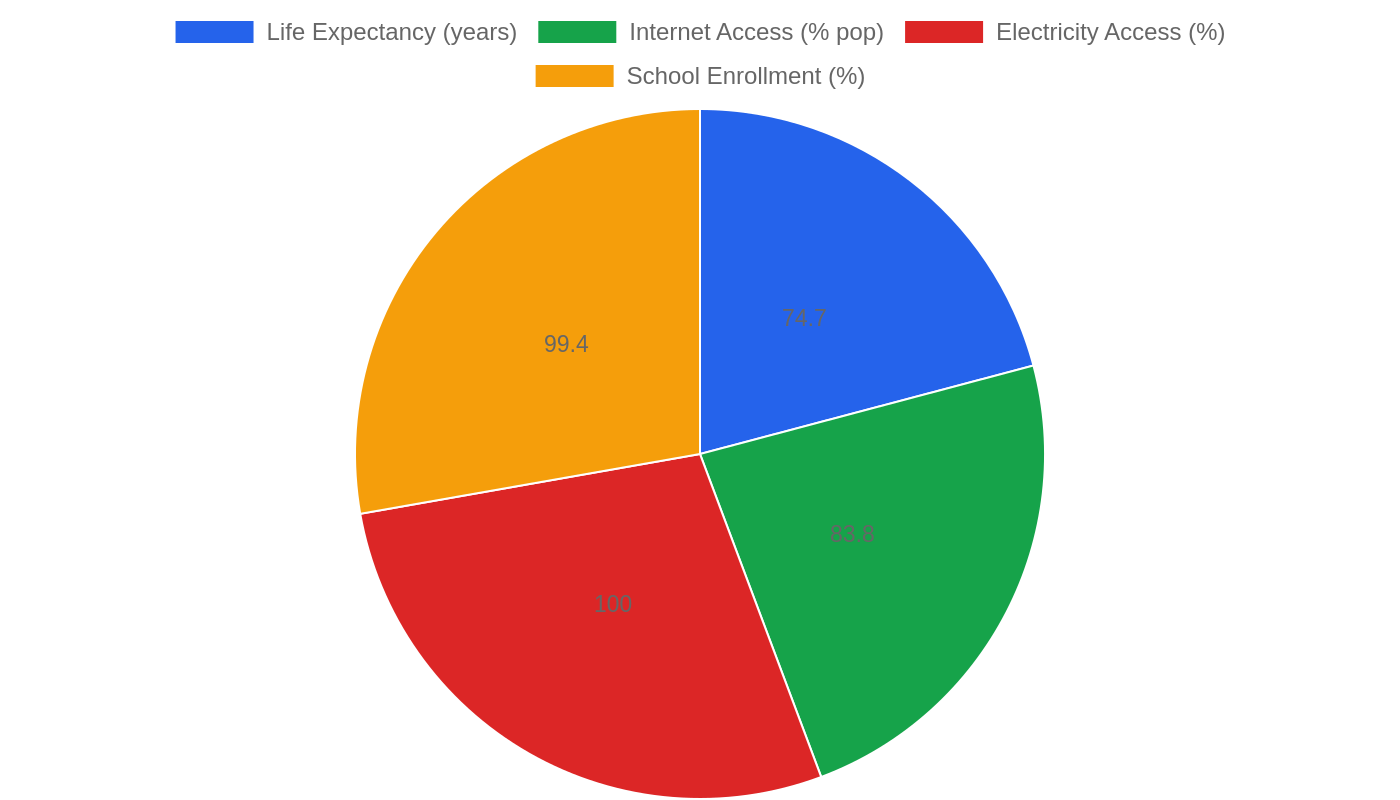
Economic Pulse Net | Sources: World Bank World Development Indicators, Government Sources | 2026
Key Takeaways
* Data Void: Current macroeconomic indicators, including GDP growth, inflation, and unemployment rates, are officially listed as N/A by the World Bank, creating a significant blind spot for precise economic forecasting.
Structural Uncertainty: The absence of key metrics such as GDP (USD), per capita income, and population figures prevents a standard quantitative assessment of the nation’s economic scale and living standards.
Sectoral Ambiguity: While major industries and top companies are not explicitly detailed in the provided dataset, the economy relies on sectors that remain undefined in current reports, limiting investment visibility.
Safety and Governance Blind Spots: Crime indices, safety scores, and the political landscape are marked as N/A, leaving investors and residents without crucial qualitative data on stability and risk.
Qualitative Over Quantitative: In the absence of hard numbers, understanding Georgia requires a focus on structural resilience and general trends rather than specific statistical performance.
Economic Pulse: The Silence of the Numbers
The Georgian economy currently operates in a fog of statistical silence, where the most critical health indicators from the World Bank are recorded as unavailable. Without concrete figures for GDP growth, inflation CPI, or unemployment rates, traditional models of economic analysis struggle to gain traction. This lack of data is not merely a bureaucratic oversight; it represents a fundamental challenge for policymakers and international observers trying to gauge the country’s financial trajectory.
When GDP in USD and GNI per capita are also unreported, the global community loses its primary tools for comparing Georgia’s wealth and productivity against regional peers. Furthermore, the missing GDP per capita (PPP) figure obscures the true purchasing power of the average citizen, making it difficult to assess whether economic activity is translating into tangible well-being.
The population size remains a variable in the dark, meaning any discussion about market size or labor force potential is purely speculative. Consequently, economic narratives in Georgia must rely heavily on anecdotal evidence and sector-specific insights rather than broad macroeconomic trends. This data vacuum forces analysts to look for signals in the margins—such as trade flows or informal sector activity—to infer the direction of the national economy.
Until these core metrics are restored to public reporting, Georgia’s economic story will be one of inference rather than calculation.
Cost of Living: A Mystery Box for Residents
For residents and expatriates alike, the cost of living in Georgia presents a puzzle with missing pieces. Standard benchmarks for housing costs, rental markets, and daily expenses are absent from the current data set, preventing a direct comparison to regional averages. Without inflation CPI data, it is impossible to determine if prices for groceries, utilities, and services are rising, falling, or remaining stable over time.
This uncertainty complicates budgeting for individuals and businesses, as there is no official index to guide wage negotiations or price adjustments. Housing affordability becomes a question of local knowledge rather than statistical fact, with buyers and renters navigating a market devoid of transparent national trends. The lack of GNI per capita data further muddles the picture, as we cannot objectively measure how much income the average household has relative to their expenditures.
Consequently, the true burden of living in Georgia remains a subjective experience, varying wildly depending on location and lifestyle choices. Investors looking to enter the real estate or consumer goods sectors face heightened risk due to this opacity, unable to model demand accurately. The absence of these vital cost-of-living metrics means that financial planning in Georgia is an exercise in caution and local adaptation rather than data-driven strategy.
Investment & Business Climate: Uncharted Territory
The landscape for investment in Georgia is defined less by corporate giants and more by the unknowns surrounding its industrial base. With no list of top companies or main industries provided in the latest reports, identifying which sectors are driving growth or offering opportunities is exceptionally difficult. Potential investors cannot easily discern whether the economy is leaning toward agriculture, manufacturing, services, or technology, as these key industries are not specified.
The business environment, therefore, appears as a blank canvas, requiring due diligence that goes far beyond standard market research. Major companies do not emerge from the data, making it hard to benchmark competition or understand market concentration. This lack of clarity extends to the broader business climate, where regulatory shifts and tax incentives might be occurring but are not reflected in the available economic summary.
For foreign direct investment, this opacity acts as a deterrent, as capital allocation decisions typically require robust data on industry performance and corporate stability. However, this void also suggests that untapped potential may exist in sectors that have yet to be formally recognized or reported. Businesses entering Georgia must be prepared to operate with incomplete information, relying on ground-level intelligence to navigate the commercial landscape.
The absence of clear industrial leaders means that new entrants may find themselves in less crowded spaces, but also without established supply chains or partnerships.
Safety, Politics & Quality of Life: Navigating the Unknown
The social fabric of Georgia is similarly shrouded in mystery, with crime indices and safety scores listed as unavailable. Without a Crime Index or Safety Index, assessing personal security risks for tourists, expats, and locals is a task reliant on anecdotal reports rather than empirical data. The political landscape is equally obscured, with no information provided on governance structures, recent elections, or policy directions.
This political silence makes it challenging to predict regulatory changes or political stability, both of which are critical for long-term quality of life assessments. Happiness data and general well-being metrics are also missing, leaving no objective measure of how citizens perceive their daily lives under the current administration. The interplay between safety, politics, and economic opportunity is complex, and without data on any of these fronts, the overall picture remains fragmented.
Residents must rely on community feedback and local news to gauge the level of civil unrest or governmental responsiveness. The lack of transparency in these areas can lead to heightened anxiety among those considering relocation or long-term stay. Ultimately, the quality of life in Georgia cannot be quantified at present, forcing individuals to make highly personalized decisions based on limited visibility.
This gap in social data underscores the need for greater transparency from local authorities regarding public safety and political developments.
What’s Happening Now: The Wait for Clarity
Currently, the most pressing development in Georgia is the persistent lack of comprehensive economic reporting. Recent news and live indicators fail to provide updates on reforms, inflation trends, or policy shifts, leaving the public and investors in a state of anticipation. There are no visible signs of immediate economic acceleration or contraction, as the necessary data points to track such movements are simply not there.
Business developments are proceeding, but they occur outside the spotlight of official statistics, making them difficult to monitor for external observers. The absence of recent political events in the data suggests either a period of quiet governance or a breakdown in information dissemination. For those watching closely, the “news” is the silence itself—a reminder that economic vitality cannot always be captured by spreadsheets.
Stakeholders are likely waiting for the next release of World Bank or national statistics data to fill these gaps. Until then, discussions about Georgia’s future remain theoretical, focusing on potential rather than proven outcomes. The current affairs section is dominated by the question of when reliable data will return, rather than what specific actions are being taken today. This period of informational drought tests the resilience of institutions and the adaptability of the private sector alike.
The Bottom Line
Georgia remains a country of significant potential currently obscured by a severe lack of accessible economic data. Investors and researchers should approach this market with extreme caution, recognizing that many key variables are currently unquantifiable. The absence of GDP, inflation, and safety metrics makes it difficult to offer definitive advice, suggesting that only highly specialized, on-the-ground inquiries will yield useful insights.
Watch this country not for its current numbers, but for its recovery of transparency and the eventual restoration of reliable statistical reporting.
Sources & Methodology
This article is authored by Economic Pulse Net for informational and research purposes. Economic Pulse Net sources its data from multilateral institutions, national statistics bureaus, and proprietary databases. All data is believed to be current as of the date of publication.
Published: October 31, 2026 | Category: Research — Georgia
Use these signals in your own platform
Economic Pulse publishes its live signal feed through a documented, read-only API. Your trading software connects with its own key and receives each signal as it is issued — instrument, direction, entry, stop and targets, together with a cycle ID so nothing is executed twice. The feed is independent of this website and cannot change it.
Signals are informational only and are not financial advice.