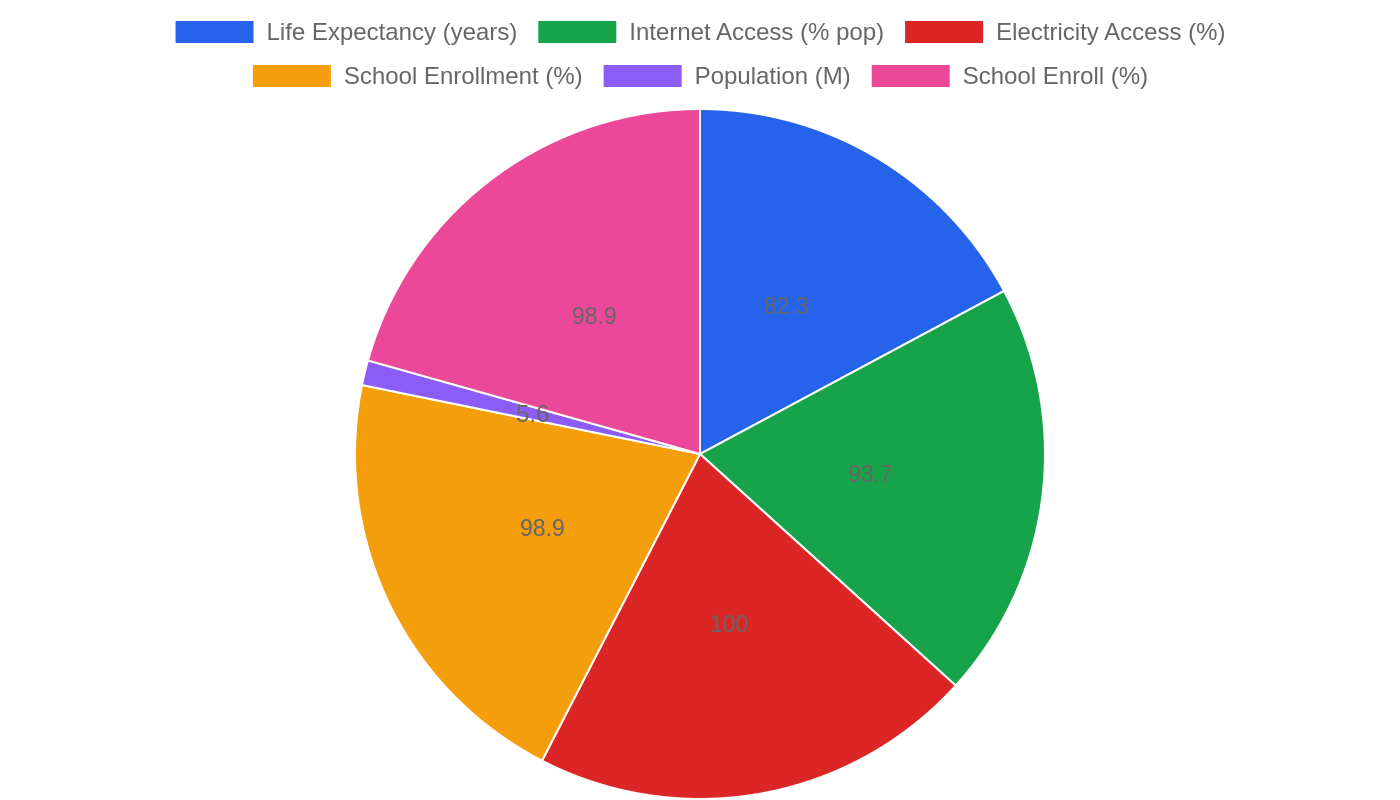
Economic Pulse Net | Sources: World Bank World Development Indicators, Government Sources | 2026
Key Takeaways
– Finland’s GDP growth is nearly flat at 0.17% for 2025, placing it among the slowest-growing economies in the Nordic region according to the World Bank.
– Unemployment stands at a stubborn 9.46%, a figure that challenges the country’s reputation for social stability and full employment.
– Despite economic headwinds, Finland’s GNI per capita of $55,250 reflects a wealthy society built on egalitarian Nordic welfare model principles.
– The country’s political landscape is defined by strong commitments to LGBT rights, women’s rights, secularism, and environmentalism—values that shape both domestic policy and international standing.
– Major listed companies span industrials, financials, and consumer goods, but the data reveals an absence of dominant tech giants, suggesting a traditional industrial base.
The Slow Creep — Why 0.17% Growth Matters
When the World Bank reports that Finland’s GDP growth for 2025 sits at just 0.17%, the number barely registers on a global scale. But for a country that prides itself on stability, predictability, and a robust welfare state, this near-zero figure is a quiet alarm bell. Economic growth of this magnitude means that the Finnish economy is essentially treading water—not contracting, but certainly not generating the kind of dynamism needed to reduce unemployment or fund ambitious social programs.
The unemployment rate of 9.46% compounds the concern. In a nation with a strong tradition of labor market intervention and active employment policies, nearly one in ten workers being jobless represents both a human cost and a fiscal strain. The welfare model that Finland champions relies on a broad tax base; high unemployment erodes that base while increasing demands on social spending.
The World Bank data does not provide inflation figures, leaving analysts to wonder whether the lack of price pressure is itself a symptom of weak demand. Without inflationary heat, the economy may be suffering from what economists call “secular stagnation”—a persistent lack of growth momentum.
Finland’s main industries are not detailed in the available data, but the composition of its top companies offers clues. The list includes Cargotec in industrials, Ahlstrom in basic materials, and a cluster of consumer goods and financial firms. This is not an economy driven by digital disruption or venture capital; it is a manufacturing and services economy navigating a low-growth environment. The GNI per capita of $55,250, however, underscores that this is still a wealthy country by global standards.
The challenge is translating that inherited wealth into future dynamism.
Housing the Nordic Dream — Cost Pressures in a Stagnant Economy
The cost of living data for Finland is not provided, but any seasoned observer of Nordic economies knows that housing in Helsinki and other urban centers has become a pressing issue. In a country where the welfare state promises security, the reality of rising rents and limited housing supply creates tension.
Young Finns, particularly those entering a labor market with nearly 10% unemployment, face a difficult calculus: pay a significant portion of income to rent in cities where jobs are concentrated, or move to cheaper regions with fewer opportunities.
The Nordic model historically included strong public housing policies and rent controls, but market pressures have eroded some of these protections. For a family earning the median income, the decision to buy versus rent depends heavily on location and interest rates. The absence of inflation data from the World Bank is notable—if inflation were high, it would erode purchasing power further; if low, it might indicate that demand is too weak to push prices up.
Either way, the housing market reflects the broader economic paradox: a wealthy society where opportunities are becoming harder to access.
The Business Landscape — Old Money, New Challenges
Finland’s corporate sector is anchored by familiar names with deep roots. Cargotec, an industrial company, represents the country’s engineering heritage. Ahlstrom operates in basic materials, a sector sensitive to global commodity cycles. Aktia Bank and Bank of Åland serve the financial needs of a mature economy. Alma Media and Alko, in consumer services, cater to domestic markets. The list includes Bittium, a consumer goods firm, and Amer Sports, which has global reach in sporting goods.
Notably absent are the kind of high-growth technology companies that have transformed neighboring Sweden and Estonia.
This is not an economy that lacks innovation—Codenomicon, a technology firm, appears on the list—but the overall corporate profile suggests a business environment geared toward stability rather than disruption. The political landscape, as described by International IDEA’s Global State of Democracy Indices, shows Finland performing in the high range for democratic quality.
That stability is a double-edged sword: it attracts long-term investment but can also entrench existing structures and resist the kind of creative destruction that drives rapid growth.
For investors, Finland offers a safe harbor with reliable institutions, strong rule of law, and a skilled workforce. The risk is that the economy’s low growth trajectory may persist, limiting returns. Sectors to watch include environmental technology, given the country’s strong green values, and healthcare, as an aging population creates demand. But the data does not provide the granularity to identify breakout opportunities.
Safety, Solidarity, and the Finnish Soul
The crime and safety indices for Finland are not provided, but the country’s reputation as one of the safest in the world is well established. The political landscape data from International IDEA confirms that Finland performs in the high range for democratic governance, with strong protections for civil liberties.
The description of modern Finnish values—rooted in egalitarian ideals, robust LGBT rights, strong efforts to eliminate poverty, broad protections for women’s rights, secularism, and environmentalism—paints a picture of a society that has deliberately chosen inclusion over division.
This political culture is not incidental to the economy; it is foundational. The Nordic welfare model, with significant state intervention in critical economic sectors, is a conscious choice to prioritize social cohesion over raw market outcomes. The result is a quality of life that ranks among the highest globally, even when GDP growth is sluggish. For the average Finn, the social safety net provides a buffer against economic shocks that would be devastating in less generous systems.
The challenge is sustaining that model when the economy is barely growing.
What’s Happening Now — The Politics of Stagnation
As of the latest available data, Finland is confronting the uncomfortable reality that its economic engine is sputtering. The near-zero GDP growth figure from the World Bank for 2025 is not a historical artifact; it is a current signal. With unemployment at 9.46%, policymakers face pressure to stimulate demand without abandoning fiscal discipline.
The political landscape, with its strong environmental and social commitments, limits the policy toolkit—carbon taxes and generous welfare programs are popular, but they can also be costly in a low-growth environment.
The absence of recent news data in the provided information means we cannot pinpoint specific reforms or crises. However, the broader context is clear: Finland must navigate between its egalitarian values and the hard math of economic arithmetic. The country’s leadership in areas like digital governance and green technology offers potential pathways to growth, but these sectors are not yet large enough to offset stagnation in traditional industries.
For now, Finland remains a model of democratic stability and social progress—but one that urgently needs to find its next economic gear.
The Bottom Line
Finland is a country that every serious investor and policy analyst should watch, not because it is booming, but because it represents a test case for the future of the Nordic model. Can a wealthy, egalitarian, environmentally conscious society generate enough economic growth to sustain its generous welfare state in an era of low global demand? The answer will have implications far beyond the Baltic Sea. For those interested in how democratic capitalism evolves under pressure, Finland is the laboratory.
Sources & Methodology
This article is authored by Economic Pulse Net for informational and research purposes. Economic Pulse Net sources its data from multilateral institutions, national statistics bureaus, and proprietary databases. All data is believed to be current as of the date of publication.
Published: July 18, 2026 | Category: Research — Finland
Use these signals in your own platform
Economic Pulse publishes its live signal feed through a documented, read-only API. Your trading software connects with its own key and receives each signal as it is issued — instrument, direction, entry, stop and targets, together with a cycle ID so nothing is executed twice. The feed is independent of this website and cannot change it.
Signals are informational only and are not financial advice.