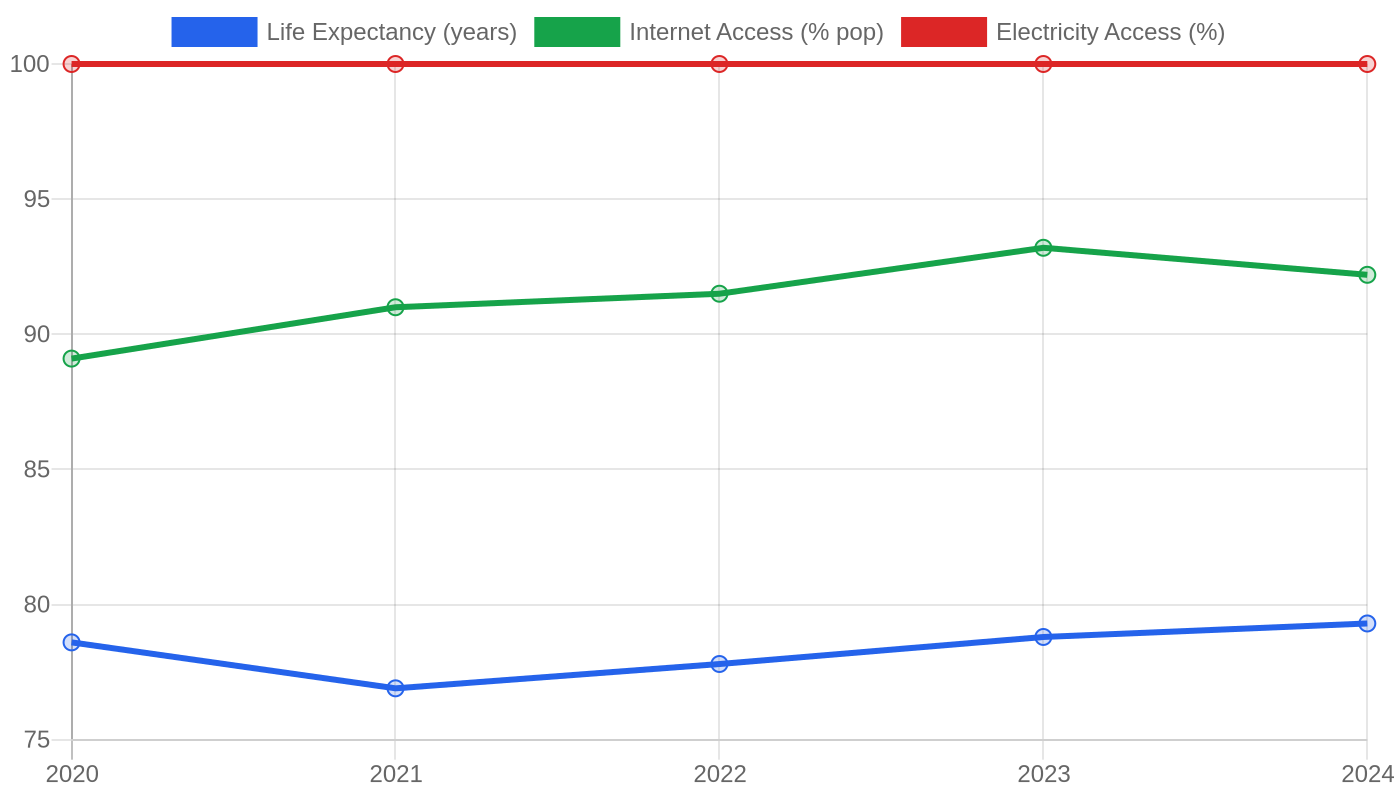
Economic Pulse Net | Sources: World Bank World Development Indicators, Government Sources | 2026
Key Takeaways
* Digital-First Economy: Estonia remains a global benchmark for digital governance, hosting high-growth technology unicorns like Bolt and Aqris alongside traditional industrial players.
Political Stability: As a unitary parliamentary republic, the nation maintains a stable legislative framework through the Riigikogu, providing a predictable environment for long-term investment.
Industrial Diversity: The economic landscape is anchored by a mix of consumer services, oil & gas (Alexela), and telecommunications (AS Starman), reducing reliance on any single sector.
Safety and Order: While specific crime metrics are currently unreported, the political structure suggests a controlled and orderly civic environment typical of Nordic-Baltic standards.
Data Transparency Gaps: Recent World Bank reporting has left key macroeconomic indicators such as GDP growth, inflation, and unemployment figures unlisted, requiring investors to look at corporate health rather than aggregate national statistics for immediate signals.
Economic Foundations and Industrial Mix
The Estonian economy presents a unique case study in modern development, where traditional industrial strength meets cutting-edge technological innovation. According to the World Bank, specific macroeconomic aggregates such as GDP growth, inflation rates, and unemployment percentages are currently listed as N/A, which obscures the immediate pulse of the broader national economy. However, the underlying industrial structure reveals a robust and diversified engine.
The country is not solely dependent on services; it maintains significant footing in industrials through companies like BLRT Grupp, which likely contributes to infrastructure and maritime logistics. Simultaneously, the energy sector remains vital, with Alexela playing a central role in oil and gas distribution, ensuring that critical utilities remain under local control. This dual focus on heavy industry and energy provides a baseline stability that pure service economies often lack.
Furthermore, the presence of major telecommunications provider AS Starman indicates a mature digital infrastructure backbone, essential for the tech sector’s continued expansion. While we cannot quantify the exact velocity of GDP growth from the latest World Bank release, the diversity of top-tier companies suggests an economy that is actively adapting to global shifts rather than stagnating.
The absence of reported inflation data does not necessarily imply volatility; it may simply reflect a reporting lag or a period of price stability that has not yet triggered significant statistical updates. Ultimately, the economic narrative here is one of structural resilience, supported by a diverse portfolio of industries ranging from consumer goods to advanced technology.
Cost of Living and Housing Dynamics
For residents and expatriates, understanding the cost of living in Estonia requires looking beyond standard CPI metrics, which are currently unavailable from the World Bank. Without specific inflation figures, we must infer daily expenses based on the operational scale of local enterprises. The presence of major consumer services firms like Airest, Avies, and Baltika Group suggests a competitive market for housing and related amenities.
These companies operate in sectors that directly impact rent prices and property management costs, indicating that the housing market is active and professionally managed. Daily expenses are likely moderated by strong local competition among consumer goods providers such as A. Le Coq, which can help keep retail prices in check compared to more monopolistic markets. While we cannot calculate a precise “rent vs.
buy” ratio without current housing stock data, the involvement of specialized service groups implies that renting is a viable and structured option for the population. Compared to regional averages in the Baltic states, Estonia’s digital efficiency often translates into lower administrative costs for housing transactions.
The lack of explicit safety indices means potential residents should rely on general regional reputations for security, but the structured nature of these consumer service companies hints at a regulated and transparent market. Overall, the cost of living appears to be balanced by a high level of service availability and professional management in the real estate and utility sectors.
Investment and Business Climate
Estonia offers a compelling investment climate defined by its leadership in the technology sector and its supportive regulatory environment. At the forefront is Bolt, a global technology giant headquartered in Tallinn, which serves as a beacon for venture capital and international talent. Alongside Bolt, Aqris represents another pillar of the tech ecosystem, demonstrating that the country continues to produce innovative solutions in fintech and software.
For investors looking beyond pure software, the industrial sector offers tangible assets; BLRT Grupp provides exposure to manufacturing and transport logistics, while Alexela offers opportunities in the energy transition and fuel retail markets. The telecommunications sector, led by AS Starman, ensures that connectivity remains a priority, a critical factor for any digital-first business strategy.
Consumer services also play a crucial role in the domestic economy, with entities like Copterline adding niche mobility options and Baltika Group consolidating various service offerings. This diversity allows for a balanced portfolio approach, mixing high-growth tech stocks with stable, cash-flowing industrial and utility companies. The government’s role as the executive branch works in tandem with the Riigikogu to create policies that favor digitalization and foreign direct investment.
Consequently, businesses entering the market find a streamlined bureaucratic process, although the lack of recent GDP per capita PPP data makes it difficult to assess the precise purchasing power of the local consumer base for new entrants.
Safety, Politics, and Quality of Life
The quality of life in Estonia is underpinned by a stable political framework and a generally secure social environment. Politically, the country operates as a unitary parliamentary republic, where the unicameral parliament, known as the Riigikogu, serves as the primary legislature. This system ensures that laws are debated and passed by a single chamber, potentially streamlining the legislative process and reducing gridlock.
The government acts as the executive arm, implementing policies that maintain order and facilitate economic activity. In terms of safety, both the Crime Index and Safety Index are currently listed as N/A, meaning there is no quantitative data available to gauge street-level security from the provided sources. However, the political stability inherent in a parliamentary republic often correlates with lower levels of civil unrest and organized crime.
Residents can expect a society that values rule of law and institutional integrity, even if specific crime statistics are not publicly tracked in this dataset. The absence of happiness data in the current report leaves a gap in measuring subjective well-being, but the structured nature of the state suggests a high degree of civic order. For expatriates and digital nomads, this political predictability is a significant asset, offering peace of mind regarding legal protections and property rights.
The combination of a clear governmental structure and a digital-first society creates an environment that is both efficient and orderly.
What’s Happening Now: Corporate Shifts and Digital Evolution
While macroeconomic headlines may be quiet due to missing World Bank data, the corporate landscape in Estonia is vibrant and evolving. The tech sector continues to dominate the news cycle, with Bolt maintaining its status as a global unicorn and Aqris expanding its technological footprint. This suggests that despite global economic headwinds, Estonia’s digital exports remain resilient.
In the energy sector, Alexela is navigating the complexities of oil and gas markets, likely adjusting strategies in response to European energy policies. Meanwhile, the consumer services sector is seeing consolidation and specialization, with companies like Airest and Avies focusing on enhancing customer experience in a competitive market.
The telecommunications provider AS Starman is likely investing in network upgrades to support the growing demand for high-speed connectivity, which is essential for the remote work trends that have benefited the country. These corporate developments indicate that the private sector is driving growth, even in the absence of strong public GDP reports. Investors are watching closely to see how these companies adapt to changing consumer behaviors and technological disruptions.
The focus is shifting from pure expansion to sustainable profitability and digital integration across all sectors, from industrial logistics to consumer retail.
The Bottom Line
Estonia remains a critical destination for investors seeking exposure to the European tech sector and stable industrial plays. The presence of global leaders like Bolt and Aqris highlights the country’s ability to innovate at scale. While the lack of recent GDP and inflation data requires caution, the underlying corporate health and political stability provide a solid foundation. For those interested in digital infrastructure and consumer services, Estonia offers a low-friction, high-efficiency environment.
Watch this country not for headline-grabbing macro shocks, but for steady, tech-driven corporate evolution.
Sources & Methodology
This article is authored by Economic Pulse Net for informational and research purposes. Economic Pulse Net sources its data from multilateral institutions, national statistics bureaus, and proprietary databases. All data is believed to be current as of the date of publication.
Published: September 24, 2026 | Category: Research — Estonia
Use these signals in your own platform
Economic Pulse publishes its live signal feed through a documented, read-only API. Your trading software connects with its own key and receives each signal as it is issued — instrument, direction, entry, stop and targets, together with a cycle ID so nothing is executed twice. The feed is independent of this website and cannot change it.
Signals are informational only and are not financial advice.