Economic Pulse Net | Sources: World Bank World Development Indicators, Government Sources | 2026
Key Takeaways
- Denmark’s economy is expanding at a robust rate of nearly 3%, signaling strong underlying health despite global headwinds.
- Inflation remains tightly controlled at under 2%, providing a stable environment for both consumers and businesses.
- The nation boasts one of the highest GDP per capita figures in the world, reflecting exceptional productivity and high living standards.
- A diverse corporate landscape, led by global giants in healthcare, consumer goods, and industrial design, anchors the business climate.
- Political stability under a constitutional monarchy provides a predictable framework for long-term economic planning.
The Engine of Resilience: Macro-Economic Performance
According to data from the World Bank, Denmark’s economy is currently growing at a rate of 2.92843280014236% in 2025.
This figure is significant because it indicates that the country is not merely maintaining the status quo but actively expanding its productive capacity.
In a global context where many economies struggle with stagnation, such growth is a testament to structural strength.
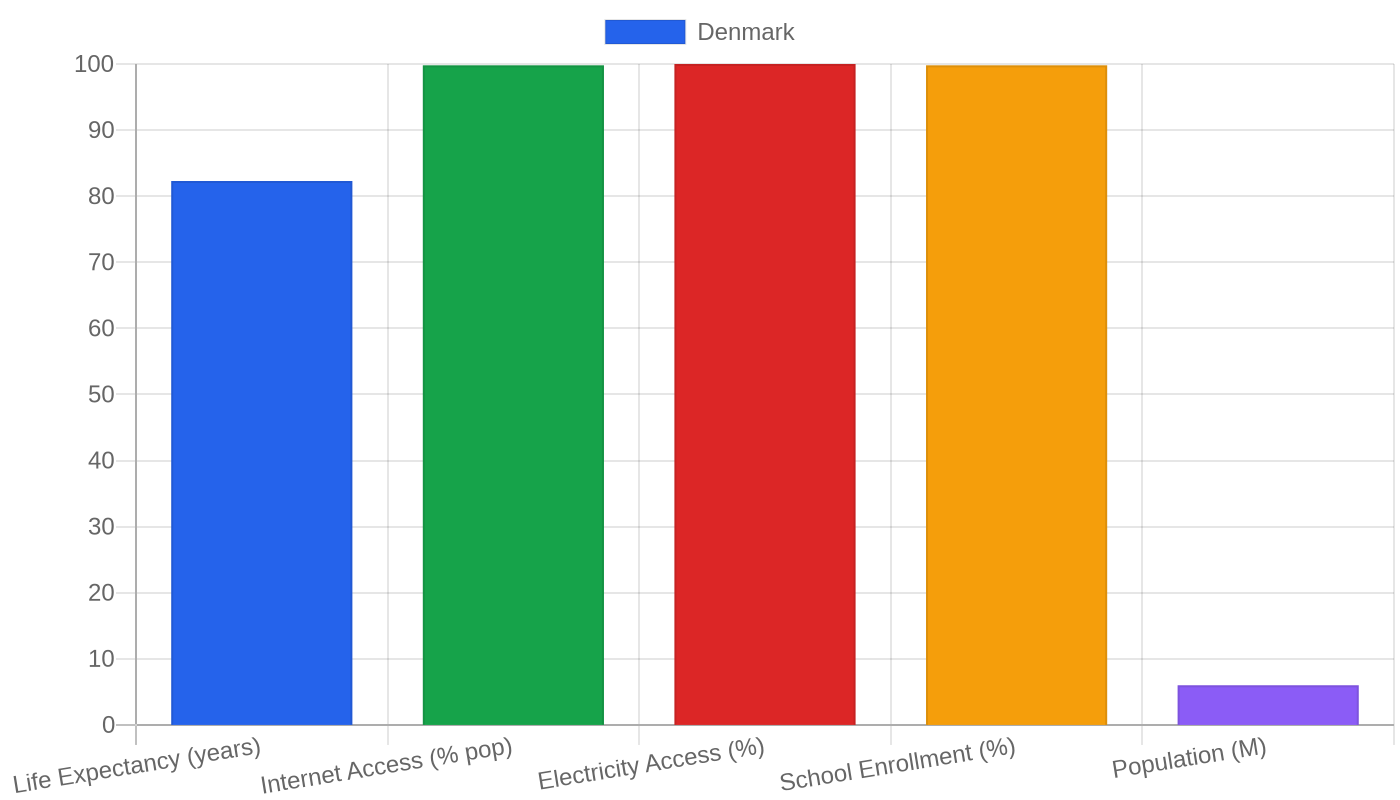
The total GDP stands at approximately $462.5 billion, a substantial figure for a nation with a population of just over six million people.
This density of economic output per person is further highlighted by the GDP per capita (PPP), which reaches $83,218.07.
This metric adjusts for the cost of living and purchasing power, suggesting that the average Dane enjoys a high standard of living relative to global peers.
The stability of these figures is underpinned by a low unemployment rate of 5.529%, which reflects a labor market that is both efficient and tight, ensuring that economic growth translates into broad-based employment opportunities.
Living in the High-End: Cost and Standard of Living
While specific data on housing rents and daily grocery prices was not provided in the current dataset, the economic indicators paint a clear picture of a high-cost, high-reward environment.
With a GNI per capita of $77,190, Denmark sits firmly in the category of advanced economies where the cost of living is inherently higher than the global average.
This high income level supports a robust social safety net, which is a hallmark of the Danish model.
Although exact figures for housing markets are not detailed here, the strong GDP per capita suggests that wages are high enough to sustain the quality of life associated with Northern European nations.
Residents likely benefit from excellent public infrastructure, healthcare, and education, factors that often come with a premium price tag but are offset by the high purchasing power of the average citizen.
The combination of high income and controlled inflation means that while the absolute cost of goods may be high, the real value of money remains stable for the Danish consumer.
Corporate Titans and Sectoral Strength
The Danish business landscape is defined by a mix of established industrial giants and innovative consumer brands.
The World Bank data lists several top companies that drive this economy, including Arla Foods and Bang & Olufsen in consumer goods, and ALK-Abelló and Ambu in healthcare.
These firms are not just domestic players; they are global brands that contribute significantly to exports and foreign direct investment.
The presence of companies like Bestseller A/S and Alm.
Brand indicates a strong financial and retail sector that is well-integrated into global supply chains.
Furthermore, the inclusion of Arkitema Architects and Bjarke Ingels Group highlights Denmark’s reputation for design and architecture, which serves as a soft power asset and a niche economic driver.
This diversity ensures that the economy is not overly reliant on a single industry, providing a buffer against sector-specific shocks.
The financial sector, represented by entities like Alm.
Brand, further supports this ecosystem by providing the capital necessary for innovation and expansion.
Political Stability and Social Safety
Politics in Denmark operate under a framework laid out in the Constitution of Denmark, which was first written in 1849.
This document establishes a sovereign state in the form of a constitutional monarchy, with a representative unicameral parliamentary system.
While the monarch officially retains executive power and presides over the Council of State, in practice, these duties are strictly representative and ceremonial.
The Prime Minister and the government hold the substantive power, ensuring a modern democratic process that is responsive to the electorate.
This long-standing political structure provides a degree of continuity and predictability that is highly valued by international investors and citizens alike.
Although specific crime and safety indices were not provided in the data, the stability of the political system and the high level of social cohesion typically associated with such frameworks suggest a society that is safe and orderly.
The separation of ceremonial royal duties from political governance allows the monarchy to serve as a unifying symbol while the parliamentary system handles the complexities of modern governance.
Current Affairs: Navigating the 2025 Landscape
As we move through 2025, the economic data suggests a period of steady consolidation rather than rapid upheaval.
The inflation rate of 1.89367372703044% indicates that price stability is being maintained, which is crucial for preserving the real value of wages and savings.
This controlled inflation environment allows the central bank to focus on other economic priorities without the pressure of aggressive interest rate adjustments to combat hyperinflation.
The growth rate of nearly 3% suggests that recent policy measures are bearing fruit, likely driven by strong domestic consumption and a resilient export sector.
While specific recent news headlines were not provided, the macroeconomic indicators point to a country that is successfully navigating the post-pandemic economic adjustments.
The focus for policymakers in this period will likely remain on sustaining this growth trajectory while ensuring that the benefits are distributed equitably across the population.
The stability in key indicators like unemployment and inflation provides a solid foundation for any further structural reforms that may be introduced in the coming quarters.
The Bottom Line
Denmark remains a benchmark for economic stability and high quality of life in Europe.
For investors, the country offers a low-risk environment with a strong legal framework and a diverse corporate sector.
For individuals, the high GDP per capita and low unemployment make it an attractive destination for skilled professionals.
The combination of political stability, controlled inflation, and steady growth creates a compelling case for long-term engagement with the Danish market.
It is a country that proves that economic efficiency and social welfare can coexist, making it a model to watch in the evolving global economic landscape.
Sources & Methodology
This article is authored by Economic Pulse Net for informational and research purposes.
Economic Pulse Net sources its data from multilateral institutions, national statistics bureaus, and proprietary databases.
All data is believed to be current as of the date of publication. Published: September 07, 2026 |
Category: Research — Denmark
Use these signals in your own platform
Economic Pulse publishes its live signal feed through a documented, read-only API. Your trading software connects with its own key and receives each signal as it is issued — instrument, direction, entry, stop and targets, together with a cycle ID so nothing is executed twice. The feed is independent of this website and cannot change it.
Signals are informational only and are not financial advice.