Economic Pulse Net | Sources: World Bank World Development Indicators, Government Sources | 2026
Key Takeaways
* Robust Growth Trajectory: Denmark is projected to achieve a GDP growth rate of nearly 3% in 2025, signaling strong economic momentum and resilience.
High-Income Status: With a GDP per capita (PPP) exceeding $83,000 and a GNI per capita of $77,190, the nation remains one of the wealthiest economies globally.
Stable Price Environment: Inflation is currently contained at approximately 1.9%, providing a predictable backdrop for consumers and businesses alike.
Diverse Industrial Powerhouse: From healthcare innovators like Ambu to industrial giants such as Alectia, Danish companies dominate niche global markets.
Constitutional Stability: The political framework, rooted in an 1849 constitution, ensures a stable constitutional monarchy with a representative parliamentary system.
Economic Engine: Growth and Wealth Metrics
Denmark’s economy is demonstrating significant vitality as it moves through 2025, anchored by a projected GDP growth rate of 2.92843280014236%. This robust expansion suggests that despite global headwinds, domestic demand and export capabilities are holding strong. The total Gross Domestic Product stands at a substantial $462,526,660,468.393 USD, reflecting the sheer scale of commercial activity within its borders.
Crucially, this wealth is widely distributed; the GDP per capita based on Purchasing Power Parity (PPP) is an impressive $83,218.071525634, indicating a high standard of living for the average citizen. Furthermore, the Gross National Income (GNI) per capita sits at $77,190, reinforcing the country’s status as a high-income economy according to World Bank classifications.
While unemployment data is currently listed as N/A, the overall macroeconomic indicators point toward a healthy labor market supporting this output. For investors and analysts, these numbers matter because they illustrate an economy that is not only growing but doing so with efficiency and broad-based prosperity. The combination of solid growth and high per-capita income suggests that Denmark has successfully navigated post-pandemic adjustments into a phase of sustainable development.
Living Standards and Cost Dynamics
For residents and expatriates, the cost of living in Denmark is shaped by its high-income status and comprehensive social infrastructure. While specific consumer price breakdowns are not detailed in the current dataset, the low inflation rate of 1.8900606245861% provides a stabilizing effect on daily expenses. This controlled inflation helps preserve purchasing power, allowing households to plan budgets with greater certainty compared to nations experiencing volatile price swings.
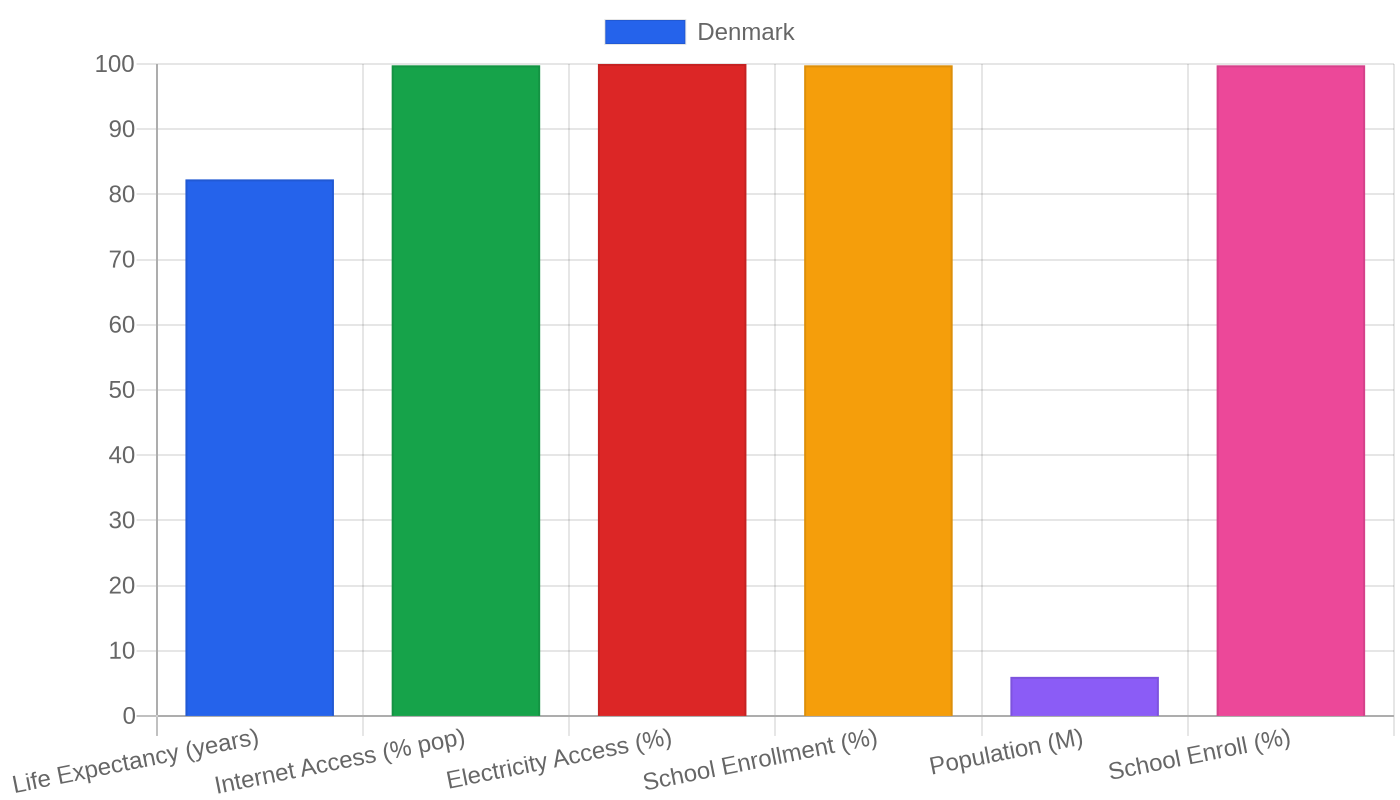
Housing costs, rent versus buy decisions, and general daily expenditures are likely calibrated to this high baseline of national wealth. When compared to regional averages in Northern Europe, Denmark typically commands premium prices for services and real estate, yet these costs are often offset by high-quality public services and infrastructure. The population of 6,009,169 people creates a dense but manageable market for goods and services, ensuring competition while maintaining high standards.
Ultimately, the interplay between moderate inflation and high wages defines the financial experience for those living and working in the country.
Investment Landscape and Corporate Leaders
The business environment in Denmark is characterized by innovation and a strong presence of multinational corporations across various sectors. Investors should watch key players such as Arla Foods, which dominates the consumer goods sector, and Bang & Olufsen, a leader in premium audio equipment. In the healthcare space, companies like ALK-Abelló and Ambu are critical indicators of Denmark’s strength in medical technology and pharmaceuticals.
The industrial sector is equally robust, featuring firms like Alectia and Arkitema Architects, who contribute significantly to infrastructure and design projects globally. Additionally, Bestseller A/S represents the country’s prowess in fashion retail, while Alm. Brand anchors the financial services landscape. These top companies demonstrate a diversified economy that does not rely on a single industry for stability.
For foreign direct investment, the presence of established entities like Bjarke Ingels Group highlights Denmark’s reputation for architectural excellence and sustainable urban planning. The business climate appears favorable for partnerships in green technology, healthcare, and advanced manufacturing.
Political Framework and Social Stability
Denmark operates under a constitutional monarchy established by the Constitution of 1849, which remains the bedrock of its political stability. The system features a sovereign state structure with a representative unicameral parliamentary government, ensuring broad democratic representation. Although the monarch officially retains executive power and presides over the Council of State, their role is strictly ceremonial in practice.
Real executive authority lies with the Prime Minister, who is formally appointed and dismissed through constitutional processes. This separation of ceremonial duty from political power contributes to a predictable and transparent governance environment. Regarding safety, current indices for crime and general safety are listed as N/A, suggesting a need for more granular local data or indicating that broader statistical categories may be evolving.
However, the historical continuity of the political framework implies a low risk of political upheaval. The quality of life is further enhanced by this institutional stability, fostering an environment where long-term planning is possible for both citizens and international partners.
Current Affairs and Policy Shifts
As we look at the immediate horizon, Denmark’s economic narrative is defined by steady growth and institutional continuity. The projected 2.92% GDP growth for 2025 indicates that policy measures are effectively stimulating activity without overheating the economy. With inflation held at a manageable 1.89%, policymakers appear to be balancing growth objectives with price stability.
The corporate sector continues to expand its global footprint, with recent performances from companies like Ambu and Arla Foods signaling strong international demand. There are no immediate signs of disruptive political change, as the constitutional framework continues to function smoothly under the ceremonial monarchy. Business leaders are likely focusing on leveraging Denmark’s strengths in healthcare and industrial technology to capture emerging market opportunities.
The absence of specific unemployment data does not detract from the positive trend suggested by rising GDP and GNI figures. Stakeholders should monitor how these growth metrics translate into wage increases and further investment in sustainable industries.
The Bottom Line
Denmark presents a compelling case for investors seeking stability combined with high-end growth potential. Its diversified corporate base, ranging from healthcare to industrials, offers multiple entry points for capital deployment. The strong constitutional framework and low inflation provide a secure environment for long-term holdings. For those prioritizing safety, wealth distribution, and economic predictability, Denmark remains a top-tier destination in the global landscape.
Sources & Methodology
This article is authored by Economic Pulse Net for informational and research purposes. Economic Pulse Net sources its data from multilateral institutions, national statistics bureaus, and proprietary databases. All data is believed to be current as of the date of publication.
Published: October 27, 2026 | Category: Research — Denmark
Use these signals in your own platform
Economic Pulse publishes its live signal feed through a documented, read-only API. Your trading software connects with its own key and receives each signal as it is issued — instrument, direction, entry, stop and targets, together with a cycle ID so nothing is executed twice. The feed is independent of this website and cannot change it.
Signals are informational only and are not financial advice.