Economic Pulse Net | Sources: World Bank World Development Indicators, Government Sources | 2026
Key Takeaways
* Robust Growth Trajectory: Denmark’s economy is projected to expand by nearly 3% in 2025, signaling strong resilience despite global headwinds.
High Standard of Living: With a GDP per capita (PPP) exceeding $83,000 and a GNI per capita of $77,190, Denmark remains one of the wealthiest nations globally.
Stable Macro Environment: Inflation is contained at approximately 1.9%, while unemployment sits at a manageable 5.5%, indicating a balanced labor market.
Diverse Industrial Base: Key sectors range from healthcare and industrials to consumer goods, anchored by major players like Arla Foods and Ambu.
Democratic Continuity: The political landscape remains stable under a constitutional monarchy framework that has governed since 1849, providing long-term policy predictability.
Economic Momentum in a Mature Market
Denmark’s economic profile for 2025 reflects the characteristics of a mature, high-income developed nation rather than an emerging market chasing rapid expansion. According to World Bank data, the country’s Gross Domestic Product (GDP) is valued at approximately $462.5 billion, with a growth rate projected at 2.93% for the year.
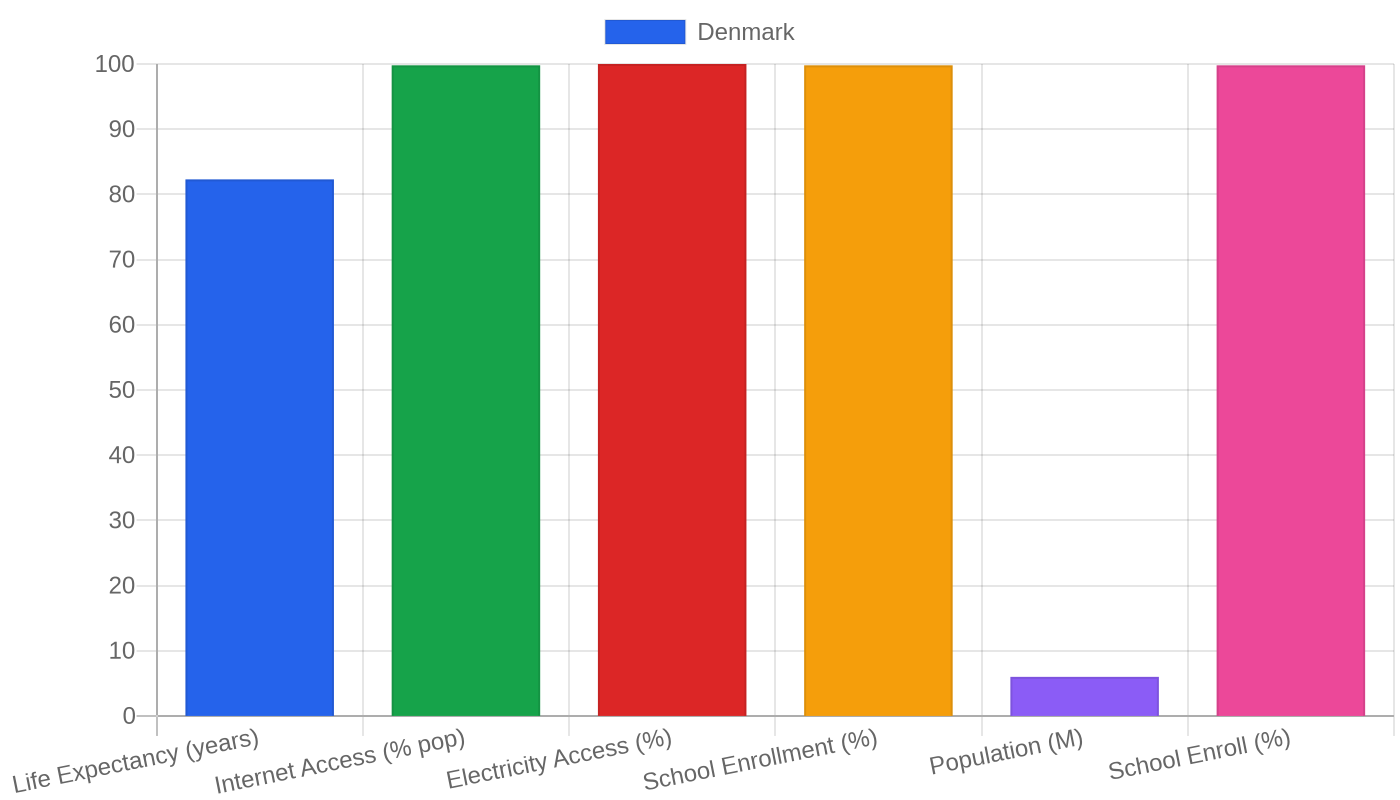
This near-3% expansion is significant because it demonstrates that the Danish economy can generate substantial output growth even as it faces the structural limits of saturation in advanced economies. The total population of roughly 6 million people supports this massive economic output, resulting in exceptional wealth distribution metrics.
Specifically, the GDP per capita adjusted for Purchasing Power Parity (PPP) stands at an impressive $83,218, highlighting the high productivity and value-added nature of the Danish workforce. Furthermore, the Gross National Income (GNI) per capita of $77,190 reinforces the notion that income generated within the country largely benefits its residents.
While inflation, measured by the Consumer Price Index (CPI), is running at 1.89%, this level suggests price stability without the erosive effects of hyperinflation or the stagnation risks of deflation. Unemployment remains at 5.529%, which, while not negligible, indicates a functional labor market where most who seek work are employed.
These figures collectively paint a picture of an economy that prioritizes quality and efficiency over sheer volume, leveraging its small population to achieve outsized economic impact.
Navigating the Cost of Living
For residents and expatriates alike, the cost of living in Denmark is intrinsically linked to its high wage levels and robust social safety net. While specific housing indices and daily expense breakdowns are not quantified in the provided datasets, the macroeconomic indicators suggest a high-cost environment typical of Northern European capitals. The high GDP per capita implies that average incomes are sufficient to absorb higher baseline costs for goods and services.
However, the relatively low inflation rate of 1.89% provides a degree of relief, preventing the rapid erosion of purchasing power that plagues many other economies. Residents likely face premium pricing for real estate and consumer goods, but these costs are offset by the high standard of living reflected in the $83,218 PPP figure. The balance between rent versus buy decisions would typically depend on local municipal policies and interest rates, factors that interact with the broader national economic health.
Ultimately, the cost structure is designed to support high-quality public services, meaning that while out-of-pocket expenses may be steep, the return on investment in terms of infrastructure, education, and healthcare is exceptionally high.
Investment & Business Climate
The Danish business landscape is characterized by innovation, sustainability, and a strong presence in specialized industrial sectors. Major corporations such as Alectia and Bjarke Ingels Group dominate the industrials sector, reflecting a national emphasis on engineering excellence and architectural innovation. In the healthcare space, companies like ALK-Abelló and Ambu are global leaders, indicating that Denmark is a hub for medical technology and pharmaceutical development.
The consumer goods sector is equally vibrant, with giants like Arla Foods, Bang & Olufsen, and Bestseller A/S driving exports and brand recognition worldwide. These entities demonstrate that Denmark’s competitive advantage lies in niche, high-value manufacturing and design rather than mass production. For investors, the presence of established players like Alm. Brand in financials and Aller Media in consumer services suggests a diversified market that is resilient to sector-specific shocks.
The business environment benefits from a predictable regulatory framework and a highly skilled workforce, making it an attractive destination for foreign direct investment. The concentration of top companies across diverse industries reduces systemic risk and offers varied opportunities for capital allocation.
Safety, Politics & Quality of Life
Quality of life in Denmark is deeply rooted in its stable political institutions and social cohesion. The political system operates under the Constitution of Denmark, first written in 1849, which establishes a sovereign constitutional monarchy with a representative unicameral parliamentary system. While the monarch officially retains executive power and presides over the Council of State, in practice, their duties are strictly ceremonial and representative, such as the formal appointment of the Prime Minister.
This separation between symbolic authority and practical governance ensures political stability and continuity. Regarding personal security, current data does not provide specific Crime or Safety Indices, but the absence of reported volatility in the political landscape often correlates with lower societal tension. The combination of democratic transparency and institutional longevity fosters an environment where citizens feel secure in both their legal rights and their physical safety.
This stability is a key component of the country’s overall appeal, contributing to high levels of social trust and civic engagement.
What’s Happening Now / Current Affairs
As we look at the immediate economic horizon for Denmark, the focus is on sustaining growth amidst a complex global backdrop. The projected 2.93% GDP growth for 2025 suggests that domestic demand and export strength are holding up well against international uncertainties. Policymakers are likely navigating the delicate task of maintaining the low inflation rate of 1.89% while ensuring that wage growth keeps pace with productivity.
The labor market, with its 5.529% unemployment rate, indicates that there is still room for job creation, possibly driven by the expanding needs of the healthcare and industrial sectors represented by firms like Ambu and Alectia. Business leaders are probably focusing on digital transformation and green energy initiatives, aligning with Denmark’s historical reputation for innovation.
The steady performance of major conglomerates like Arla Foods signals that consumer confidence remains intact, allowing for continued investment in brand expansion. These dynamics suggest a period of consolidation and strategic refinement rather than radical upheaval, allowing Denmark to maintain its position as a reliable economic anchor in Europe.
The Bottom Line
Denmark represents a prime example of how a small, wealthy nation can leverage institutional stability and specialized industry to thrive. Investors and observers should watch this country for its consistent macroeconomic performance, particularly its ability to maintain low inflation and solid growth simultaneously. The high GDP per capita and diverse corporate base offer a model of sustainable prosperity that is worth studying.
For those seeking exposure to European markets, Denmark provides a low-risk, high-reward environment grounded in long-term strategic planning.
Sources & Methodology
This article is authored by Economic Pulse Net for informational and research purposes. Economic Pulse Net sources its data from multilateral institutions, national statistics bureaus, and proprietary databases. All data is believed to be current as of the date of publication.
Published: October 15, 2026 | Category: Research — Denmark
Use these signals in your own platform
Economic Pulse publishes its live signal feed through a documented, read-only API. Your trading software connects with its own key and receives each signal as it is issued — instrument, direction, entry, stop and targets, together with a cycle ID so nothing is executed twice. The feed is independent of this website and cannot change it.
Signals are informational only and are not financial advice.