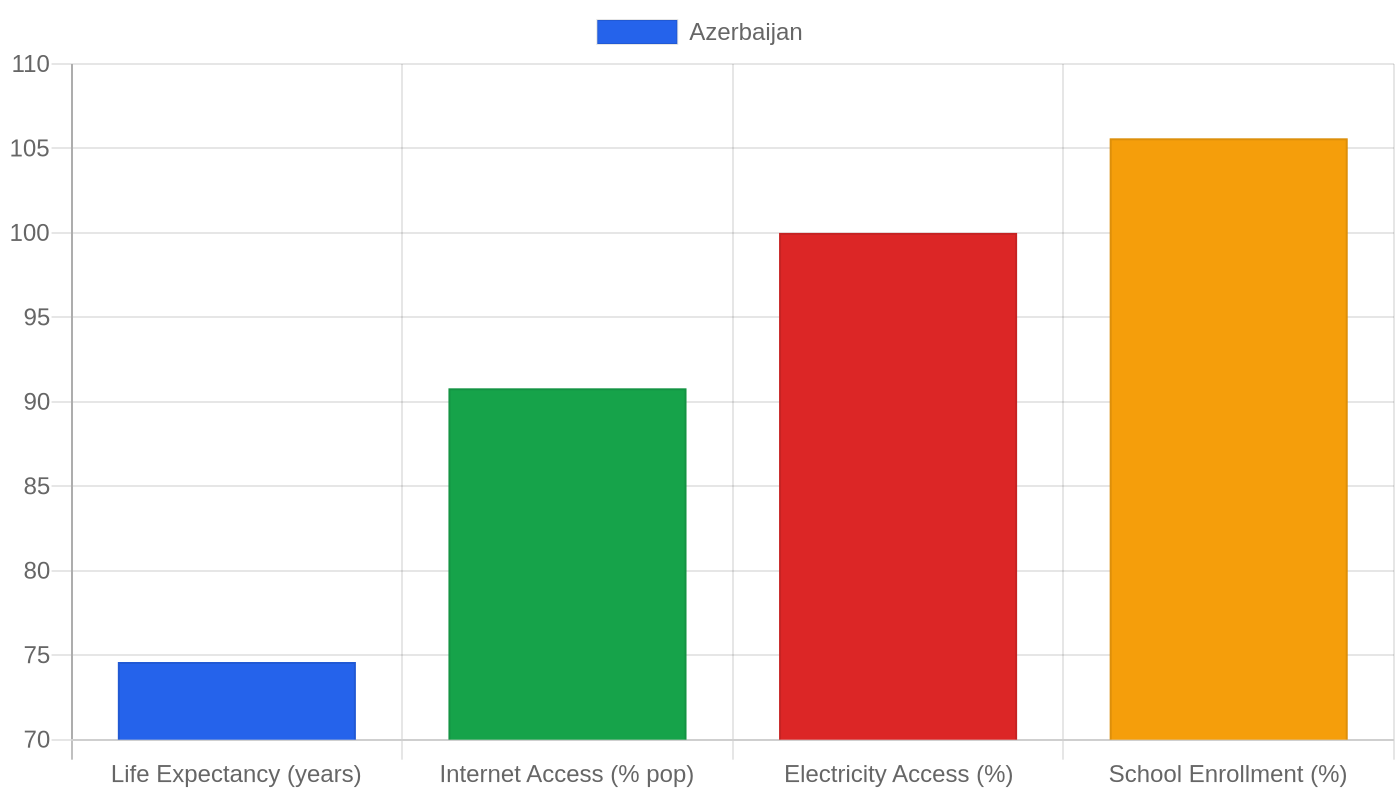
Economic Pulse Net | Sources: World Bank World Development Indicators, Government Sources | 2026
Key Takeaways
– Azerbaijan’s economy remains heavily concentrated in state-controlled industrial sectors, with the nation’s corporate landscape dominated by utilities, transportation monopolies, and banking institutions tied to the ruling establishment.
– The political environment is defined by the Aliyev family’s uninterrupted rule since 1993, with the New Azerbaijan Party (YAP) maintaining a tight grip on power and elections consistently criticized for unfair practices.
– Freedom House categorizes the country as “not free,” scoring it a stark 7/100 on Global Freedom metrics, signaling significant constraints on civil liberties and political participation.
– Despite holding regular elections, international observers and watchdogs point to systemic electoral fraud, creating a challenging environment for foreign investors and democratic institutions alike.
– The country’s economic trajectory is inextricably linked to its authoritarian governance structure, where major industries and infrastructure projects flow through politically connected channels.
The Caspian Economic Engine: State Power and Industrial Might
Azerbaijan’s economic landscape is a study in concentrated state power and strategic industrial positioning. While the World Bank’s latest data on GDP growth, inflation, and unemployment remains unavailable, the structural composition of the nation’s top companies reveals a clear pattern: the state dominates. Azerbaijan Caspian Shipping Company and Azerbaijan Railways anchor the industrials sector, representing critical transportation arteries for both goods and energy resources.
These are not merely commercial entities; they are strategic national assets that underpin the country’s role as a Caspian transit hub. The presence of Azersu Open Joint Stock Company in the utilities sector further underscores the government’s reach into essential services, controlling water supply infrastructure that serves as a daily lifeline for citizens.
The financial sector, represented by AccessBank Azerbaijan and AtaBank, operates within a system where political connections and state influence often determine lending priorities and market access. Meanwhile, AF Holding and its subsidiary AF Hotel Group illustrate the diversification of politically connected conglomerates into consumer services, capturing value from both domestic consumption and international business travel.
The inclusion of Medeniyyet TV and ANS Group of Companies in the consumer services category highlights the media landscape’s entanglement with economic power — a particularly significant fact given the country’s poor press freedom rankings.
Akkord Industry Construction Investment Corporation rounds out the industrial picture, pointing toward infrastructure development as a key state priority, though the opaque nature of public procurement in authoritarian systems raises questions about efficiency and competition.
Housing and the Cost of Daily Life in Baku
The cost of living in Azerbaijan’s capital, Baku, reflects the broader economic disparities that characterize post-Soviet resource-rich states. While specific housing data from the World Bank is not available, the structure of the economy suggests that urban real estate remains a premium asset class, particularly in central Baku where oil wealth has historically driven property speculation.
The presence of AF Hotel Group and other consumer services companies indicates a tourism and business travel sector that supports higher-end accommodation and services, creating a two-tier market where international visitors and wealthy locals pay premium prices while average citizens face more modest options.
Renting versus buying in Azerbaijan presents the classic dilemma seen in many emerging markets: limited mortgage accessibility, high upfront costs, and a preference for property ownership as a store of value. The utilities sector’s state control, exemplified by Azersu, suggests that basic service costs may be subsidized or politically managed, but efficiency concerns and aging infrastructure could lead to gradual price adjustments.
For the average Azerbaijani household, daily expenses on food, transportation, and housing likely consume a significant portion of income, with the gap between the oil-fueled elite and the broader population remaining a persistent social tension point.
Investment Climate: Navigating Politics and Patronage
For foreign investors and domestic entrepreneurs alike, Azerbaijan’s business environment is defined by the imperative of political alignment. The dominance of state-linked entities across industrials, utilities, and financials creates a market where success often depends on relationships with the ruling New Azerbaijan Party rather than purely commercial merit.
The Aliyev family’s long-standing control, established by Heydar Aliyev in 1993 and maintained by his successor, has created a predictable but restrictive business environment where major contracts and licenses flow through politically approved channels.
The industrials sector, particularly shipping and railways, offers opportunities for companies willing to partner with state entities, especially given Azerbaijan’s strategic position along the Trans-Caspian International Transport Route. The construction industry, represented by Akkord, signals ongoing infrastructure investment that could attract international contractors and suppliers.
However, the financial sector’s concentration in politically connected banks like AccessBank and AtaBank suggests that credit allocation is not purely market-driven, creating risks for minority shareholders and foreign financial institutions. The conglomerate model exemplified by AF Holding demonstrates how diversified business groups can thrive under authoritarian conditions, but it also highlights the barriers to entry for independent players who lack political protection.
Security, Politics, and the Quality of Civic Life
Azerbaijan’s political landscape presents a paradox: formal democratic structures exist, but substantive democratic practice does not. The government’s characterization as an authoritarian regime by multiple international observers, combined with Freedom House’s “not free” designation and its 7/100 Global Freedom score, paints a clear picture of constrained civil society, limited press freedom, and restricted political opposition.
The regularity of elections does little to legitimize the system when those elections are consistently marred by electoral fraud and unfair practices, as documented by election observers and human rights organizations.
The absence of crime index and safety index data from the World Bank makes it difficult to assess public security quantitatively, but the authoritarian state’s emphasis on control typically results in low visible crime rates in urban centers. However, this public order comes at the cost of political freedom, with citizens who challenge the status quo facing significant risks.
For the international business community, the security situation presents a trade-off: stable and predictable for those with government approval, but potentially hazardous for those who run afoul of political interests. The quality of life in Azerbaijan is therefore bifurcated — comfortable for the politically connected elite, constrained for the broader population, and uncertain for independent voices.
Current Affairs: The Aliyev Era Continues
Azerbaijan continues to operate under the firm control of the Aliyev political dynasty and the New Azerbaijan Party, maintaining the political continuity that has defined the country since 1993. The government’s approach to governance remains consistent: holding regular elections while ensuring through electoral fraud and other unfair practices that outcomes align with regime interests.
This political stability — however authoritarian — provides a degree of predictability for state-linked businesses and international partners who have learned to navigate the system. The continued dominance of state-controlled industries in shipping, railways, utilities, and finance suggests that economic policy remains oriented toward consolidating state power rather than liberalizing markets.
The recent news cycle around Azerbaijan’s political landscape centers on the ongoing consolidation of authority and the continued marginalization of opposition voices. For international observers, the country’s trajectory raises questions about succession planning within the Aliyev family structure and the long-term sustainability of a governance model that relies heavily on personalist rule.
Meanwhile, the business community watches for signals about economic diversification beyond the state-dominated sectors, though current indicators suggest that the conglomerate model — with its close ties to political power — remains the template for commercial success in Azerbaijan.
The Bottom Line
Azerbaijan represents a compelling case study for those interested in the intersection of authoritarian governance and resource-driven economic development. The country’s strategic Caspian location, state-controlled industrial base, and politically connected business elite create opportunities for investors who understand and accept the rules of the game.
However, the Freedom House ranking of 7/100 and the persistent documentation of electoral fraud should give pause to companies and institutions that prioritize transparency and democratic governance. For political risk analysts, students of post-Soviet development, and investors with high risk tolerance and strong government connections, Azerbaijan offers valuable insights — but the price of entry is navigating a system where political power and economic opportunity are inseparable.
Sources & Methodology
This article is authored by Economic Pulse Net for informational and research purposes. Economic Pulse Net sources its data from multilateral institutions, national statistics bureaus, and proprietary databases. All data is believed to be current as of the date of publication.
Published: August 05, 2026 | Category: Research — Azerbaijan
Use these signals in your own platform
Economic Pulse publishes its live signal feed through a documented, read-only API. Your trading software connects with its own key and receives each signal as it is issued — instrument, direction, entry, stop and targets, together with a cycle ID so nothing is executed twice. The feed is independent of this website and cannot change it.
Signals are informational only and are not financial advice.