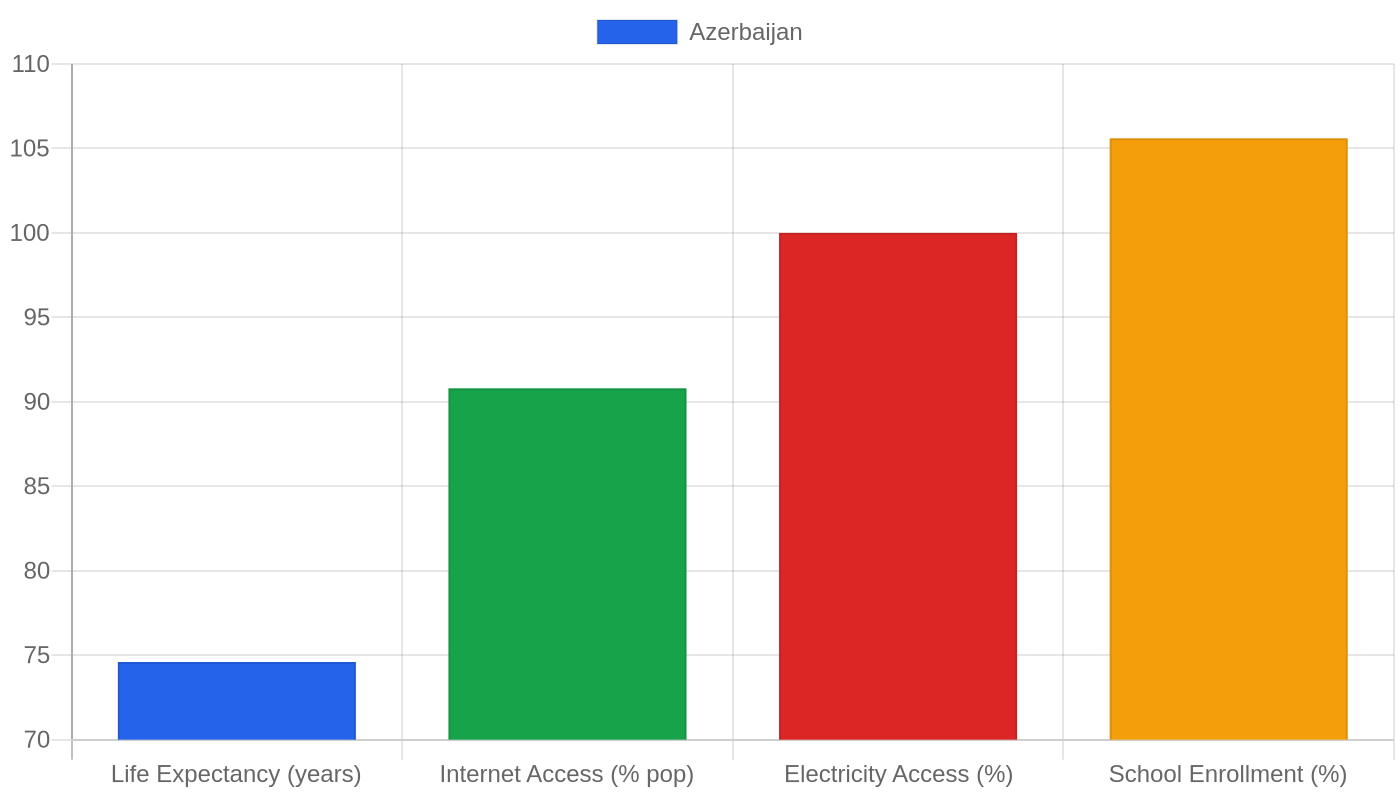
Economic Pulse Net | Sources: World Bank World Development Indicators, Government Sources | 2026
Key Takeaways
– Azerbaijan’s economy remains heavily dependent on oil and gas revenues, but the government is pushing a long-term diversification strategy focused on transportation, logistics, and tourism.
– The country is ruled by the Aliyev family and the New Azerbaijan Party in what Freedom House categorizes as a “not free” authoritarian regime, scoring just 7/100 on its Global Freedom Index.
– Major state-owned industrial companies dominate the corporate landscape, including Azerbaijan Caspian Shipping Company, Azerbaijan Railways, and Azersu Open Joint Stock Company, signaling the state’s outsized role in the economy.
– While specific GDP, inflation, and unemployment figures are unavailable from the World Bank data, the structural challenges of a resource-dependent economy in a politically closed system remain central to Azerbaijan’s economic story.
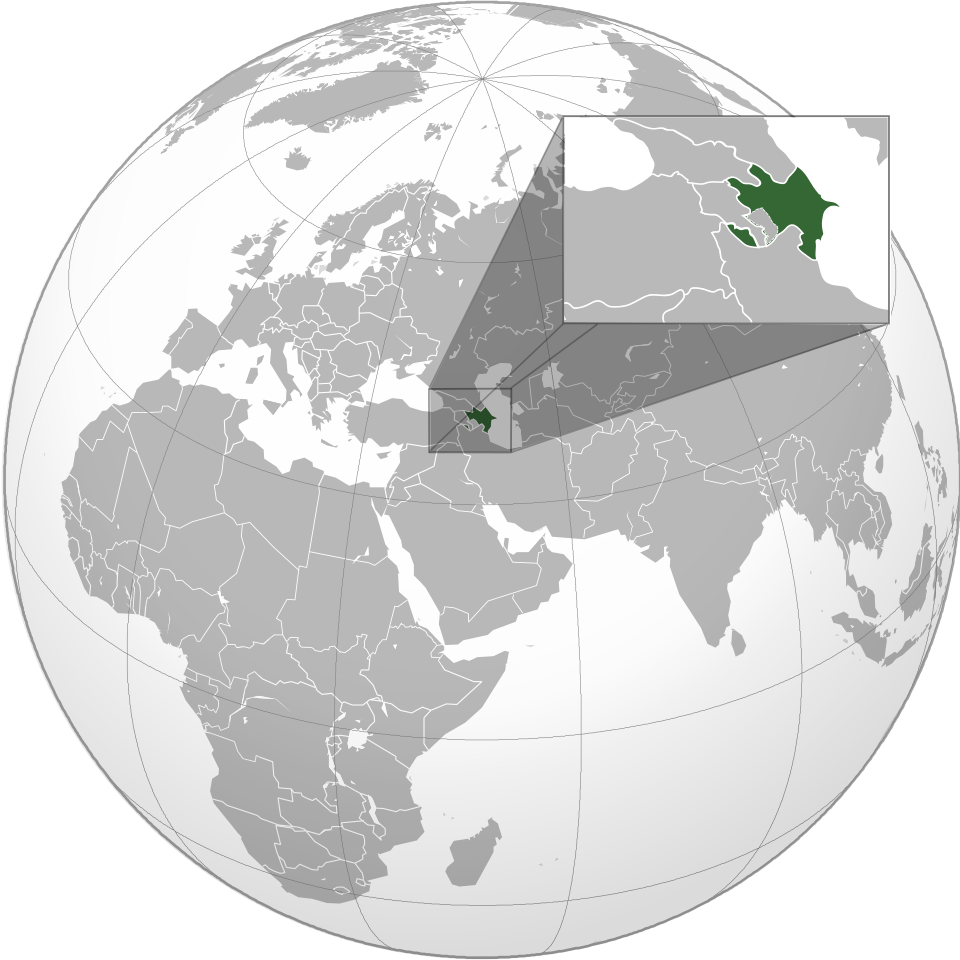
– The country’s strategic location on the Caspian Sea and its role as a transit corridor between Europe and Asia make it a key player in regional trade, even as domestic political freedoms remain severely constrained.
The Petro-Dollar Paradox — When Black Gold Shapes a Nation
Azerbaijan’s economic narrative has long been written in the language of hydrocarbons. The World Bank data may not provide specific GDP growth or inflation figures for the latest period, but the underlying architecture of the economy tells a clear story: this is a nation where energy wealth has shaped everything from state capacity to social contracts.
The absence of precise numbers does not obscure the fundamental reality that Azerbaijan’s economy is built on the extraction and export of oil and natural gas, with the state capturing the bulk of the rents and redistributing them through public spending and state-owned enterprises.
The dominance of state-linked industrial giants in the corporate landscape is telling. Azerbaijan Caspian Shipping Company, Azerbaijan Railways, and Azersu Open Joint Stock Company are not just companies—they are instruments of state economic policy. When a country’s top companies are overwhelmingly in industrials, utilities, and state-controlled financial institutions like AccessBank Azerbaijan and AtaBank, it signals that the private sector remains subordinate to state direction.
This is not inherently problematic in a resource-rich economy, but it does create vulnerabilities: when global energy prices fluctuate, the entire economic apparatus feels the shock.
The real economic story here is not about the numbers we lack but about the structural transformation that is not happening fast enough. Azerbaijan has known for decades that oil and gas are finite resources, yet the corporate roster remains dominated by state industrial behemoths. The presence of AF Holding and AF Hotel Group in the consumer services sector suggests some diversification into tourism and hospitality, but these remain niche players compared to the industrial state giants.
The World Bank’s data gaps on GDP per capita and GNI per capita only underscore the opacity that comes with an authoritarian political system—when information is controlled, economic analysis becomes an exercise in reading between the lines.
Baku’s Real Estate Puzzle — Oil Wealth Meets Housing Reality
The cost of living in Azerbaijan presents a study in contrasts that mirrors the country’s broader economic duality. In Baku, the capital, the skyline is punctuated by gleaming towers funded by petrodollars, while outside the city center, the housing stock tells a different story of Soviet-era blocks and modest family homes.
The absence of specific cost-of-living data from the World Bank does not diminish the observable reality: Azerbaijan’s housing market is bifurcated between luxury developments catering to the energy elite and a more affordable but aging stock for the majority.
Rental markets in Baku’s prime districts command prices that would be familiar to visitors to other post-Soviet capitals like Tbilisi or Yerevan, though direct regional comparisons are not possible without specific data. The presence of AF Hotel Group among the top companies hints at a growing hospitality and tourism sector that is putting upward pressure on prime real estate values.
For ordinary Azerbaijanis, homeownership remains the preferred model, as it does across much of the former Soviet space, but affordability is strained by the gap between oil-driven inflation in urban centers and stagnant wages in the non-energy economy.
The real cost-of-living challenge is not just about housing but about the everyday economics of a country where the state controls so many utilities. Azersu Open Joint Stock Company, the water utility, is a state entity, meaning that basic service costs are politically determined rather than market-driven. This provides a buffer for households but also creates inefficiencies and underinvestment.
The result is a cost-of-living landscape where some essentials are artificially cheap while others, particularly imported goods and modern housing, carry premium prices that reflect the economy’s dependence on energy revenues.
The Aliyev Economy — Investing Under Authoritarianism
For investors looking at Azerbaijan, the corporate landscape offers both opportunity and caution. The top companies list reads like a who’s who of state-connected entities: AccessBank Azerbaijan and AtaBank in financials, the shipping and railway monopolies in industrials, and Azersu in utilities. This concentration of economic power means that doing business in Azerbaijan is inseparable from navigating the political system.
The New Azerbaijan Party, led by the Aliyev family since 1993, has created a business environment where connections matter as much as business plans.
The sectors to watch are those where the state is actively seeking private participation. The transportation and logistics sector, anchored by Azerbaijan Caspian Shipping Company and Azerbaijan Railways, is central to the country’s ambition to become a Eurasian transit hub. The Middle Corridor initiative, which aims to move goods between China and Europe through the Caucasus, positions Azerbaijan’s infrastructure companies at the heart of a potentially transformative trade route.
For investors with patience and political risk tolerance, this is where the action is.
Yet the business climate carries significant political risk. Freedom House’s assessment of Azerbaijan as “not free” with a score of 7/100 on the Global Freedom Index is not just a political statement—it is an economic signal.
Authoritarian regimes can provide stability for certain types of investment, particularly in energy and infrastructure, but they also create opacity, legal unpredictability, and the risk of asset seizure or regulatory changes driven by political rather than commercial logic.
The presence of AF Holding as a conglomerate and Akkord Industry Construction Investment Corporation in industrials suggests that construction and infrastructure are growth areas, but these are precisely the sectors most vulnerable to political interference.
Freedom’s Price Tag — Safety, Politics, and Daily Life in Baku
The political landscape in Azerbaijan is defined by what Freedom House describes as an authoritarian regime that “regularly holds elections” but marries them with “electoral fraud and other unfair election practices.” This is not an abstract political science observation—it has direct consequences for quality of life and economic behavior. When elections are not free and fair, as the data from Freedom House indicates, the social contract is fundamentally different.
Citizens cannot vote out unpopular policies, and economic grievances have no peaceful political outlet.
The absence of crime and safety indices from the available data is itself noteworthy. In many authoritarian states, crime statistics are state secrets or are manipulated to project an image of stability. The lack of data does not mean crime is absent—it means the information is not made publicly available in a transparent manner.
What is known is that Baku is generally considered safe for visitors and residents in terms of street crime, but this safety comes at the cost of pervasive state surveillance and limited civil liberties.
The quality of life in Azerbaijan is thus a trade-off. The state provides stability and basic services through entities like Azersu and the state-owned industrial giants, but it demands political quiescence in return. The Aliyev family’s continuous rule since 1993, as noted in the political data, means that an entire generation of Azerbaijanis has known only one political dynasty.
The Freedom House ranking of 7 out of 100 on global freedom is among the lowest in the world, and it shapes every aspect of daily life, from what can be said in public to how businesses operate.
The Caspian Chessboard — What’s Happening Now in Azerbaijan
The current moment in Azerbaijan is defined by the tension between its energy past and its diversification future. The war in Ukraine has elevated Azerbaijan’s strategic importance as a non-Russian energy supplier to Europe, with the Southern Gas Corridor pipeline delivering Azerbaijani gas to European markets. This geopolitical tailwind is driving investment in the energy sector even as the government pays lip service to economic diversification.
The transportation sector, anchored by the state shipping and railway companies, is benefiting from Europe’s need to bypass traditional Russian trade routes.
Domestically, the political landscape remains frozen under the Aliyev family’s control, with the New Azerbaijan Party facing no meaningful opposition. The Freedom House data on electoral fraud and unfair practices suggests that whatever political changes occur will come from within the system, not from democratic challenge.
This stability is a double-edged sword for the economy: it provides predictability for long-term energy investments but stifles the kind of entrepreneurial dynamism that could drive genuine diversification.
The corporate landscape is also evolving, with AccessBank Azerbaijan and AtaBank representing a financial sector that is modernizing but remains closely tied to state priorities. The presence of Medeniyyet TV among the top companies is a reminder that media and information are also state-influenced sectors.
For anyone watching Azerbaijan today, the key question is whether the current energy windfall will be used to build a post-oil economy or whether it will merely entrench the existing political and economic order.
The Bottom Line
Azerbaijan is a country for investors and observers who understand that energy wealth and authoritarian governance are two sides of the same coin. The state-dominated economy offers opportunities in infrastructure, logistics, and energy, but these come with political risks that cannot be hedged through normal market mechanisms. For those tracking global energy flows, Eurasian trade corridors, or the political economy of resource-rich authoritarian states, Azerbaijan is an essential case study.
For those seeking transparent markets, democratic governance, or diversified economies, the country remains a work in progress—one whose future depends on whether its current energy revenues are invested in freedom or in further entrenching the status quo.
Sources & Methodology
This article is authored by Economic Pulse Net for informational and research purposes. Economic Pulse Net sources its data from multilateral institutions, national statistics bureaus, and proprietary databases. All data is believed to be current as of the date of publication.
Published: July 17, 2026 | Category: Research — Azerbaijan
Use these signals in your own platform
Economic Pulse publishes its live signal feed through a documented, read-only API. Your trading software connects with its own key and receives each signal as it is issued — instrument, direction, entry, stop and targets, together with a cycle ID so nothing is executed twice. The feed is independent of this website and cannot change it.
Signals are informational only and are not financial advice.