Economic Pulse Net | Sources: World Bank World Development Indicators, Government Sources | 2026
Key Takeaways
* Political Stagnation: The nation remains under the continuous rule of the Aliyev political family and the New Azerbaijan Party since 1993, with elections frequently criticized for fraud.
Data Vacuum: Critical economic indicators such as GDP growth, inflation, and unemployment figures are currently unreported by the World Bank, creating a significant blind spot for investors.
State-Linked Dominance: Major economic activity is concentrated in state-linked or closely affiliated entities, particularly in transport, utilities, and banking sectors.
Freedom Deficit: International observers classify the country as “not free,” ranking it poorly on global freedom indices due to systemic unfair election practices.
Economic Landscape: Navigating the Data Void
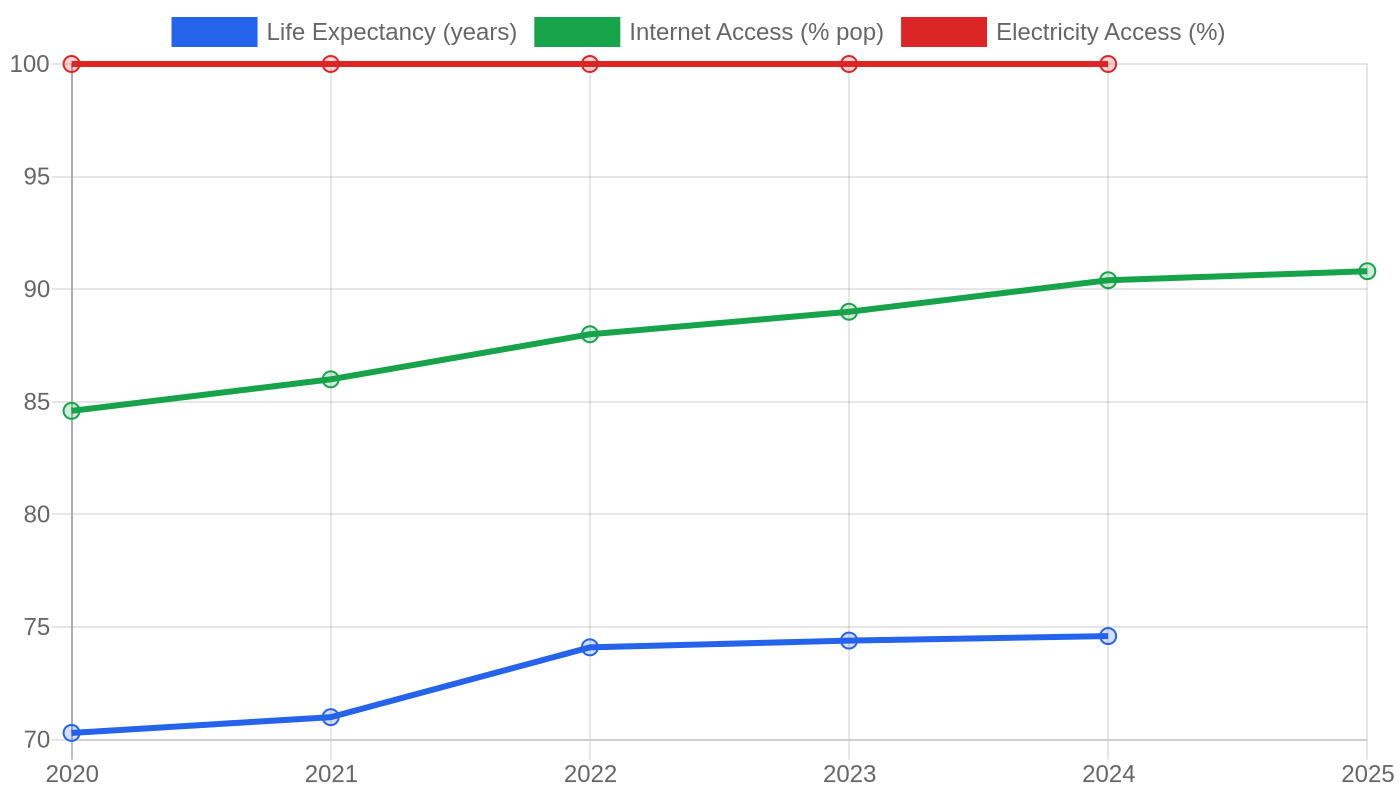
The macroeconomic picture of Azerbaijan presents a paradox of strategic importance obscured by a lack of transparent data. According to the World Bank, key metrics including GDP growth, inflation CPI, unemployment rates, and total GDP in USD are listed as N/A, leaving analysts without standard quantitative benchmarks to assess the health of the economy. This absence of official statistics makes it difficult to determine whether the nation is experiencing expansion or contraction in real-time terms.
Without figures for GDP per capita in PPP or GNI per capita, assessing the actual wealth distribution among the population remains a challenge. Furthermore, the population size is also recorded as N/A, complicating any per-capita analysis of resource allocation or market potential. In an environment where hard numbers are missing, the structure of the economy becomes the primary lens through which performance must be judged.
Investors must therefore rely on qualitative assessments of industrial output and corporate stability rather than traditional macroeconomic trends. The lack of data itself signals a potential opacity that could pose risks for foreign capital seeking predictable regulatory environments.
Cost of Living: The Unmeasured Daily Reality
While specific consumer price indices are unavailable, the cost of living in Azerbaijan is shaped heavily by its status as a hydrocarbon-rich nation with limited domestic manufacturing diversity. The absence of CPI data means that fluctuations in the price of essential goods are not tracked through standard international reporting channels, making budgeting for expatriates or researchers difficult.
Housing costs and rent prices are likely influenced by the concentration of wealth in Baku, though precise comparisons to regional averages cannot be made without underlying income data. Daily expenses for food and services are presumably tied to local production capabilities and import dependencies, but without inflation figures, the pace of these changes is unknown. Consumers may face volatility in purchasing power if currency stability is not maintained, yet this dynamic is invisible in current public datasets.
The general affordability of life outside major urban centers remains a variable that requires on-the-ground verification rather than statistical inference. Ultimately, the lack of cost-of-living metrics suggests that residents operate in a market where price signals are less transparent than in more developed economies.
Investment & Business Climate: A Corporate Hierarchy
The business landscape is defined by a handful of dominant players that control critical infrastructure and services, suggesting a highly centralized economic model. Leading enterprises include Azerbaijan Caspian Shipping Company and Azerbaijan Railways, both categorized under Industrials, highlighting the strategic importance of logistics and transport networks. The financial sector is anchored by AccessBank Azerbaijan and AtaBank, indicating a banking system that supports large-scale commercial activities.
Consumer services are represented by Medeniyyet TV, AF Hotel Group, and ANS Group of Companies, pointing to a growing focus on media and tourism within the private sphere. Industrial construction is managed by entities like Akkord Industry Construction Investment Corporation, while utilities are handled by Azersu Open Joint Stock Company, ensuring state oversight of basic resources.
AF Holding operates as a conglomerate, reflecting a business culture where diversified holdings play a central role in the national economy. For foreign investors, entering this market means navigating relationships with these established giants rather than competing in a fragmented competitive field. The dominance of these specific firms implies that policy decisions often align with the interests of these large-scale operators.
Safety, Politics & Quality of Life: Governance Under Scrutiny
Azerbaijan’s political environment is characterized by long-standing authoritarian governance that significantly impacts social stability and civil liberties. The government has been ruled continuously since 1993 by the Aliyev political family and the New Azerbaijan Party (Yeni Azərbaycan Partiyası, YAP), which was established by Heydar Aliyev. Although regular elections are held, they are widely reported to be marred by electoral fraud and other unfair practices, undermining democratic legitimacy.
Freedom House categorizes the country as “not free,” assigning it a dismal rank of 7/100 on its Global Freedom index, which reflects severe restrictions on political participation. Crime and safety indices are currently listed as N/A, meaning there is no standardized metric to gauge the physical security of residents or visitors from international databases.
This lack of safety data, combined with the political climate, suggests that quality of life is heavily dependent on one’s relationship with the ruling establishment. Civil society operates under tight constraints, limiting the ability of citizens to influence policy or express dissent openly. The political risk premium for operating in such an environment is high, given the lack of institutional checks and balances.
What’s Happening Now: The Entrenched Status Quo
Current affairs in Azerbaijan are dominated by the consolidation of power rather than transformative reform or sudden economic shifts. The political narrative remains fixed on the continuity of the Aliyev administration, with no significant opposition movements gaining traction in the public sphere. Recent analyses emphasize the gap between the formal existence of elections and the substantive reality of democratic choice, as noted by international watchdogs.
There are no recent news items indicating major policy reversals, new trade agreements, or sudden spikes in inflation, suggesting a period of stable but rigid control. The business sector continues to function within the existing framework, with major companies like AF Holding and Azerbaijan Railways maintaining their operational roles without disruption. Any developments in the region are likely filtered through the lens of state-controlled media, such as Medeniyyet TV and ANS Group, which shape public perception.
The absence of live economic indicators means that “what is happening now” is best understood as a continuation of the past decade’s political trajectory. Stability is guaranteed by authority, but at the cost of transparency and pluralism.
The Bottom Line
Azerbaijan offers a unique case study in how resource wealth and political control can sustain a regime despite a lack of economic transparency. It is a country where investment opportunities exist primarily within established, state-aligned corridors rather than open markets. Observers should watch this nation not for rapid growth or liberalization, but for signs of internal pressure or external geopolitical shifts that might test the durability of the current system.
For businesses, the key takeaway is the necessity of navigating a closed ecosystem dominated by a few powerful conglomerates.
Sources & Methodology
This article is authored by Economic Pulse Net for informational and research purposes. Economic Pulse Net sources its data from multilateral institutions, national statistics bureaus, and proprietary databases. All data is believed to be current as of the date of publication.
Published: October 10, 2026 | Category: Research — Azerbaijan
Use these signals in your own platform
Economic Pulse publishes its live signal feed through a documented, read-only API. Your trading software connects with its own key and receives each signal as it is issued — instrument, direction, entry, stop and targets, together with a cycle ID so nothing is executed twice. The feed is independent of this website and cannot change it.
Signals are informational only and are not financial advice.