Economic Pulse Net | Sources: World Bank World Development Indicators, Government Sources | 2026
Key Takeaways
* Austria’s economy is experiencing a period of modest stagnation, with GDP growth projected at just 0.61% for 2025, reflecting broader European headwinds.
Despite slow growth, the country maintains a high standard of living, supported by a robust GDP per capita (PPP) of approximately $76,778 and a strong labor market with unemployment below 6%.
The industrial and technology sectors remain pillars of economic strength, anchored by global leaders like Andritz, ams AG, and AHT Cooling Systems.
Political stability is entrenched within a federal democratic framework established in 1945, providing a predictable environment for long-term investment.
Inflation remains a persistent challenge at 3.5%, slightly above typical central bank targets, impacting consumer purchasing power despite high income levels.
Economic Performance: Navigating Slow Growth
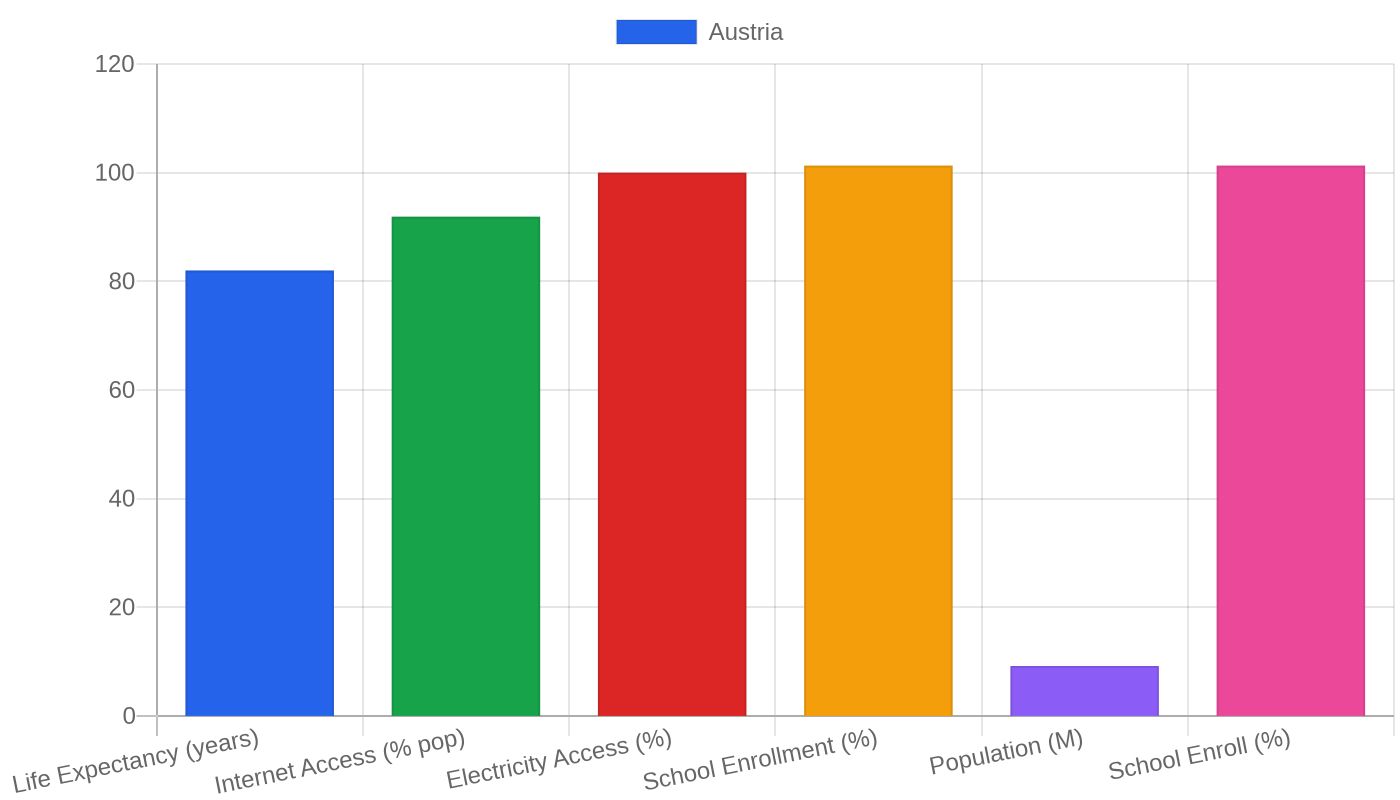
Austria’s economic trajectory in 2025 presents a nuanced picture of resilience amidst sluggish expansion. According to World Bank data, the nation’s GDP growth is projected at a mere 0.6157%, indicating an economy that has largely plateaued rather than surged forward. This near-stagnant growth rate suggests that domestic consumption and external demand are currently balanced at a low-energy equilibrium.
However, the underlying wealth of the nation remains substantial; the total GDP stands at roughly $579.47 billion USD, underscoring the sheer scale of its economic output relative to its population. More telling than the headline growth figure is the prosperity of the average citizen, with GDP per capita measured in Purchasing Power Parity (PPP) reaching $76,777.54.
This high per-capita metric highlights that while the aggregate engine may be idling, individual productivity and value creation remain elite by global standards. Furthermore, the Gross National Income (GNI) per capita of $60,360 reinforces the narrative of a wealthy, developed economy where household income closely tracks national production. With a population of 9.2 million, the density of this wealth creates a formidable internal market for high-value goods and services.
Cost of Living and Daily Expenses
For residents and expatriates alike, the cost of living in Austria is shaped by its status as a high-income European hub. While specific housing indices are not detailed in the current dataset, the high GNI per capita implies that daily expenses, from groceries to utilities, are calibrated to support a premium quality of life. The inflation rate, recorded at 3.527%, serves as a critical pressure point for household budgets, eroding some of the gains from high wages.
This level of inflation suggests that while prices are rising, they are doing so at a manageable pace compared to more volatile emerging markets. Consumers can expect a stable but increasingly expensive environment for discretionary spending. The interplay between the high cost of living and the robust GDP per capita means that Austrians generally retain significant disposable income after essential needs are met.
This dynamic supports a vibrant retail sector, particularly in consumer goods, which remains a dominant industry within the national portfolio.
Investment & Business Climate
The Austrian business landscape is characterized by a blend of traditional industrial strength and modern technological innovation. Investors should look closely at the top companies driving this dual engine. In the industrials sector, giants like Andritz and AHT Cooling Systems provide critical infrastructure and engineering solutions globally, signaling strong export potential.
The technology sector is equally compelling, with firms such as ams AG and AT&S leading in sensor technology and printed circuit board manufacturing, areas crucial for the future of automotive and electronics supply chains. Consumer goods also play a pivotal role, with established brands like Agrana, Atomic Skis, and Ammerer Bed Company leveraging Austria’s reputation for quality craftsmanship.
These entities demonstrate that the country is not reliant on a single industry but possesses a diversified corporate base. For foreign investors, the presence of these multinational players indicates a mature regulatory environment and a skilled workforce capable of supporting high-tech and high-quality manufacturing operations. The concentration of such diverse top-tier companies suggests a healthy ecosystem for partnerships and joint ventures.
Safety, Politics & Quality of Life
Political stability forms the bedrock of Austria’s appeal as a place to live and do business. The country operates as a federal, representative democratic republic, a system rooted in the Federal Constitutional Law of 1920 and re-enacted in 1945. This enduring political framework, centered in Vienna, provides a predictable legal environment that reduces political risk for stakeholders.
The capital city of Vienna serves as both the political heart and the most populous urban center, concentrating administrative and cultural resources. While specific crime and safety indices are listed as N/A in the provided data, the structural integrity of the state and the high standard of living imply a society with low social friction. The nine-state federal structure allows for regional autonomy while maintaining national cohesion, fostering a sense of local identity alongside national unity.
This political maturity contributes to a high quality of life, attracting talent and capital seeking a secure, orderly environment.
What’s Happening Now: Current Affairs and Outlook
The current economic narrative in Austria is defined by cautious management of inflationary pressures and steady industrial output. With inflation holding at 3.527%, policymakers and businesses are likely focused on stabilizing prices without stifling the fragile 0.61% growth momentum. The labor market remains a bright spot, with unemployment sitting at a healthy 5.582%, suggesting that businesses are retaining staff despite the slow growth.
This employment stability supports consumer confidence, even as prices rise. The focus for the immediate future appears to be on maintaining the competitiveness of key sectors like technology and industrials against global rivals. As the world economy navigates post-pandemic adjustments, Austria’s reliance on high-value exports through companies like Andritz and ams AG positions it well to capture international demand.
Stakeholders should watch for any shifts in EU-wide trade policies that could impact these export-heavy industries. The steady political handover and constitutional continuity ensure that policy shifts will be gradual and deliberate, avoiding the shocks seen in less stable regions.
The Bottom Line
Austria is a destination for investors and professionals seeking stability, high income, and political security over rapid, speculative growth. The combination of a nearly $77,000 PPP GDP per capita and a diversified industrial base makes it a resilient market. Those looking for safe-haven assets or long-term partnerships in engineering and technology will find ample opportunity here. It is a country that rewards patience and values consistency, offering a premium lifestyle backed by solid economic fundamentals.
Sources & Methodology
This article is authored by Economic Pulse Net for informational and research purposes. Economic Pulse Net sources its data from multilateral institutions, national statistics bureaus, and proprietary databases. All data is believed to be current as of the date of publication.
Published: September 29, 2026 | Category: Research — Austria
Use these signals in your own platform
Economic Pulse publishes its live signal feed through a documented, read-only API. Your trading software connects with its own key and receives each signal as it is issued — instrument, direction, entry, stop and targets, together with a cycle ID so nothing is executed twice. The feed is independent of this website and cannot change it.
Signals are informational only and are not financial advice.