Economic Pulse Net | Sources: World Bank World Development Indicators, Government Sources | 2026
Key Takeaways
* Growth is Stalling: According to World Bank data, Austria’s GDP growth is projected at a mere 0.62% for 2025, signaling a period of economic stagnation rather than recession.
Inflation Persists: The Consumer Price Index (CPI) stands at 3.53%, indicating that the cost of living remains elevated despite the slowdown in economic activity.
High Value Economy: With a GDP per capita (PPP) of approximately $76,777, Austria remains one of the wealthiest nations in the world, driven by high-value industries and strong purchasing power.
Labor Market Resilience: Unemployment sits at 5.58%, a figure that, while not at historic lows, demonstrates a labor market that is holding up better than the sluggish GDP growth might suggest.
Industrial Diversity: The corporate landscape is dominated by a mix of consumer goods giants and advanced industrial technology firms, providing a buffer against sector-specific shocks.
The Economics of Stagnation: A Decelerating Giant
The macroeconomic picture for Austria in 2025 is one of cautious preservation rather than dynamic expansion. According to the World Bank, the country’s Gross Domestic Product (GDP) is valued at approximately $579.47 billion, a testament to its robust industrial base and service sector. However, the momentum behind this economic engine is fading, with GDP growth projected at just 0.615747280959056% for the current year.
This near-zero growth rate suggests that the Austrian economy is effectively flatlining, struggling to find new drivers of demand in a challenging global environment. The implication for policymakers is significant: without a substantial boost in productivity or demand, the economy risks drifting into a prolonged period of low growth that could erode public confidence and tax revenues.
While the growth rate is modest, the underlying structure of the economy remains exceptionally strong. The World Bank reports a GDP per capita (PPP) of $76,777.54, placing Austria firmly in the elite tier of global economies. This high level of purchasing power means that despite the slow growth, the standard of living for the average Austrian remains exceptionally high compared to global averages.
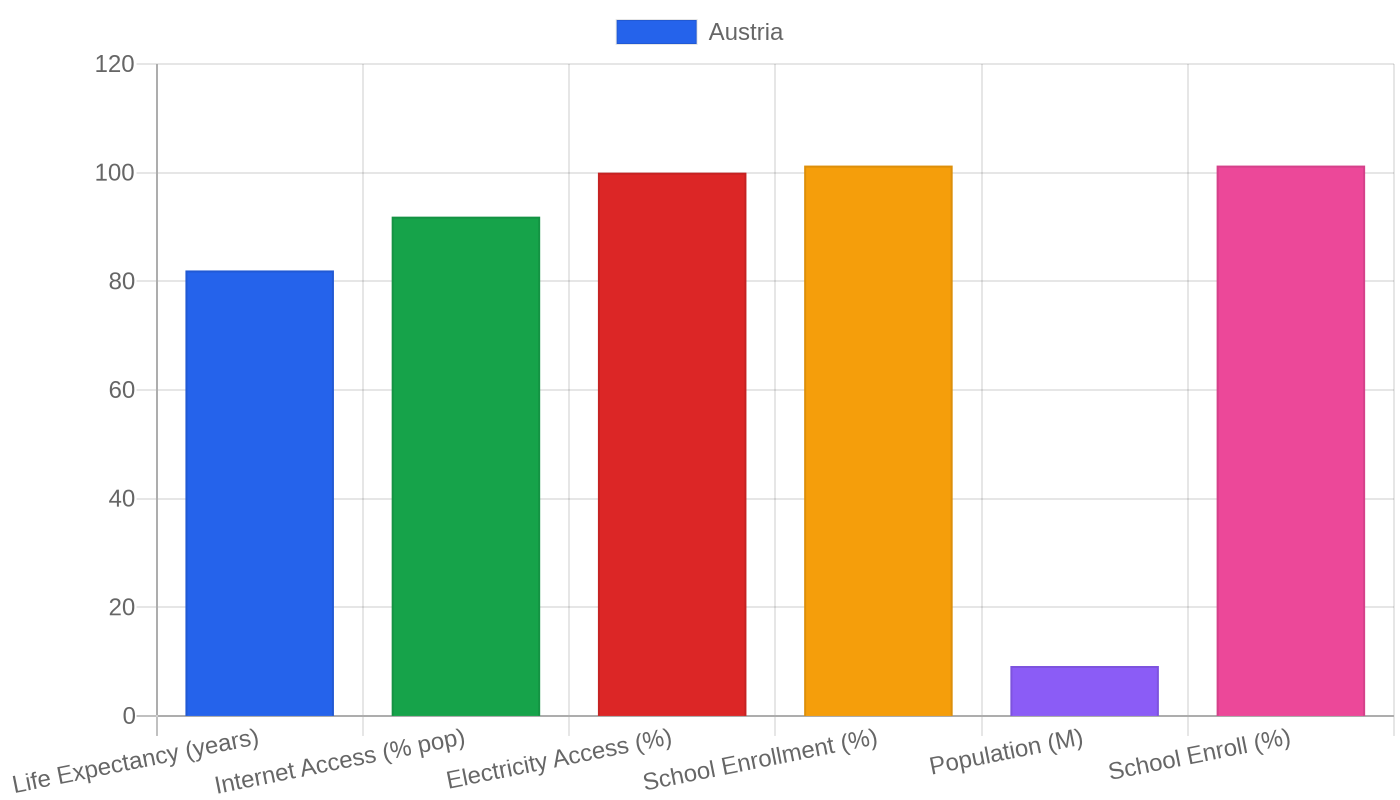
The Gross National Income (GNI) per capita, listed at $60,360.00, further underscores the high income levels supported by a relatively small population of 9,208,163. This demographic compactness allows for concentrated economic activity, particularly in the capital, Vienna, which acts as the primary hub for both political and commercial power.
The labor market provides a counter-narrative to the sluggish GDP figures. With an unemployment rate of 5.582%, the job market has not collapsed in line with the slowing economic output. This suggests that while companies may be expanding at a slower pace, they are not engaging in mass layoffs, indicating a degree of structural resilience in the workforce. However, the persistence of inflation at 3.52719439956928% complicates the picture.
For the average worker, this means that wage growth must keep pace with rising prices to maintain real income. If wages do not rise at this rate, the high GDP per capita figures become less meaningful in day-to-day terms, as the cost of basic necessities erodes purchasing power. The challenge for the Austrian economy is to break this cycle of low growth and sticky inflation, a task that requires careful monetary and fiscal policy coordination.
The Price of Stability: Living Costs in a High-Income Nation
For residents and potential expatriates, the headline GDP figures translate into a very specific quality of life that is both premium and expensive. While specific housing cost data is not detailed in the provided metrics, the high GDP per capita of nearly $77,000 implies that the cost of living, particularly in urban centers like Vienna, is among the highest in Central Europe. The inflation rate of 3.53% serves as a key indicator of current spending pressure.
This level of inflation means that daily expenses, from groceries to utilities, are rising at a pace that requires active budget management for households. It is a significant departure from the low-inflation environments often associated with stable European economies, suggesting that supply chain issues or energy costs continue to exert upward pressure on prices.
The disparity between nominal income and real cost of living is a critical factor for anyone considering a move to Austria. A salary that looks impressive on paper must be adjusted for the 3.5% annual increase in the cost of goods and services. In a country with a population of over 9.2 million, competition for housing in the capital is likely intense, driving up rental and purchase prices.
While the data does not provide specific rent-to-buy ratios, the high GNI per capita of $60,360 suggests that the majority of the population has the financial means to absorb these costs, provided their income is aligned with the national average. However, for lower-income earners, the combination of stagnant growth and persistent inflation creates a squeeze on disposable income, making everyday financial planning more complex.
The economic stability of Austria also means that the cost of living is less volatile than in emerging markets, but it is not immune to global shocks. The 3.5% inflation rate indicates that the economy is still adjusting to post-pandemic and geopolitical supply chain disruptions. For businesses and individuals, this translates to a need for financial prudence. Savings rates may need to be higher to offset the erosion of value, and long-term financial planning must account for a higher baseline cost of living.
The high standard of living, reflected in the per capita figures, comes with the responsibility of managing a household budget in an environment where prices are not falling, making fiscal discipline a key component of maintaining quality of life in Austria.
Industrial Powerhouses: The Corporate Backbone of the Economy
Austria’s economic resilience is heavily underpinned by a diverse and sophisticated corporate sector that spans from consumer goods to high-tech industrial solutions. The list of top companies reveals a nation that is not just a financial hub but a center of manufacturing and innovation. In the consumer goods sector, brands like A. Darbo, Agrana, and AKG are household names, providing essential products and contributing significantly to domestic demand.
Agrana, in particular, is a major player in the food and beverage industry, reflecting Austria’s strength in agricultural processing and export-oriented manufacturing. These companies ensure a steady flow of employment and contribute to the stable unemployment rate of 5.58%.
The industrial sector is equally formidable, with companies like Andritz, ATP, and AHT Cooling Systems representing the heart of Austrian engineering. Andritz is a global leader in machinery and process technology, while ATP and AHT Cooling Systems focus on specialized industrial applications. This concentration in industrials highlights Austria’s role as a key supplier of high-value machinery and technology to the rest of Europe and beyond.
The presence of these firms means that the economy is less dependent on volatile service sectors and more anchored in tangible production and export capabilities. This industrial base provides a buffer against economic downturns, as the demand for industrial machinery and technology tends to be more consistent than consumer discretionary spending.
Technology is another pillar of the Austrian corporate landscape, with firms like ams AG and AT&S leading the way. ams AG is a significant player in the sensor and technology industry, while AT&S specializes in printed circuit boards, a critical component of the global electronics supply chain. These companies position Austria at the forefront of the digital and technological revolution, ensuring that the economy is not left behind in the transition to high-tech manufacturing.
The diversity of these top companies—ranging from consumer goods to advanced industrials and technology—creates a balanced corporate ecosystem. This diversification is crucial for risk management, as it ensures that a downturn in one sector, such as consumer goods, can be offset by strength in another, like industrial technology.
The result is a business environment that is both competitive and resilient, capable of adapting to changing global market conditions while maintaining high standards of production and innovation.
Governance and Safety: The Political Foundation of Prosperity
The stability of Austria’s economy is closely tied to its political framework, which has been a cornerstone of social and economic policy since the mid-20th century. Austria is a federal, representative democratic republic, a structure established through the Federal Constitutional Law of 1920 and re-enacted on 1 May 1945. This political system, known as the Second Republic, is based on a constitution that has been amended over time, most notably in 1929, to reflect the evolving needs of the state.
The country is divided into nine states, each with its own level of autonomy, which allows for localized policy-making while maintaining national cohesion. This federal structure ensures that regional interests are represented in the political process, contributing to a balanced approach to governance.
The Parliament of Austria is located in Vienna, the country’s capital and most populous city, which serves as the center of political power and economic activity. The location of the Parliament in Vienna underscores the centralization of political influence, even within a federal system. This concentration of power facilitates efficient decision-making and policy implementation, which is crucial for maintaining economic stability.
The political landscape is characterized by a tradition of consensus-building, which has historically helped to manage social conflicts and ensure smooth economic transitions. While specific crime and safety indices are not provided in the data, the political stability and high level of governance are strong indicators of a safe and secure environment for residents and businesses.
The quality of life in Austria is further enhanced by the strong social safety net and public services that are supported by the stable political system. The high GDP per capita and GNI per capita figures reflect not just individual wealth but also the collective prosperity of the nation, which is distributed through social programs and public investments. The political commitment to maintaining high standards of living is evident in the country’s approach to labor markets, education, and healthcare.
This holistic view of governance ensures that the benefits of economic growth are widely shared, contributing to a high level of social cohesion and public trust. The absence of significant political instability or social unrest is a key factor in Austria’s appeal as a place to live and do business, providing a predictable and secure environment for long-term planning and investment.
The Current Reality: Navigating the 2025 Slowdown
The current economic climate in Austria is defined by a delicate balance between high income levels and slowing growth. The World Bank’s projection of 0.62% GDP growth for 2025 is a stark reminder that the easy gains of previous decades are no longer available. This slowdown is not a sudden collapse but a gradual deceleration, likely driven by global economic headwinds and domestic structural challenges.
The persistence of inflation at 3.53% adds a layer of complexity, as it erodes the real value of the high nominal incomes that Austrians enjoy. Businesses are likely to be focusing on cost management and efficiency, rather than aggressive expansion, as they navigate this uncertain environment.
The labor market’s resilience, with unemployment at 5.58%, is a silver lining in an otherwise challenging economic picture. It suggests that the workforce is still engaged and productive, even if the overall economy is not growing rapidly. However, this stability could be tested if the low growth persists, potentially leading to tighter labor markets and wage pressures.
Companies in the industrial and technology sectors, such as Andritz and ams AG, may be better positioned to weather the storm due to their global reach and high-value offerings. In contrast, consumer goods companies may face more pressure as discretionary spending slows.
The political landscape, with its federal structure and stable parliamentary system, provides a framework for addressing these challenges. The government in Vienna is likely to be focused on policies that stimulate growth while controlling inflation, a difficult task that requires careful calibration. The re-enacted constitution of 1945 continues to serve as a stable foundation for these efforts, ensuring that policy changes are made through democratic processes.
The current affairs in Austria are thus a story of adaptation, as the country seeks to maintain its high standard of living in a period of economic stagnation. The focus will be on innovation, efficiency, and social cohesion, as Austria navigates the complexities of the 2025 economic landscape.
The Bottom Line
Austria in 2025 is a country of contradictions: it is wealthy yet stagnant, innovative yet cautious, and stable yet facing inflationary pressures. For investors and professionals, the key takeaway is that while the growth rate is low, the quality of the economy is high. The high GDP per capita and strong industrial base make it a resilient destination, but the 3.5% inflation rate and 0.6% growth rate require a careful approach to financial planning and business strategy.
Those who value stability, high purchasing power, and a strong industrial ecosystem should watch Austria closely. It is not a market for quick gains, but for long-term value, where the fundamentals remain strong despite the current headwinds. The country’s political stability and diverse corporate sector provide a solid foundation for navigating the economic challenges of the coming years.
Sources & Methodology
This article is authored by Economic Pulse Net for informational and research purposes. Economic Pulse Net sources its data from multilateral institutions, national statistics bureaus, and proprietary databases. All data is believed to be current as of the date of publication.
Published: September 09, 2026 | Category: Research — Austria
Use these signals in your own platform
Economic Pulse publishes its live signal feed through a documented, read-only API. Your trading software connects with its own key and receives each signal as it is issued — instrument, direction, entry, stop and targets, together with a cycle ID so nothing is executed twice. The feed is independent of this website and cannot change it.
Signals are informational only and are not financial advice.