Economic Pulse Net | Sources: World Bank World Development Indicators, Government Sources | 2026
Key Takeaways
– Andorra’s unique political system—a parliamentary diarchy with the Bishop of Urgell and the President of France serving as co-princes—creates a governance structure unlike any other in the world, blending medieval tradition with modern democratic institutions.
– The economy is dominated by financial services, with five of the seven top companies operating in banking and wealth management, positioning Andorra as a discreet European financial hub.
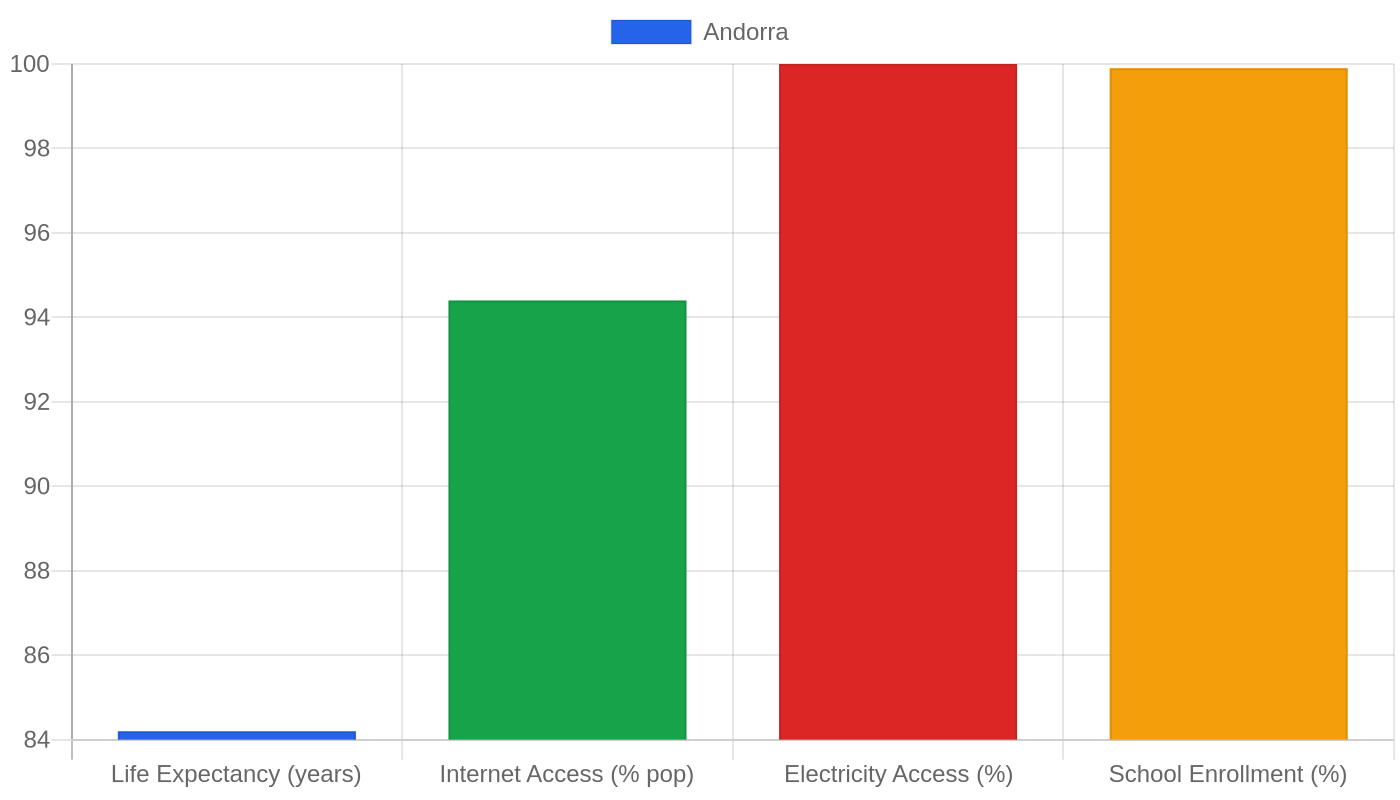
– Despite the absence of recent World Bank economic data, Andorra’s high concentration of private banks and telecommunications infrastructure suggests a service-oriented economy with significant cross-border financial activity.
– The country operates as a unitary parliamentary representative democracy with a unicameral legislature and multi-party system, providing political stability that underpins its appeal to international investors and residents.
– Andorra’s consumer services sector, anchored by Grans Magatzems Pyrénées and PGI Management, indicates a retail and tourism economy that serves both local residents and visitors from neighboring France and Spain.
The Invisible Economy — Banking, Borders, and Balance Sheets
Andorra presents a fascinating puzzle for economic analysts: the World Bank provides no recent data on GDP growth, inflation, unemployment, GDP, GDP per capita, GNI per capita, or even population. This absence of conventional metrics is itself revealing. The Principality of Andorra has historically operated as a low-tax jurisdiction and banking haven nestled in the Pyrenees between France and Spain, and its economic profile has long been built on discretion rather than transparency.
The available data tells a story through corporate structure rather than macroeconomic aggregates. Andorra’s top companies are overwhelmingly financial institutions: Andbank, Banca Privada d’Andorra, Crèdit Andorrà, and Mora Banc Grup dominate the corporate landscape. This concentration suggests a sophisticated financial services sector that manages substantial cross-border wealth.
Andorra Telecom, the state-owned telecommunications provider, represents the only non-financial infrastructure company among the top seven, indicating that digital connectivity is considered a strategic national asset.
The consumer services sector, represented by Grans Magatzems Pyrénées and PGI Management, points to a retail and lifestyle economy that serves both the resident population and the millions of tourists who visit annually for skiing, shopping, and tax-free goods. Andorra’s position as a duty-free destination has historically driven retail activity, with Pyrénées department stores acting as a regional shopping destination for French and Spanish consumers.
Without World Bank data, analysts must look to the corporate registry and sectoral composition to understand economic activity. The dominance of banking suggests that Andorra’s economy is less about production and more about asset management, wealth preservation, and service provision.
This makes the country’s economic health heavily dependent on European financial regulations, international tax transparency agreements, and the confidence of wealthy clients who choose Andorra for its stability and discretion.
The Price of Paradise — Living in Europe’s Most Discreet Tax Haven
Cost of living data for Andorra is not provided in the available information, but the country’s economic structure offers clues about daily expenses. As a high-altitude microstate with limited agricultural land and a reliance on imports, basic goods in Andorra typically carry a premium compared to neighboring Spain and France. However, the absence of VAT and significantly lower income taxes create a counterbalancing effect that makes overall living costs competitive for high-income earners.
Housing in Andorra presents a particular challenge. The country’s mountainous terrain limits available land for development, and demand from wealthy newcomers seeking residency has pushed property prices upward in recent years. The rental market is tight, particularly in the parishes of Andorra la Vella and Escaldes-Engordany, where most economic activity is concentrated. Buying property remains the preferred option for long-term residents, but entry costs are substantial compared to regional averages.
Daily expenses for food, transportation, and utilities tend to run higher than in Spanish border towns like La Seu d’Urgell, reflecting the costs of importing goods into a landlocked microstate. However, the absence of sales tax on many items partially offsets these premiums. For those working in Andorra’s financial sector or running businesses that benefit from the favorable tax regime, the cost of living is easily absorbed by higher disposable incomes.
For service workers and those outside the banking industry, the equation is considerably more challenging.
Banking on the Future — Investment Climate in a Financial Fortress
Andorra’s investment climate is defined by its corporate DNA. The seven largest companies in the country are overwhelmingly financial institutions, with Andbank, Banca Privada d’Andorra, Crèdit Andorrà, and Mora Banc Grup forming the core of the economy. This concentration creates both opportunity and vulnerability for investors.
The financial sector is highly regulated, with Andorra having moved toward greater international transparency in recent years to comply with OECD standards and avoid being placed on tax haven blacklists.
The business environment in Andorra is characterized by low corporate taxes, a stable political system, and a regulatory framework designed to attract international capital. The country’s unique political structure—with the Bishop of Urgell and the President of France serving as co-princes—provides a layer of constitutional stability that few other jurisdictions can match.
Investors benefit from the protection of both Spanish and French diplomatic interests, while the Andorran government maintains independent control over economic policy.
Sectors to watch beyond banking include telecommunications, where Andorra Telecom holds a strategic monopoly, and consumer services, led by Grans Magatzems Pyrénées. The retail sector benefits from duty-free shopping that attracts millions of visitors annually. PGI Management, listed among top companies in consumer services, suggests a growing professional services and management consulting industry that supports the broader economy.
For international investors, Andorra offers access to the European market without full EU membership, allowing the country to maintain its own tax and regulatory policies while benefiting from proximity to France and Spain. The challenge for investors lies in the limited size of the domestic market and the heavy reliance on financial services, which makes the economy sensitive to changes in international banking regulations and tax transparency requirements.
Safety in Seclusion — Politics and Quality of Life in the Pyrenees
Crime and safety indices are not available in the provided data, but Andorra’s reputation as one of Europe’s safest countries is well-established through its low crime rates and stable social environment. The absence of major urban centers, combined with a close-knit population and effective policing, creates conditions for a high quality of life that attracts both wealthy residents and tourists seeking security.
The political landscape of Andorra is genuinely unique in the modern world. The country operates as a unitary co-principality governed as a parliamentary constitutional diarchy. This means the Bishop of Urgell and the President of France serve as joint heads of state, making the French president—currently Emmanuel Macron—an elected monarch in his capacity as Prince of Andorra.
This peculiar arrangement means the co-prince is elected by the French people, not by Andorrans, creating a fascinating constitutional anomaly.
The politics of Andorra take place within a framework of parliamentary representative democracy with a unicameral legislature and a multi-party system. The General Council, Andorra’s parliament, is elected by popular vote and forms the government. This democratic structure coexists with the medieval tradition of co-princes, creating a hybrid system that has proven remarkably stable.
The multi-party system ensures representation of diverse interests, from urban professionals in Andorra la Vella to rural communities in the mountain parishes.
Quality of life in Andorra is enhanced by the natural environment—the Pyrenees mountains provide opportunities for skiing, hiking, and outdoor recreation—and by the country’s low population density. The absence of major industrial pollution, combined with clean mountain air and excellent healthcare facilities, contributes to high life expectancy.
The social fabric is strengthened by a strong sense of national identity and the preservation of Catalan as the official language, which connects Andorra culturally to the broader Catalan-speaking regions of Spain and France.
The Transparency Tightrope — Andorra’s Balancing Act in 2026
The most pressing current affairs issue for Andorra revolves around the tension between its historical role as a discreet banking jurisdiction and the international pressure for financial transparency. In recent years, Andorra has signed tax information exchange agreements with multiple countries and has worked to remove itself from various tax haven lists. This process of opening up while maintaining the confidentiality that attracts wealthy clients represents the central policy challenge of the current era.
Andorra’s financial institutions, led by Andbank and Crèdit Andorrà, have been adapting to new international standards while trying to preserve the competitive advantages that have made the country a wealth management destination. The European Union’s ongoing efforts to harmonize tax policies and combat money laundering create a regulatory environment that Andorra must navigate carefully, balancing compliance with the preservation of its economic model.
The tourism sector, anchored by retail through Grans Magatzems Pyrénées and winter sports, continues to be a significant economic driver. However, changing travel patterns and the growth of online shopping have put pressure on the traditional duty-free retail model. Andorra’s government is exploring diversification strategies, including attracting digital nomads and remote workers who can take advantage of the country’s low taxes and high quality of life.
The political stability provided by the co-principality system continues to serve Andorra well, but questions about succession and the future of the relationship with France remain in the background. As European politics evolve, the unique position of the French president as a foreign head of state for a sovereign microstate may face new scrutiny or require modernization.
The Bottom Line
Andorra deserves attention from investors and analysts who understand that small economies can offer outsized opportunities. The country’s combination of political stability, low taxation, and a sophisticated financial sector makes it an attractive jurisdiction for wealth management and lifestyle investment. However, the heavy reliance on banking and the ongoing pressure for financial transparency mean that Andorra must continue to adapt or risk losing the very advantages that have sustained its prosperity.
For those watching European microstates, Andorra remains the most intriguing case study in how tradition and modernity can coexist in economic policy.
Sources & Methodology
This article is authored by Economic Pulse Net for informational and research purposes. Economic Pulse Net sources its data from multilateral institutions, national statistics bureaus, and proprietary databases. All data is believed to be current as of the date of publication.
Published: July 17, 2026 | Category: Research — Andorra
Use these signals in your own platform
Economic Pulse publishes its live signal feed through a documented, read-only API. Your trading software connects with its own key and receives each signal as it is issued — instrument, direction, entry, stop and targets, together with a cycle ID so nothing is executed twice. The feed is independent of this website and cannot change it.
Signals are informational only and are not financial advice.