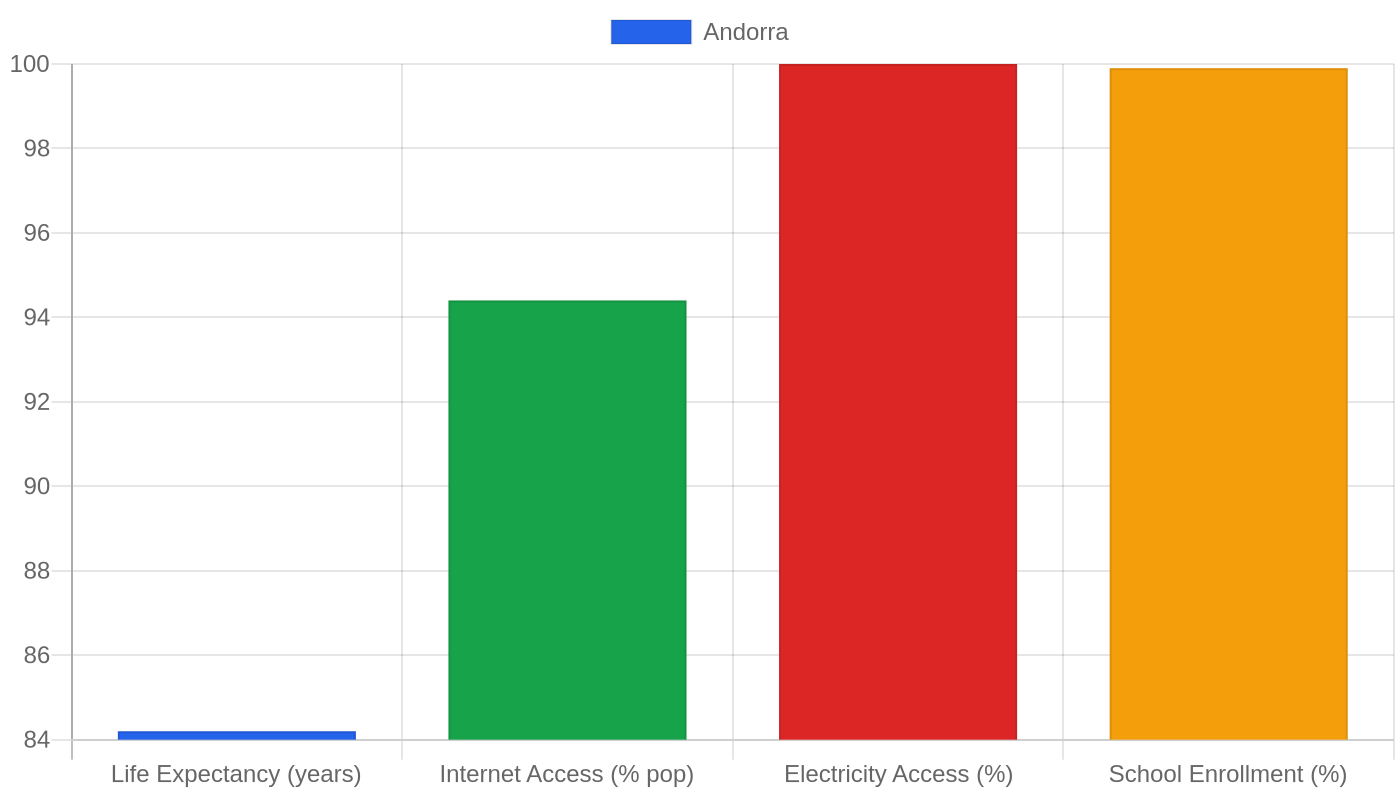
Economic Pulse Net | Sources: World Bank World Development Indicators, Government Sources | 2026
Nestled high in the Pyrenees between France and Spain, Andorra has long been known as a tax haven ski destination and duty-free shopping paradise. But beneath the alpine postcard surface, this parliamentary co-principality is navigating a delicate transformation.
With a political system unique on the global stage—where the Bishop of Urgell and the President of France serve jointly as co-princes—Andorra is working to modernize its economy, diversify beyond tourism and banking, and cement its place in the European financial ecosystem. The story of Andorra today is one of a microstate leveraging its stability and strategic location to punch far above its weight class.
Key Takeaways
– Unique Governance: Andorra operates under a 1993 Constitution establishing a parliamentary co-principality, with the Bishop of Urgell and the French President serving as joint heads of state with equal constitutional powers.
– Financial Sector Dominance: The economy is anchored by a powerful private banking cluster, with six of the country’s seven largest companies operating in financial services.
– Sovereignty Shift: The 1993 Constitution marked a historic transition, vesting sovereignty in the Andorran people rather than in feudal lords—a fundamental reshaping of the nation’s political DNA.
– Services-Led Economy: Beyond finance, telecommunications and consumer services form the backbone of a highly developed services economy.
– Stability as Currency: With a political system designed for consensus and arbitration, Andorra offers a case study in how small states leverage institutional stability for economic resilience.
Banking on the Mountain: The Anatomy of a Services Economy
The most striking feature of Andorra’s economic landscape is the sheer dominance of its financial sector. Of the seven top companies operating in the principality, six are financial institutions—Andbank, Banca Privada d’Andorra, Crèdit Andorrà, Mora Banc Grup, and their peers form a dense cluster of private banking operations that would be remarkable for any country, let alone one with a population that would fit inside a medium-sized European city.
This concentration tells a clear story: Andorra has built its modern prosperity on the twin pillars of private banking and financial services.
The World Bank data for Andorra shows GDP growth, inflation, unemployment, and per capita income figures as not available, which is itself a reflection of the challenges in tracking a microstate’s economy through standard international metrics. However, the composition of the corporate landscape offers its own economic narrative.
Andorra Telecom, the state-owned telecommunications provider, represents the critical infrastructure backbone, while Grans Magatzems Pyrénées and PGI Management anchor the consumer services sector. This mix suggests an economy that has evolved from its historical reliance on duty-free retail and winter tourism into a more sophisticated, services-oriented model.
The absence of heavy industry or manufacturing among the top companies underscores Andorra’s strategic choice to focus on high-value services rather than goods production. For a landlocked microstate with limited physical resources, this is a rational adaptation to geographic constraints.
The financial sector’s predominance also explains Andorra’s longstanding reputation as a private banking haven—though the country has been working to shed the more controversial aspects of that reputation in favor of a regulated, transparent financial center.
The Price of Paradise: Cost of Living in the Principality
Living in Andorra means accepting a premium for the privilege of alpine living. While specific housing cost data is not available in the World Bank figures, the economic structure of the country—with its heavy concentration of high-margin financial services and its geographic isolation—strongly suggests a cost of living that runs above the Spanish and French regional averages.
The presence of Grans Magatzems Pyrénées as a major consumer services company indicates a retail sector catering to both local residents and cross-border shoppers drawn by the principality’s historic duty-free status.
The housing market in Andorra is constrained by simple geography: the country occupies a relatively small valley system in the Pyrenees, limiting available land for development. This natural constraint, combined with the desirability of the location for wealthy individuals seeking tax advantages, creates pressure on property prices that would be familiar to observers of other Alpine micro-economies.
Rent versus buy calculations in Andorra heavily favor purchase for those who can afford entry, as property retains value well in such constrained markets.
Daily expenses for essentials like food and transportation likely carry an import premium, given that virtually all consumer goods must be brought into the country. For residents, this means budgeting more for everyday items than their counterparts in Barcelona or Toulouse.
The counterbalance to these costs is the absence of certain tax burdens that weigh on residents of neighboring countries, making the effective cost of living a complex calculation that depends heavily on individual circumstances and consumption patterns.
Open for Business: Investment Climate and Corporate Landscape
Andorra’s business environment is defined by its political stability and its strategic position between two major European economies. The 1993 Constitution created a modern legal framework that has helped transform the country from a feudal holdover into a functioning parliamentary democracy. For investors, this constitutional stability is a crucial asset—it signals that the rules of the game are clear and unlikely to change arbitrarily.
The financial sector remains the primary draw for outside investment, with private banking operations like Andbank and Crèdit Andorrà managing substantial assets for clients across Europe. These institutions have developed expertise in wealth management that belies the country’s small size. The telecommunications sector, anchored by Andorra Telecom, represents another area of strategic importance, providing the digital infrastructure necessary for a modern financial center.
Consumer services, including the retail operations of Grans Magatzems Pyrénées and PGI Management, round out an economy that has deliberately positioned itself as a high-end services hub.
For international businesses considering Andorra, the appeal lies in the combination of European proximity, political neutrality, and a regulatory environment that, while increasingly aligned with international standards, remains more flexible than that of larger EU member states.
The country is not an EU member, which creates both challenges and opportunities—businesses must navigate customs arrangements, but they also gain access to a jurisdiction that can offer advantages in terms of tax efficiency and regulatory agility.
The Politics of Consensus: Safety, Stability, and the Co-Principality System
Andorra’s political system is genuinely unique in the modern world. The 1993 Constitution established a parliamentary co-principality in which sovereignty is vested in the Andorran people—a profound shift from the centuries-old arrangement where the Bishop of Urgell and the President of France ruled as feudal co-princes. Under the current system, these two figures serve as joint heads of state, with equal constitutional powers.
They represent the state and, crucially, arbitrate and moderate the functioning of public authorities.
This unusual arrangement provides a built-in mechanism for political balance. The co-princes, coming from very different institutional backgrounds—one a Catholic bishop, the other the leader of a secular republic—must cooperate in their ceremonial and arbitral functions. Except where the Constitution provides otherwise, their acts require the countersignature of the head of government, ensuring that the elected government maintains ultimate control over policy.
This system has proven remarkably stable, with Andorra avoiding the political turbulence that has affected many larger European nations.
The safety situation in Andorra, while not quantified in available crime indices, benefits from the same factors that drive its political stability: small population, strong social cohesion, and the absence of the urban inequality that drives crime in larger jurisdictions. The quality of life is enhanced by the country’s natural setting, with the Pyrenees providing recreational opportunities that would be the envy of residents in flatter, more urbanized nations.
For those seeking a combination of political tranquility, physical safety, and natural beauty, Andorra offers a compelling package.
Winds of Change: Andorra’s Modernization Push
The most significant development in Andorra’s recent history was the adoption of the 1993 Constitution, which fundamentally restructured the nation’s governance. But the country has continued to evolve since that watershed moment. The constitution’s requirement that co-princes’ acts be countersigned by the head of government has, in practice, meant that Andorra’s democratically elected leaders have increasing latitude to shape policy.
This has facilitated a gradual opening of the economy and a move toward greater international integration.
The financial sector, historically known for its discretion, has been working to reposition itself in an era of global tax transparency. The presence of multiple established private banks suggests a sector that is adapting to new regulatory realities rather than resisting them. Andorra Telecom’s role as a major company indicates ongoing investment in digital infrastructure, positioning the country for the data-driven economy of the future.
The consumer services sector, including retail operations, continues to evolve as well, adapting to changes in cross-border shopping patterns and tourism flows.
The political system itself remains a work in progress under the 1993 framework. The balance between the co-princes and the elected government is one that requires constant negotiation and mutual respect. As Andorra navigates its relationship with the European Union—without full membership—and responds to global economic pressures, the stability of this unique political arrangement will be tested.
The country’s ability to maintain its distinctive character while adapting to external pressures will determine its trajectory in the coming years.
The Bottom Line
Andorra deserves attention as a case study in how small states can thrive through strategic specialization and institutional stability. For investors, the country offers exposure to a private banking sector that has weathered numerous global financial storms, plus a political environment designed for consensus rather than confrontation.
For observers of European politics, Andorra’s co-principality system provides a fascinating alternative model of governance—one that has delivered remarkable continuity in a rapidly changing world. And for anyone interested in the future of microstates in an era of globalization, Andorra’s careful balancing act between tradition and modernization offers valuable lessons.
The country may be small in size, but its approach to governance and economic development commands attention far beyond its mountain borders.
Sources & Methodology
This article is authored by Economic Pulse Net for informational and research purposes. Economic Pulse Net sources its data from multilateral institutions, national statistics bureaus, and proprietary databases. All data is believed to be current as of the date of publication.
Published: August 20, 2026 | Category: Research — Andorra
Use these signals in your own platform
Economic Pulse publishes its live signal feed through a documented, read-only API. Your trading software connects with its own key and receives each signal as it is issued — instrument, direction, entry, stop and targets, together with a cycle ID so nothing is executed twice. The feed is independent of this website and cannot change it.
Signals are informational only and are not financial advice.