Economic Pulse Net | Sources: World Bank World Development Indicators, Government Sources | 2026
Key Takeaways
– Vietnam’s economy is roaring ahead with 8.02% GDP growth in 2025, according to the World Bank, making it one of the fastest-growing economies in the region and cementing its status as a manufacturing powerhouse.
– Inflation remains remarkably contained at 3.31% despite the growth surge, suggesting the central bank has managed the delicate balancing act between stimulus and price stability with notable skill.
– Unemployment sits at just 1.52% — a figure that would be the envy of virtually any economy on earth and points to a labour market operating at full capacity.
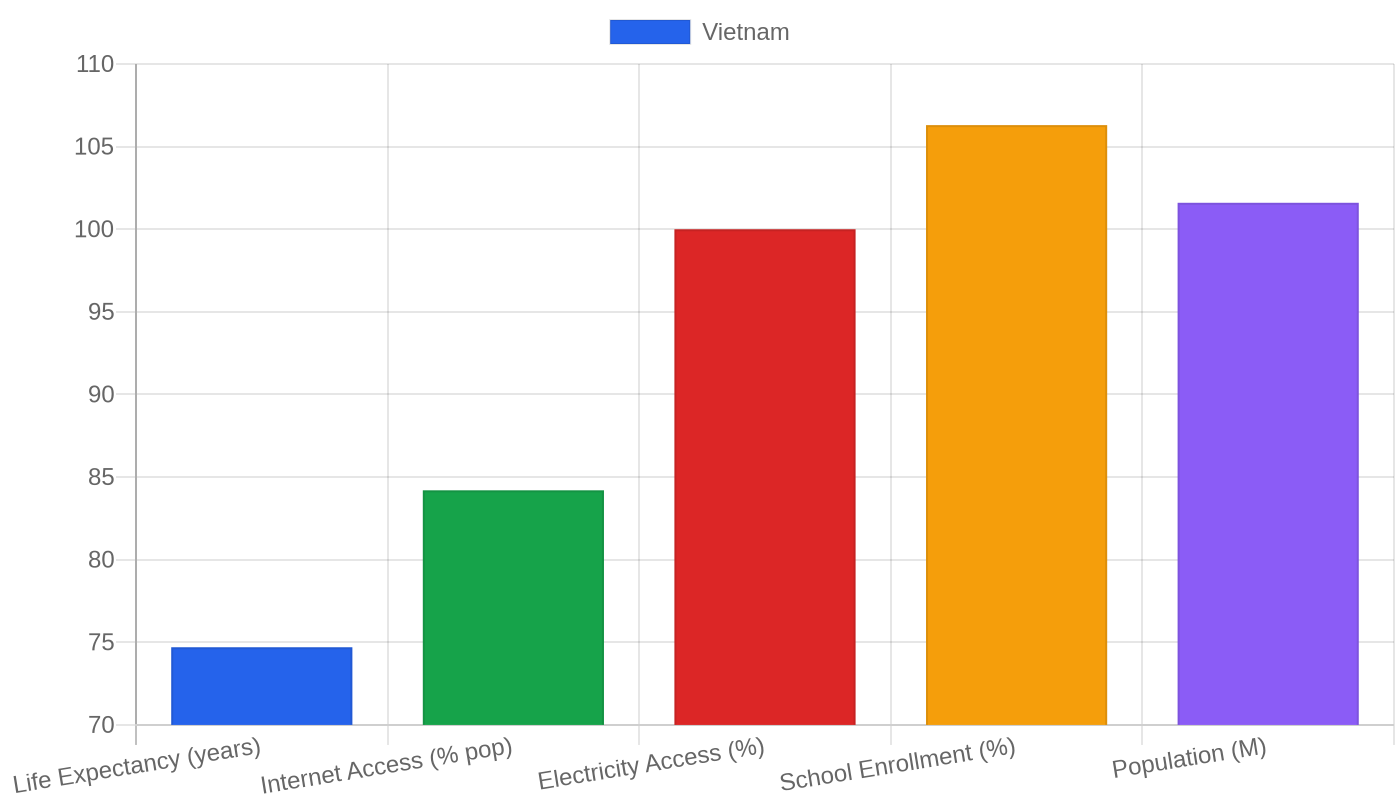
– The economy has crossed the half-trillion-dollar milestone, with GDP reaching $514.7 billion, while GDP per capita on a purchasing power parity basis has climbed to $18,088.
– Despite its official communist creed, Vietnam’s economic trajectory is increasingly market-driven, with observers and international media characterising its leadership as “ardently capitalist communists.”
The Half-Trillion-Dollar Surprise: Anatomy of a Growth Miracle
The numbers coming out of Hanoi would be extraordinary for any economy, but for a nation still officially committed to socialism, they border on the remarkable. The World Bank’s latest data shows Vietnam’s GDP expanding by 8.02% in 2025 — a growth rate that outpaces virtually all of its Southeast Asian neighbours and places it firmly in the upper echelon of global economic performers.
This isn’t a flash in the pan; it’s the continuation of a decades-long transformation that has seen Vietnam evolve from one of the world’s poorest nations into a lower-middle-income country with genuine ambitions of joining the upper-middle-income ranks within the next decade.
What makes this growth particularly impressive is its quality. Inflation, the perennial enemy of emerging market prosperity, sits at just 3.31% — comfortably within the target ranges that central banks across the developing world struggle to maintain. The World Bank data reveals an economy that is growing rapidly without overheating, a testament to careful macroeconomic management that has learned from the boom-and-bust cycles that have plagued other developing nations.
The population of 101.6 million provides both a substantial domestic market and a youthful workforce that continues to attract foreign manufacturers seeking alternatives to more expensive production bases.
The structural transformation underway is profound. Vietnam has moved decisively from an agrarian economy toward manufacturing and services, with the financial sector emerging as a particular strength. The presence of major financial institutions like Asia Commercial Bank and the Bank for Investment and Development of Vietnam in the country’s top companies list signals a deepening of the financial system that will be crucial for sustaining long-term growth.
With GNI per capita at $4,970, Vietnam sits at a critical inflection point — the middle-income trap looms for nations that fail to upgrade their productive capacity, but the current growth trajectory suggests Vietnam has both the policy tools and the demographic advantages to navigate this challenge successfully.
The Cost of Living Conundrum: Growth’s Double-Edged Sword
For the average Vietnamese citizen, the economic miracle translates into a complex lived reality. The World Bank’s GDP per capita figure of $18,088 on a purchasing power parity basis suggests that, when adjusted for local price levels, the average Vietnamese person enjoys a standard of living that has improved dramatically over the past two decades.
Yet the gap between this PPP measure and the nominal GNI per capita of $4,970 tells a story of an economy where rapid growth has not yet fully translated into widespread prosperity.
Housing costs in Vietnam’s major urban centres — particularly Ho Chi Minh City and Hanoi — have risen sharply as the country’s expanding middle class competes for limited supply in desirable locations. The rental market has become increasingly bifurcated, with modern high-rise apartments commanding premium prices while traditional tube houses in older neighbourhoods remain more accessible.
For young professionals flocking to the cities for manufacturing and service sector jobs, the dream of homeownership remains elusive, pushing many toward long-term renting or increasingly distant suburbs where land is more affordable.
The consumer landscape reflects this transformation. Vietnam’s top companies include significant consumer goods and services players — from An Giang Coffee to Bien Hoa Sugar — indicating a domestic consumption story that is gaining momentum. As incomes rise, spending patterns are shifting from basic necessities toward discretionary goods and services, creating opportunities for both domestic firms and international brands.
The cost of daily essentials like food remains relatively modest compared to regional peers, but the trajectory is clear: as Vietnam grows wealthier, the cost of living in its urban centres will continue its upward march.
Titans of Industry: Vietnam’s Corporate Landscape Takes Shape
The roster of Vietnam’s largest companies reads like a map of the economy’s future direction. Financial services dominate, with Asia Commercial Bank, Bank for Investment and Development of Vietnam, Bao Viet Holdings, and Bien Viet Securities all featuring prominently — a clear signal that Vietnam’s financial sector is deepening and maturing.
This is crucial for the economy’s next phase of development, as more sophisticated financial markets will be needed to channel capital toward productive investments and away from the property speculation that has historically absorbed excessive liquidity.
The consumer services sector is equally well-represented, with Air Mekong and the Airports Corporation of Vietnam pointing to a travel and tourism industry that continues to expand as Vietnam’s middle class discovers the joys of domestic and regional travel. The presence of Appota Corporation in the technology sector, alongside healthcare provider Bidiphar, suggests a diversification beyond the manufacturing base that has driven export-led growth.
These are the industries that will determine whether Vietnam can successfully transition from an economy built on low-cost assembly to one capable of generating higher value-added goods and services.
The business environment supporting these enterprises is evolving rapidly. While the state retains significant influence through its ownership stakes in many major companies, the private sector is growing in both size and sophistication.
The Economist’s characterisation of Vietnam’s leadership as “ardently capitalist communists” captures the essential paradox of the country’s economic model: a political system committed to communist ideology presiding over an economy that has embraced market mechanisms with enthusiasm.
For international investors, this creates both opportunities and complexities — the potential for high returns exists alongside the need to navigate a political system that operates differently from Western liberal democracies.
Safety, Politics, and the Quality of Life Equation
Vietnam’s political landscape is unique in Southeast Asia: a unitary communist state that self-identifies as a socialist republic, sharing this distinction regionally only with Laos. The Communist Party of Vietnam maintains its constitutional role as the leading force in society, yet the economic policies pursued under its guidance have grown increasingly capitalist by the decade.
This ideological flexibility has proven to be one of Vietnam’s greatest assets, allowing policymakers to pursue pragmatic solutions without being constrained by doctrinal purity.
The absence of crime and safety index data makes direct comparisons difficult, but Vietnam’s reputation as a safe country by regional standards is well-established. Violent crime remains rare, and the streets of Hanoi and Ho Chi Minh City, while chaotic with traffic, are generally safe for residents and visitors alike. The social stability that comes with low crime rates and a strong sense of community cohesion provides a foundation for the quality of life that money alone cannot buy.
Political stability has been a cornerstone of Vietnam’s economic success. While other nations in the region have experienced periodic upheavals, Vietnam has maintained consistent policy direction under the Communist Party’s leadership, with leadership transitions managed through established internal processes. This predictability has been enormously attractive to foreign investors, who value the certainty that comes with knowing the rules of the game are unlikely to change dramatically.
The trade-off — limited political pluralism — is a cost that Vietnam’s leadership has judged acceptable in exchange for the stability that has underpinned three decades of economic transformation.
The Road Ahead: Challenges and Opportunities in 2026
Vietnam enters 2026 with momentum that few economies can match, but the challenges ahead are substantial. The World Bank’s growth figure of 8.02% sets a high bar for future performance, and maintaining this pace will require continued investment in infrastructure, education, and institutional capacity.
The unemployment rate of 1.52% indicates an economy operating at or near full employment, which brings its own pressures: rising wages could erode the cost advantage that has made Vietnam an attractive manufacturing destination, and labour shortages in skilled occupations are already emerging as a constraint on business expansion.
The inflation picture bears watching. At 3.31%, price pressures remain contained, but the combination of rapid growth, full employment, and rising wages could easily push inflation higher in the coming years. Vietnam’s policymakers will need to walk a careful line between supporting growth and preventing the economy from overheating.
The country’s integration into global supply chains, while a source of strength, also exposes it to external shocks — from shifts in global trade policy to disruptions in key export markets.
The political economy of reform will be equally important. The Economist’s observation about Vietnam’s “ardently capitalist communists” points to a leadership that has embraced economic liberalisation while maintaining political control. The question for the next phase is whether this model can continue to deliver the growth that has transformed Vietnamese society.
As the economy becomes more complex and the middle class expands, pressures for institutional reform — in areas ranging from property rights to financial regulation — will intensify. Vietnam’s ability to adapt its governance model to meet these challenges while maintaining stability will determine whether the current growth spurt becomes a sustained trajectory or merely a high-water mark in the country’s development story.
The Bottom Line
Vietnam is the standout performer in Southeast Asia, an economy that has combined political stability with market-oriented reforms to achieve growth rates that are the envy of the developing world. For investors, the country offers exposure to a manufacturing powerhouse with a growing domestic market and a strategic position in global supply chains.
For policymakers in other developing nations, Vietnam’s experience demonstrates the potential of pragmatic, growth-focused governance — whatever the ideological label. The next few years will test whether Vietnam can navigate the transition from low-cost producer to higher-value economy, but the foundations for continued success are firmly in place.
Sources & Methodology
This article is authored by Economic Pulse Net for informational and research purposes. Economic Pulse Net sources its data from multilateral institutions, national statistics bureaus, and proprietary databases. All data is believed to be current as of the date of publication.
Published: July 31, 2026 | Category: Research — Vietnam
Use these signals in your own platform
Economic Pulse publishes its live signal feed through a documented, read-only API. Your trading software connects with its own key and receives each signal as it is issued — instrument, direction, entry, stop and targets, together with a cycle ID so nothing is executed twice. The feed is independent of this website and cannot change it.
Signals are informational only and are not financial advice.