Economic Pulse Net | Sources: World Bank World Development Indicators, Government Sources | 2026
Key Takeaways
– Strategic Autarky: Uzbekistan is leveraging its position as a doubly-landlocked Central Asian nation to build self-sufficient industrial capacity, moving away from its historical reliance on cotton and gold extraction.
– The Manufacturing Push: The corporate landscape is dominated by heavy industry and consumer goods, signaling a deliberate state-guided shift toward value-added production and regional export leadership.
– State-Led Development: With the Central Bank and state-owned giants like Navoi Mining at the helm, the economy remains a hybrid model where state capitalism drives modernization.
– Post-Soviet Political Evolution: The political system has transitioned through a parliamentary framework since independence, with the Oliy Majlis serving as the central legislative body in a state that continues to consolidate its post-Karimov governance model.
– Infrastructure as Identity: Companies like Tashkent Aviation Production Association and GM Uzbekistan anchor the country’s ambition to become a manufacturing hub for the broader Eurasian market.
The Post-Soviet Economic Engine: From Cotton to Copper
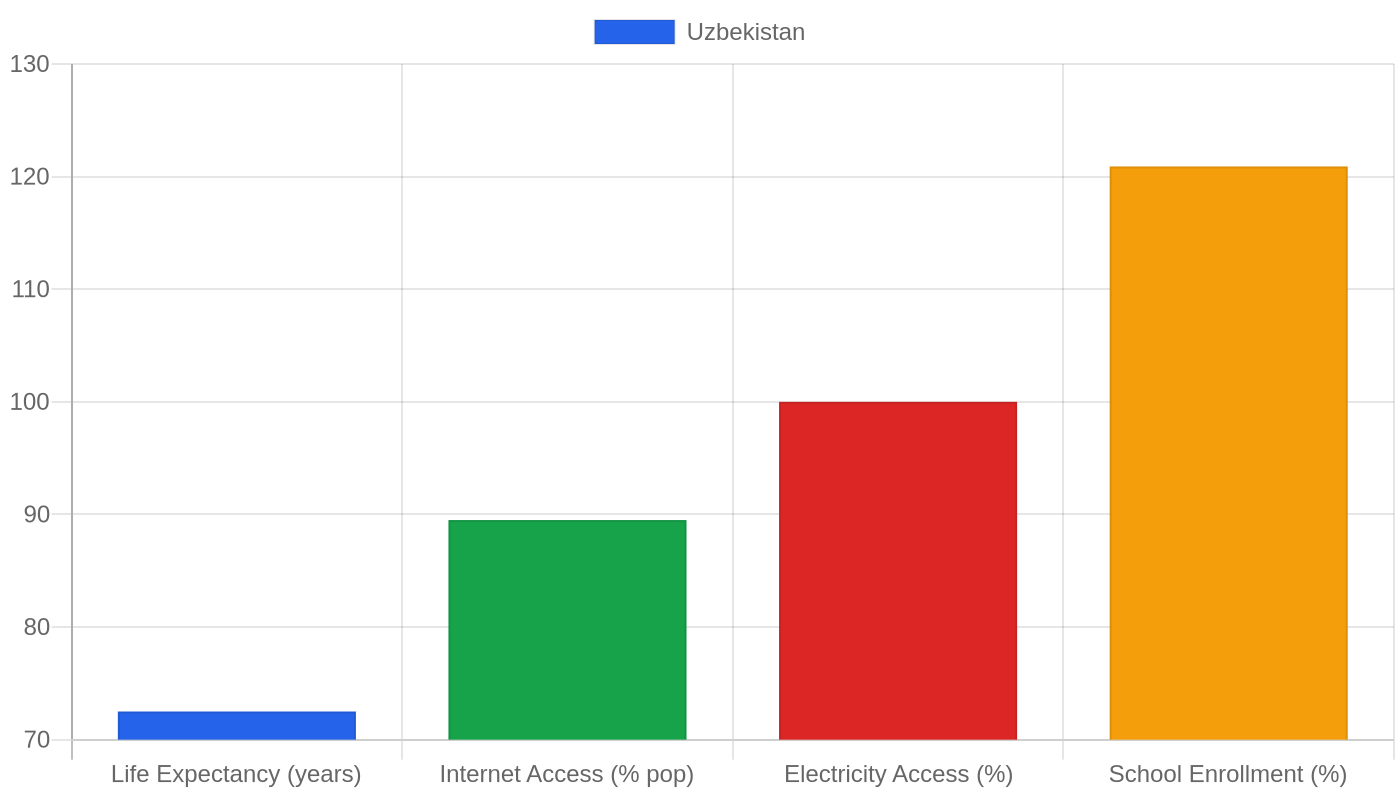
The economic narrative of Uzbekistan is one of deliberate, state-orchestrated transformation. According to the World Bank, the country has been navigating a complex transition from a primarily agrarian, resource-extraction economy toward a more diversified industrial base. The headline economic indicators—GDP growth, inflation, and unemployment—remain unquantified in recent global datasets, but the structure of the country’s top corporations reveals the true direction of travel.
The presence of Navoi Mining and Metallurgical Company in the basic materials sector underscores that the country’s vast mineral wealth—gold, uranium, and copper—remains the bedrock of its export earnings. However, the more telling signal is the concentration of companies in the industrials and consumer goods sectors.
The automotive industry, anchored by GM Uzbekistan and MAN Auto-Uzbekistan, is particularly significant. These ventures represent a strategic bet on becoming a regional manufacturing base for vehicles, leveraging the country’s central location as a crossroads between China, Russia, and South Asia. This is not merely about assembling foreign parts; it is about building a domestic supply chain that can support a middle-class consumer market.
The World Bank’s focus on structural reforms suggests that the government is attempting to wean the economy off its dependence on commodity price cycles. The challenge, however, lies in the fact that the transition is happening at a time when global capital is risk-averse, and the country’s limited integration with international financial markets makes it difficult to attract the foreign direct investment needed for a full-scale industrial leap.
The growth, when it comes, will likely be incremental, driven by public investment and the slow expansion of domestic private enterprise.
Housing and the Cost of Living: The Urban-Rural Divide
Assessing the cost of living in Uzbekistan requires a nuanced understanding of its dual economy. In the capital, Tashkent, the cost of living is experiencing upward pressure as the city modernizes, with new commercial and residential developments springing up to cater to a growing professional class. However, without specific World Bank data on price indices, we must rely on the broader economic context.
The country’s GNI per capita, while not explicitly stated in the latest data, has historically positioned it as a lower-middle-income nation, suggesting that daily expenses for the average citizen remain modest by international standards.
The housing market is characterized by a stark contrast between the older Soviet-era apartment blocks, which remain affordable but often lack modern amenities, and the new, high-end complexes targeting expatriates and wealthy locals. Renting in Tashkent is increasingly common among young professionals, but the cultural preference for homeownership remains strong, driving demand for land in suburban areas.
The cost of utilities, particularly natural gas and electricity, is heavily subsidized by the state, which helps keep the official inflation rate lower than it might otherwise be. Yet, this subsidy regime creates a fiscal burden for the government, and as the World Bank has often noted, reforming these subsidies is politically sensitive but economically necessary.
For now, the average Uzbek family spends a significant portion of its income on food, with the bazaars still the primary source of groceries, offering prices that are competitive but subject to seasonal fluctuations.
Investment and Business Climate: The Heavyweights and the State
The business environment in Uzbekistan is defined by the outsized role of the state and its affiliated entities. The top companies list is a veritable who’s who of state capitalism: the Central Bank of Uzbekistan, Navoi Mining, and the Tashkent Aviation Production Association (TAPO). These entities are not just economic players; they are instruments of national policy. TAPO, for instance, is a remnant of the Soviet military-industrial complex, now seeking to pivot to civilian aviation and engineering.
For foreign investors, the climate is improving but remains challenging. The government has made overtures toward privatization and liberalization, but the pace is cautious.
The consumer goods sector, led by Artel Electronics, is the bright spot for private enterprise. Artel has successfully captured the domestic market for home appliances and is now expanding into neighboring markets, proving that a Uzbek company can compete on quality and price. This is the kind of success story the government wants to replicate. However, the dominance of state-owned enterprises in strategic sectors makes it difficult for new private entrants to gain a foothold in energy, mining, or heavy industry.
The legal framework is also a work in progress; while the World Bank has acknowledged improvements in the ease of doing business, corruption and bureaucratic inertia remain significant hurdles for SMEs. The sectors to watch are those where the state is actively seeking partners: renewable energy, automotive parts manufacturing, and textile production, where the country hopes to move up the value chain from raw cotton to finished garments.
Safety, Politics, and Quality of Life: Stability Over Freedom
In the absence of a crime index, one must look to the political landscape to understand the social contract in Uzbekistan. The political system has been remarkably stable since the transition from Soviet rule. The election of Islam Karimov in 1991 set a precedent for strong, centralized leadership, which has continued in the post-Karimov era.
The Oliy Majlis, the parliament, has evolved into a bicameral body with a 150-member Legislative Chamber and a 100-member Senate, but its role is primarily to legitimize policy rather than to challenge the executive. This political stability has translated into a relatively safe environment for citizens and visitors alike, with low rates of violent crime compared to many of its regional neighbors.
Quality of life, however, is a mixed bag. On one hand, the social safety net, inherited from the Soviet era, provides universal access to education and healthcare, albeit with varying quality. On the other hand, the lack of political pluralism and restrictions on civil liberties mean that the country scores low on global freedom indices, a factor that the World Bank does not measure but which affects long-term human capital development.
The government’s focus on “Uzbekistan” as a brand—evident in the push for tourism and international sporting events—suggests an awareness that soft power is important for economic growth. For the average citizen, life is improving materially, but the pace of political reform lags behind economic modernization, creating a tension that will define the country’s trajectory in the coming years.
What’s Happening Now: The Pragmatic Pivot
The most current economic narrative is one of cautious opening. While the World Bank data for the latest period is incomplete, the structural changes are evident in the corporate sector. The continued operation and expansion of GM Uzbekistan and MAN Auto-Uzbekistan indicates that the automotive industry is weathering global supply chain disruptions better than anticipated.
There is a palpable sense that Tashkent is positioning itself as a diplomatic and commercial hub, leveraging its neutrality to attract business from both East and West. The government is actively courting investment from China, with infrastructure projects under the Belt and Road Initiative, while simultaneously trying to maintain ties with Russia and explore new markets in the Gulf.
The Central Bank of Uzbekistan has been engaged in a delicate balancing act, attempting to manage the exchange rate of the som and control inflation without stifling growth. The recent focus on the “real economy” suggests a shift away from purely macroeconomic stabilization toward microeconomic interventions aimed at boosting productivity.
The parliament, the Oliy Majlis, has been reviewing legislation related to land reform and property rights, which are critical for unlocking the potential of the agricultural sector. There is also a growing digital economy, with fintech companies emerging to serve a young, tech-savvy population. However, the shadow of the state looms large, and the success of these initiatives will depend on the government’s willingness to cede control and allow market forces to operate more freely.
The coming months will be telling as to whether the reform rhetoric translates into tangible change on the ground.
The Bottom Line
Uzbekistan is a country on the cusp of redefining itself. For investors, it offers a frontier market with immense potential, provided they are willing to navigate the complexities of a state-dominated economy. For policymakers in the region, it serves as a test case for whether a post-Soviet state can successfully modernize without fully embracing Western-style liberal democracy. The country’s fate hinges on its ability to diversify beyond its natural resources and build a resilient, private-sector-led economy.
Those who watch Uzbekistan closely will be witnessing the unfolding of a unique experiment in state-led development.
Sources & Methodology
This article is authored by Economic Pulse Net for informational and research purposes. Economic Pulse Net sources its data from multilateral institutions, national statistics bureaus, and proprietary databases. All data is believed to be current as of the date of publication.
Published: August 24, 2026 | Category: Research — Uzbekistan
Use these signals in your own platform
Economic Pulse publishes its live signal feed through a documented, read-only API. Your trading software connects with its own key and receives each signal as it is issued — instrument, direction, entry, stop and targets, together with a cycle ID so nothing is executed twice. The feed is independent of this website and cannot change it.
Signals are informational only and are not financial advice.