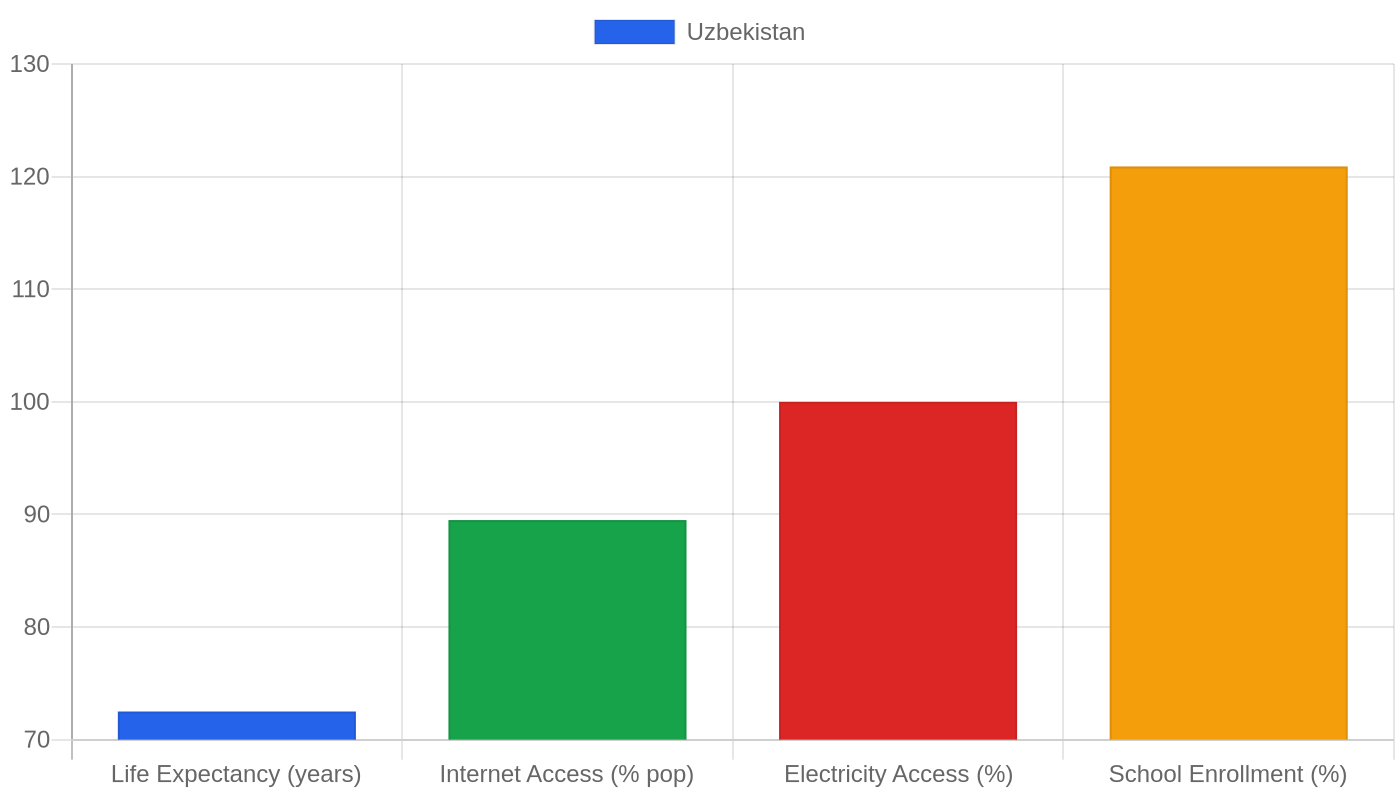
Economic Pulse Net | Sources: World Bank World Development Indicators, Government Sources | 2026
Key Takeaways
– Uzbekistan’s economy is anchored by state-backed industrial giants, with the Navoi Mining and Metallurgical Company leading the basic materials sector and GM Uzbekistan dominating consumer goods.
– The country’s political system, established after 1991 independence, features a bicameral parliament with a 150-member Legislative Chamber and 100-member Senate, shaping a stable but tightly controlled business environment.
– Industrial diversification is underway, with a heavy concentration of companies in the industrials sector — from aviation to automotive manufacturing — signaling a strategic push beyond agriculture.
– While specific World Bank economic indicators remain unavailable, the corporate landscape reveals a nation investing heavily in heavy industry, manufacturing, and infrastructure.
– For investors, Uzbekistan represents a frontier market with significant state involvement, where relationships with government-linked entities remain essential to market access.
The Economic Engine — Heavy Industry and State Power
Uzbekistan’s economic story is written in steel, copper, and assembly lines. The World Bank’s data on GDP growth, inflation, and unemployment remains unpublished, leaving analysts to piece together the picture from the country’s corporate architecture. What emerges is an economy still deeply shaped by its Soviet industrial inheritance, now being reimagined for a new era.
The dominant player is the Navoi Mining and Metallurgical Company, a basic materials behemoth that anchors the country’s resource extraction sector. Alongside it, GM Uzbekistan and MAN Auto-Uzbekistan represent a significant bet on automotive manufacturing, producing vehicles for both domestic consumption and regional export.
The industrials sector tells an even more revealing story. Tashkent Aviation Production Association, a legacy of Soviet-era aerospace engineering, remains a key employer and technological hub. Avialeasing provides aircraft leasing services, while O’zelectroapparat-Electroshield manufactures electrical equipment. O′zbekiston Pochtasi, the national postal service, and SamKochAvto round out a diverse industrial base.
This concentration in manufacturing and heavy industry suggests an economy transitioning from its agricultural roots toward higher-value production. The presence of the Central Bank of Uzbekistan among the top companies underscores the state’s central role in directing economic activity. For the casual observer, the message is clear: this is an economy where the state remains the primary architect of industrial policy, and where success often depends on navigating government priorities.
Housing and Daily Life — The Cost of Living in Transition
Without official cost-of-living indices, painting a precise picture of daily expenses in Uzbekistan requires reading between the lines. What can be inferred from the corporate landscape is that Tashkent, the capital, functions as the economic heart of the nation, drawing workers toward its industrial zones.
The presence of major manufacturing employers like GM Uzbekistan and the Tashkent Aviation Production Association suggests a workforce concentrated in formal employment, with housing demand clustering around industrial districts. Renting versus buying in Uzbekistan’s cities reflects broader post-Soviet patterns — a mix of privatized Soviet-era apartments and newer commercial developments.
For the average family, housing costs likely consume a significant portion of household income, though state involvement in key industries may provide more stability than in neighboring countries. The absence of regional comparison data makes definitive statements difficult, but the industrial composition implies a cost of living tied closely to the fortunes of the manufacturing sector.
As the economy modernizes, urban housing markets in Tashkent and regional centers are likely experiencing gradual price appreciation, driven by a growing middle class employed in the formal industrial sector.
Investment and Business Climate — Where the Opportunities Lie
For foreign investors, Uzbekistan presents a paradox: immense opportunity wrapped in state control. The top companies list reads like a who’s who of government-linked enterprises, from the Central Bank to Navoi Mining and Metallurgical Company. This is not a market for the faint-hearted or the purely market-driven investor. Success requires partnership with state entities and a long-term perspective on regulatory relationships.
The consumer goods sector, anchored by Artel Electronics and the automotive manufacturers, offers the most accessible entry points for foreign brands and joint ventures. Artel, in particular, represents Uzbekistan’s ambition to build domestic electronics manufacturing capabilities, a sector with significant growth potential as the country’s middle class expands.
The industrials sector, while dominated by state enterprises, also presents opportunities in supply chain development and technology transfer. Companies like O’zelectroapparat-Electroshield and SamKochAvto could benefit from foreign expertise in modernization and efficiency improvements.
The aviation sector, through Tashkent Aviation Production Association and Avialeasing, hints at regional ambitions in transportation and logistics — a natural fit given Uzbekistan’s strategic location along historic trade routes. However, investors should note the absence of a vibrant private sector in the top companies list. The business climate remains one where political connections and state contracts matter more than market competition.
For those willing to navigate this landscape, the rewards could be substantial as Uzbekistan continues its gradual opening to global markets.
Safety, Politics, and Quality of Life
Uzbekistan’s political landscape is defined by its post-Soviet evolution. After declaring independence in 1991, the nation elected Islam Karimov as its first president on 29 December of that year. The political structure that emerged features the Oliy Majlis, a bicameral parliament with a 150-member Legislative Chamber and a 100-member Senate. This institutional framework has provided political stability, though critics note the concentration of power and limited political pluralism.
For ordinary citizens, this stability translates into a predictable, if constrained, civic environment. Crime and safety indices are not available, but the strong state presence suggested by the corporate landscape implies a society with significant government oversight and control.
The quality of life in Uzbekistan is intrinsically linked to employment in the industrial sector. Workers at companies like GM Uzbekistan or the Navoi Mining and Metallurgical Company likely enjoy more stable incomes and benefits than those in the informal economy. The state’s investment in heavy industry suggests a priority on maintaining employment and industrial capacity over consumer-centric development.
For the population, this means access to jobs in manufacturing and mining, but potentially fewer options in services and technology. The political system, while stable, offers limited avenues for civic participation beyond formal electoral processes. As the country looks toward the future, the tension between maintaining political control and fostering the innovation needed for economic modernization will define the quality of life for Uzbekistan’s citizens.
What’s Happening Now — Uzbekistan’s Reform Moment
Uzbekistan stands at a crossroads, with its industrial base providing both stability and inertia. The continued prominence of state-owned enterprises in the top companies list suggests that privatization and market liberalization remain gradual processes. The Central Bank of Uzbekistan’s presence among the top companies signals ongoing efforts to modernize the financial sector, likely including gradual currency liberalization and banking reforms.
The automotive sector, through GM Uzbekistan and MAN Auto-Uzbekistan, appears positioned to expand production and potentially increase exports to regional markets. Meanwhile, the aviation and logistics companies — Avialeasing, Tashkent Aviation Production Association, and O′zbekiston Pochtasi — point toward investments in transportation infrastructure that could enhance Uzbekistan’s role as a Central Asian trade hub.
The political system, with its bicameral parliament, continues to provide the framework for economic decision-making. Recent years have seen discussions of reform, though the pace remains measured. The government’s focus on maintaining industrial employment while gradually opening to foreign investment suggests a careful balancing act between modernization and stability.
For businesses watching Uzbekistan, the current moment offers a window into a market in transition — one where early movers may find advantage, but where the rules of engagement are still being written. The country’s industrial legacy provides a foundation, but the extent to which it can build on that foundation will determine whether Uzbekistan emerges as a regional economic power or remains a state-dominated economy struggling to adapt to global competition.
The Bottom Line
Uzbekistan is a country to watch for investors and analysts interested in Central Asia’s economic evolution. Its state-driven industrial model offers stability but limits the dynamism needed for rapid growth. The companies that dominate its economy — from mining to automotive to aviation — represent both the country’s strengths and its challenges. Those willing to engage with the realities of state capitalism and build long-term relationships may find significant opportunities.
For everyone else, Uzbekistan remains a fascinating case study in how a post-Soviet nation navigates the path from industrial inheritance to modern economic identity.
Sources & Methodology
This article is authored by Economic Pulse Net for informational and research purposes. Economic Pulse Net sources its data from multilateral institutions, national statistics bureaus, and proprietary databases. All data is believed to be current as of the date of publication.
Published: August 24, 2026 | Category: Research — Uzbekistan
Use these signals in your own platform
Economic Pulse publishes its live signal feed through a documented, read-only API. Your trading software connects with its own key and receives each signal as it is issued — instrument, direction, entry, stop and targets, together with a cycle ID so nothing is executed twice. The feed is independent of this website and cannot change it.
Signals are informational only and are not financial advice.