Economic Pulse Net | Sources: World Bank World Development Indicators, Government Sources | 2026
Key Takeaways
* Industrial Dominance: The economy is heavily anchored by major players in consumer goods, industrials, and basic materials, with key entities like GM Uzbekistan and Navoi Mining driving production.
Political Stability: The political landscape remains defined by the post-Soviet transition established in 1991, featuring a bicameral parliament structure that has evolved since the initial elections under President Islam Karimov.
Corporate Landscape: Top companies are concentrated in manufacturing and logistics, including Artel Electronics and Tashkent Aviation Production Association, signaling a focus on domestic industrial capacity.
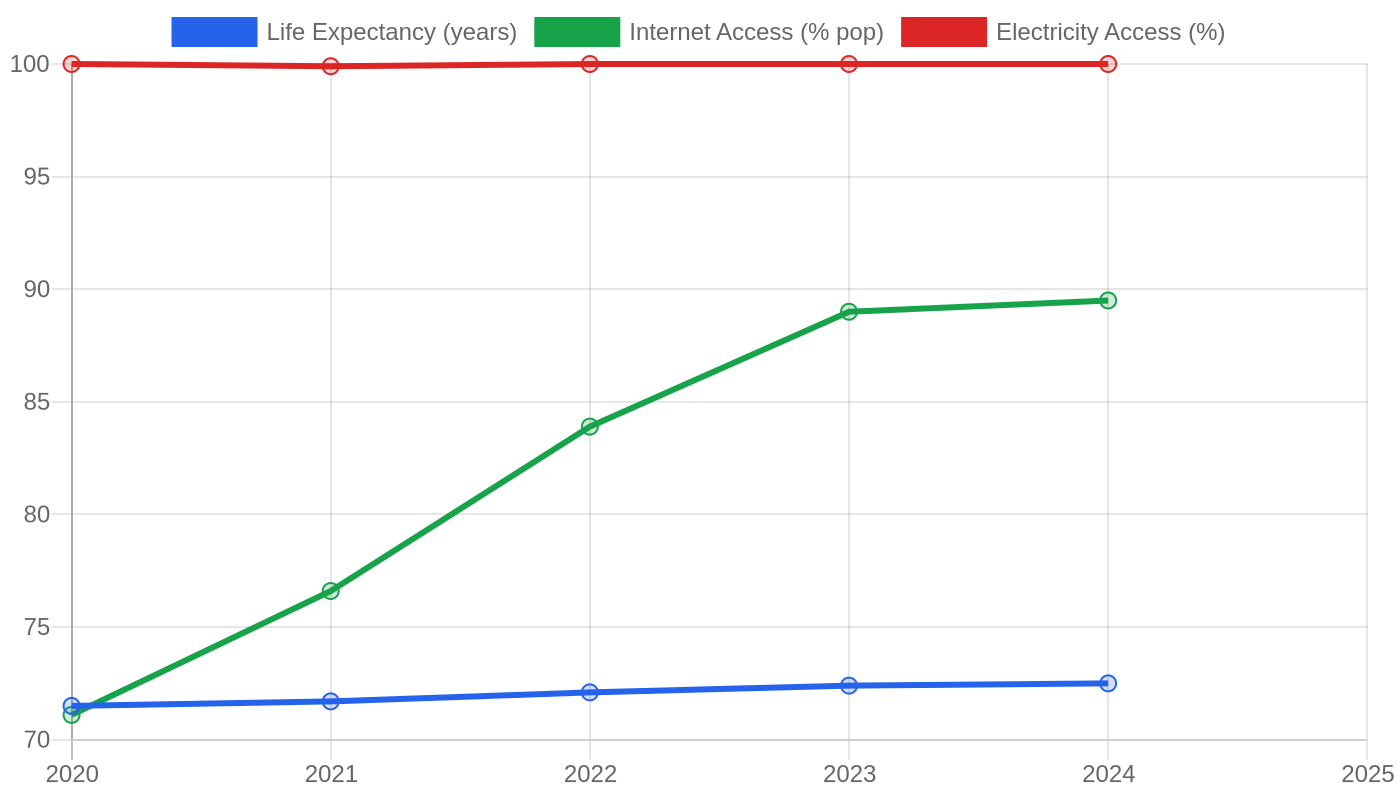
Data Gaps in Macro Metrics: While corporate and political structures are well-documented, specific macroeconomic indicators such as GDP growth, inflation rates, and unemployment figures are currently unavailable from the World Bank dataset provided.
Economic Engines and Industrial Foundations
The economic narrative of Uzbekistan is less about volatile macro-fluctuations and more about the steady accumulation of industrial capacity and state-led development. While specific metrics for GDP growth, inflation, and unemployment remain absent from the latest World Bank data, the underlying structure of the economy reveals a nation prioritizing tangible production over purely financial services.
The presence of heavyweight corporations such as Navoi Mining and Metallurgical Company highlights the critical role of basic materials in the national output, suggesting that resource extraction and processing form a bedrock of the country’s wealth generation. Simultaneously, the prominence of consumer goods manufacturers like GM Uzbekistan and MAN Auto-Uzbekistan indicates a robust domestic market for durable goods and an active automotive sector that serves both local needs and potential export markets.
This industrial mix points to an economy that is transitioning from raw material reliance toward value-added manufacturing, a common trajectory for emerging markets seeking sustainable growth. The inclusion of Artel Electronics in the top company list further underscores a strategic push into high-tech assembly and electronics, diversifying the industrial base beyond traditional sectors.
Understanding this corporate hierarchy provides a clearer picture of economic resilience than headline GDP figures alone, as these companies represent the actual engines of employment and technological transfer within the region.
Cost of Living and Housing Dynamics
Assessing the daily economic reality for residents and expatriates in Uzbekistan requires looking at the broader cost structure, even though precise housing indices and consumer price levels are not explicitly quantified in the current dataset. In markets where specific cost-of-living metrics are opaque, the strength of local industries often correlates with affordability; a strong domestic manufacturing sector can help keep prices for essential goods relatively stable compared to import-dependent economies.
For instance, the existence of local producers like O’zelectroapparat-Electroshield suggests that certain household appliances and electrical components may be more accessible domestically, potentially mitigating some inflationary pressures associated with imported finished goods. However, without concrete data on rental yields or property purchase costs, it is difficult to draw direct comparisons to regional averages or determine the purchasing power parity for the average citizen.
The absence of explicit CPI data means that observers must rely on qualitative assessments of market stability rather than quantitative benchmarks when evaluating the financial burden on households. Generally, in economies with significant state involvement in key sectors like energy and transport, utility costs and basic living expenses may be subsidized or regulated differently than in fully liberalized markets, creating a unique cost environment that defies standard international comparisons.
Investment Climate and Corporate Powerhouses
For investors and business analysts, Uzbekistan presents a landscape dominated by large, established entities that control significant portions of the industrial and logistical sectors. The top companies listed reveal a business environment where scale and state connection are paramount, with firms like Avialeasing and the Central Bank of Uzbekistan playing pivotal roles in facilitating capital and aviation-related commerce.
GM Uzbekistan stands out as a notable joint venture entity, illustrating how foreign direct investment is integrated into the local manufacturing ecosystem, particularly in the automotive industry which is a high-value sector for job creation and technology infusion. Meanwhile, the Tashkent Aviation Production Association and SamKochAvto indicate a historical and ongoing commitment to heavy machinery and transportation infrastructure, sectors that require long-term capital commitment and government support.
The presence of O′zbekiston Pochtasi in the industrials category suggests that logistics and postal services are also consolidated under major national operators, which can streamline supply chains but may limit competition. Investing in this market requires navigating a landscape where success is often tied to relationships with these dominant players and an understanding of the regulatory framework managed by institutions like the Central Bank.
The concentration of power among these specific firms means that market entry strategies must account for the dominance of incumbents in both the consumer goods and industrial equipment spaces.
Safety, Politics, and Quality of Life
The political architecture of Uzbekistan is rooted in the decisive events of the early 1990s, following its independence from the Soviet Union. The election of Islam Karimov as the first President on December 29, 1991, marked the beginning of a new era characterized by centralized authority and structured governance.
This political continuity is reflected in the legislative framework, where the Supreme Soviet was replaced by the Oliy Majlis in 1994, establishing a bicameral parliament consisting of a 150-member Legislative Chamber and a 100-member Senate. These bodies, elected under resolutions adopted by the 16th Supreme Soviet, have maintained a five-year term cycle for their members, providing a degree of institutional predictability in the political sphere.
Regarding personal security, specific crime and safety indices are currently unavailable, leaving the exact risk profile for travelers and residents undefined in quantitative terms. However, the structured nature of the political system and the long-standing administrative frameworks suggest a society where legal and procedural norms are deeply entrenched.
The quality of life is likely influenced by this political stability, although the lack of happiness or social satisfaction data prevents a comprehensive assessment of citizen well-being beyond the structural facts of governance.
Current Affairs and Policy Evolution
The most recent developments in Uzbekistan’s political history center on the consolidation of its parliamentary system and the enduring legacy of its founding leadership. The third elections for the bicameral Oliy Majlis represent a significant milestone in the country’s democratic evolution, reinforcing the separation of powers between the Legislative Chamber and the Senate.
These electoral processes, held under the resolution of the 16th Supreme Soviet in 1994, demonstrate a commitment to maintaining the constitutional order established after independence. While specific current policy shifts regarding inflation or immediate economic reforms are not detailed in the available data, the ongoing operation of these governmental bodies ensures that legislative functions continue uninterrupted.
The stability of the political landscape allows for long-term planning in sectors like mining and manufacturing, where projects span decades rather than single election cycles. Observers note that the continued relevance of the structures put in place in the early 1990s indicates a political environment resistant to sudden radical change, favoring incremental adaptation instead.
This consistency provides a backdrop against which businesses can operate, knowing that the fundamental rules of engagement set by the Central Bank and other state institutions are likely to remain consistent in the near term.
The Bottom Line
Uzbekistan offers a compelling case study for those interested in emerging markets with strong industrial bases and clear political structures. Investors should focus on the opportunities presented by dominant companies in automotive, electronics, and mining, as these sectors drive the tangible aspects of the economy. While the lack of specific macroeconomic data like GDP and inflation limits short-term trading insights, the long-term outlook is shaped by the country’s industrial depth and political continuity.
Stakeholders should monitor the operational activities of key firms like GM Uzbekistan and Navoi Mining for signals of broader economic health.
Sources & Methodology
This article is authored by Economic Pulse Net for informational and research purposes. Economic Pulse Net sources its data from multilateral institutions, national statistics bureaus, and proprietary databases. All data is believed to be current as of the date of publication.
Published: September 29, 2026 | Category: Research — Uzbekistan
Use these signals in your own platform
Economic Pulse publishes its live signal feed through a documented, read-only API. Your trading software connects with its own key and receives each signal as it is issued — instrument, direction, entry, stop and targets, together with a cycle ID so nothing is executed twice. The feed is independent of this website and cannot change it.
Signals are informational only and are not financial advice.