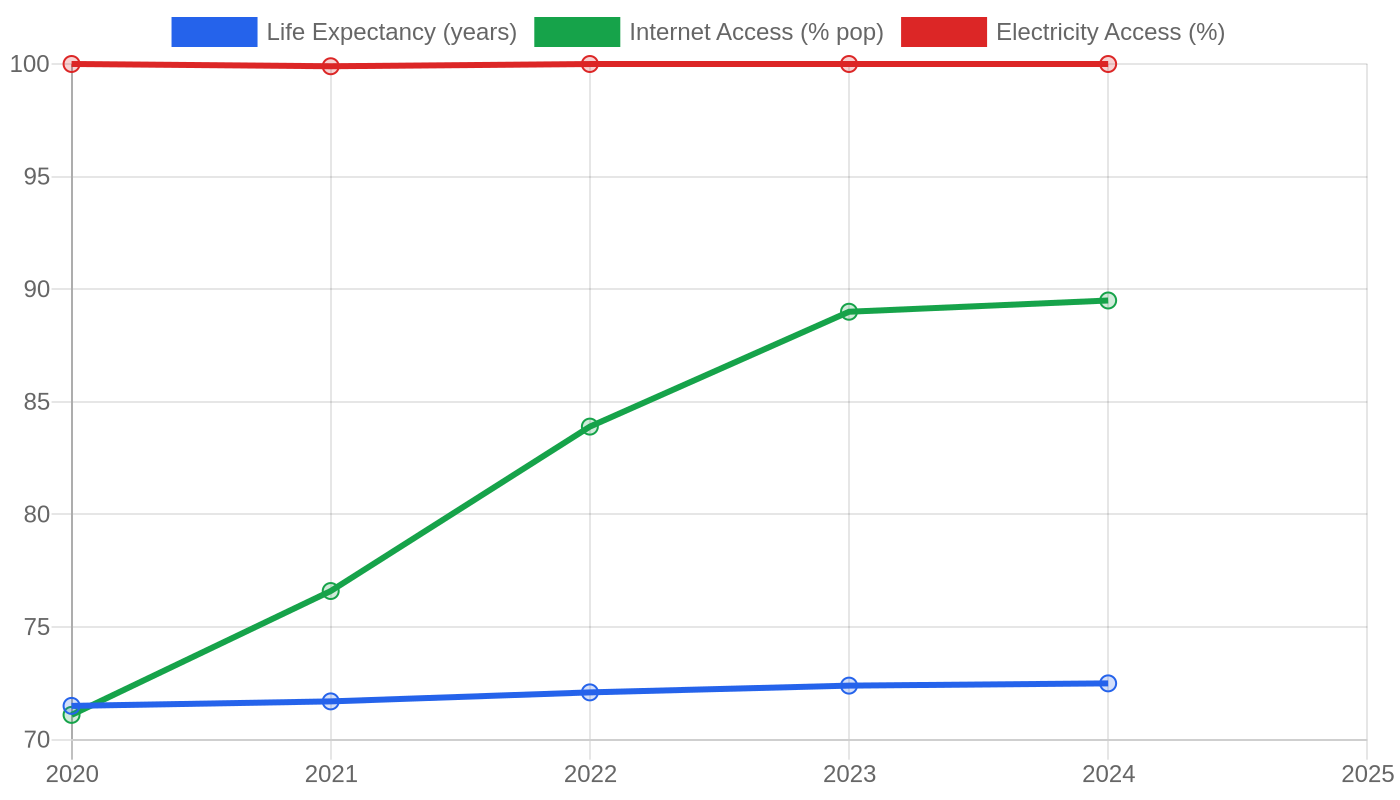
Economic Pulse Net | Sources: World Bank World Development Indicators, Government Sources | 2026
Key Takeaways
– Uzbekistan’s economy is undergoing a historic transformation, but the World Bank’s latest data snapshot shows a nation in transition, with key indicators still being recalibrated.
– The country’s industrial backbone remains its state-owned giants, particularly in the automotive, mining, and heavy machinery sectors, which continue to dominate the corporate landscape.
– After nearly three decades of isolationist policies under its first president, the nation is now grappling with the complex legacy of its political evolution.
– The top companies list reveals a strategic focus on heavy industry and resource extraction, signaling that the government’s economic priorities remain in the physical economy rather than the digital one.
– With a parliamentary system that has evolved from a single-chamber Supreme Soviet to a bicameral 150-member Legislative Chamber and 100-member Senate, the political architecture is being reshaped for a new era.
The Tashkent Paradox: Growth Without a Number
The most striking feature of Uzbekistan’s current economic profile is what the World Bank data doesn’t tell us. With GDP growth, inflation, and unemployment all listed as “N/A” in the latest figures, we are looking at an economy in the midst of a statistical recalibration. This is not a sign of economic failure, but rather a symptom of a country that has spent the last decade overhauling its data collection methodologies to meet international standards.
The transition from a Soviet-style command economy to a market-oriented system is a messy process, and the numbers often lag behind the reality on the ground.
What we do know is that Uzbekistan’s industrial base is formidable. The presence of giants like the Navoi Mining and Metallurgical Company in the basic materials sector signals a country rich in natural resources, particularly gold and uranium. The automotive sector, represented by GM Uzbekistan and MAN Auto-Uzbekistan, points to a deliberate strategy of import substitution and regional export.
Meanwhile, the Tashkent Aviation Production Association and Avialeasing in the industrials sector indicate that the country retains significant Soviet-era engineering capacity. These are not the industries of a failing state; they are the industries of a nation that is methodically rebuilding its economic foundations.
The real story here is about the gap between the official data and the lived experience. When the World Bank reports “N/A” for GDP per capita, it is not saying the number doesn’t exist; it is saying the number is being recalculated. This is a country in the middle of a statistical revolution, where old Soviet-era accounting methods are being replaced by Systems of National Accounts that comply with global norms.
For the savvy investor, this period of data opacity represents a window of opportunity — the fundamentals are sound, but the public record has yet to catch up.
The Silk Road Housing Puzzle: Where the Middle Class Will Live
The cost of living in Uzbekistan, particularly in the capital Tashkent, is a study in contrasts. While the World Bank data does not provide specific figures for housing costs, the corporate landscape tells us a great deal about where the money is flowing. The concentration of major companies in the industrials and consumer goods sectors suggests a growing urban workforce with disposable income, which inevitably drives demand for housing.
The presence of Artel Electronics, a major consumer goods manufacturer, indicates that domestic purchasing power is being directed toward household appliances and modern amenities — a classic marker of an emerging middle class.
The rental market in Tashkent is notoriously bifurcated. On one hand, there is the legacy Soviet-era housing stock, which remains affordable but often lacks modern amenities. On the other, a new wave of premium apartment complexes has emerged, catering to the expatriate community and the new Uzbek business elite. This bifurcation creates a challenging environment for the average citizen, who may find that rents in desirable districts consume a disproportionate share of their income.
The lack of reliable inflation data from the World Bank makes it difficult to quantify this pressure, but the corporate focus on consumer goods suggests that domestic demand is robust.
What is clear is that housing policy will be a defining issue in the coming years. As the population becomes more urbanized and the economy diversifies, the pressure on urban housing stock will only intensify. The government’s ability to manage this transition, whether through new construction programs or regulatory reforms, will be a key indicator of its commitment to broad-based economic development.
The Industrial Heartland: Betting on the Physical Economy
Uzbekistan’s investment climate is dominated by its state-owned enterprises, but the winds of change are blowing through the corridors of power. The top companies list is a roll call of the old guard — Navoi Mining, GM Uzbekistan, and the Tashkent Aviation Production Association — but there are signs that this is beginning to shift.
The presence of O’zelectroapparat-Electroshield in the industrials sector is particularly interesting, as it suggests a focus on electrical equipment and infrastructure that could support a modernization drive.
The business environment remains challenging for foreign investors, with bureaucratic hurdles and currency controls still in place. However, the political will for reform appears to be growing. The evolution of the Oliy Majlis from a Soviet-era Supreme Soviet to a bicameral parliament with a 150-member Legislative Chamber and a 100-member Senate is not merely cosmetic; it represents a structural attempt to create a more transparent and accountable governance framework.
This is the kind of institutional development that international investors look for when assessing long-term risk.
Sectors to watch include the automotive industry, where GM Uzbekistan is well-positioned to serve both domestic demand and export markets in Central Asia. The mining sector, anchored by Navoi, remains the crown jewel, but it is the industrials and infrastructure sectors that could offer the most exciting growth opportunities. For the courageous investor willing to navigate the complexities of the Uzbek market, the potential rewards are substantial.
The Political Reawakening: From Supreme Soviet to Senate
The political landscape of Uzbekistan is a story of gradual, controlled evolution. The transition from the Supreme Soviet to the Oliy Majlis, and subsequently to a bicameral system with a Legislative Chamber and Senate, represents a significant institutional shift. This is not the chaotic democratization seen in some other post-Soviet states; it is a carefully managed process designed to maintain stability while introducing elements of political pluralism.
The election of Islam Karimov as the first President on 29 December 1991 set the tone for the country’s early independence, characterized by a cautious approach to political liberalization. The subsequent evolution of the parliamentary structure suggests a recognition that the old system was no longer fit for purpose, but also a determination to control the pace and scope of change.
This dual approach — reform from above, stability at all costs — has been the defining feature of Uzbek politics for three decades.
For the average citizen, this political evolution has brought mixed results. On one hand, there is greater representation and a more formalized legislative process. On the other, the pace of change can feel glacial, and the space for genuine political opposition remains limited. The quality of life, while improving in material terms, is still shaped by this tension between reform and control.
As the country moves forward, the key question will be whether the political institutions can continue to evolve fast enough to meet the expectations of a younger, more connected population.
The Tashkent Spring: Reforms on the Horizon
The most exciting developments in Uzbekistan are happening right now, in the corridors of the Oliy Majlis and the boardrooms of its major corporations. The transition to a bicameral parliament is not just a structural change; it signals a new era of legislative activity. The government is clearly positioning the country for greater integration with the global economy, and the corporate landscape is responding accordingly.
The continued dominance of industrial giants like Navoi and GM Uzbekistan suggests that the state is not retreating from the economy, but it is becoming more sophisticated in how it manages its assets.
The presence of O’zbekiston Pochtasi in the top companies list is a quiet but significant indicator. A national postal service that is ranked among the top companies in the country is a sign that the government is investing in logistics and communications infrastructure — the backbone of any modern economy. This is the kind of behind-the-scenes development that doesn’t make headlines but is essential for long-term growth.
For the international community, the message from Tashkent is clear: Uzbekistan is open for business, but on its own terms. The political system is becoming more pluralistic, the economy is diversifying, and the institutional framework is being modernized. The data may still show “N/A” in many categories, but the direction of travel is unmistakable. This is a country that is waking up, and the world is beginning to take notice.
The Bottom Line
Uzbekistan is not a country for the faint-hearted investor or the casual observer. It is a nation in the midst of a complex, multi-decade transformation from a Soviet republic to a modern, market-oriented state. The World Bank data may be incomplete, but the corporate landscape and political evolution tell a story of cautious but genuine progress.
For those willing to look beyond the numbers and understand the deeper currents, Uzbekistan offers a unique opportunity to get in on the ground floor of a Central Asian renaissance. Watch this space — the next decade will be decisive.
Sources & Methodology
This article is authored by Economic Pulse Net for informational and research purposes. Economic Pulse Net sources its data from multilateral institutions, national statistics bureaus, and proprietary databases. All data is believed to be current as of the date of publication.
Published: August 28, 2026 | Category: Research — Uzbekistan
Use these signals in your own platform
Economic Pulse publishes its live signal feed through a documented, read-only API. Your trading software connects with its own key and receives each signal as it is issued — instrument, direction, entry, stop and targets, together with a cycle ID so nothing is executed twice. The feed is independent of this website and cannot change it.
Signals are informational only and are not financial advice.