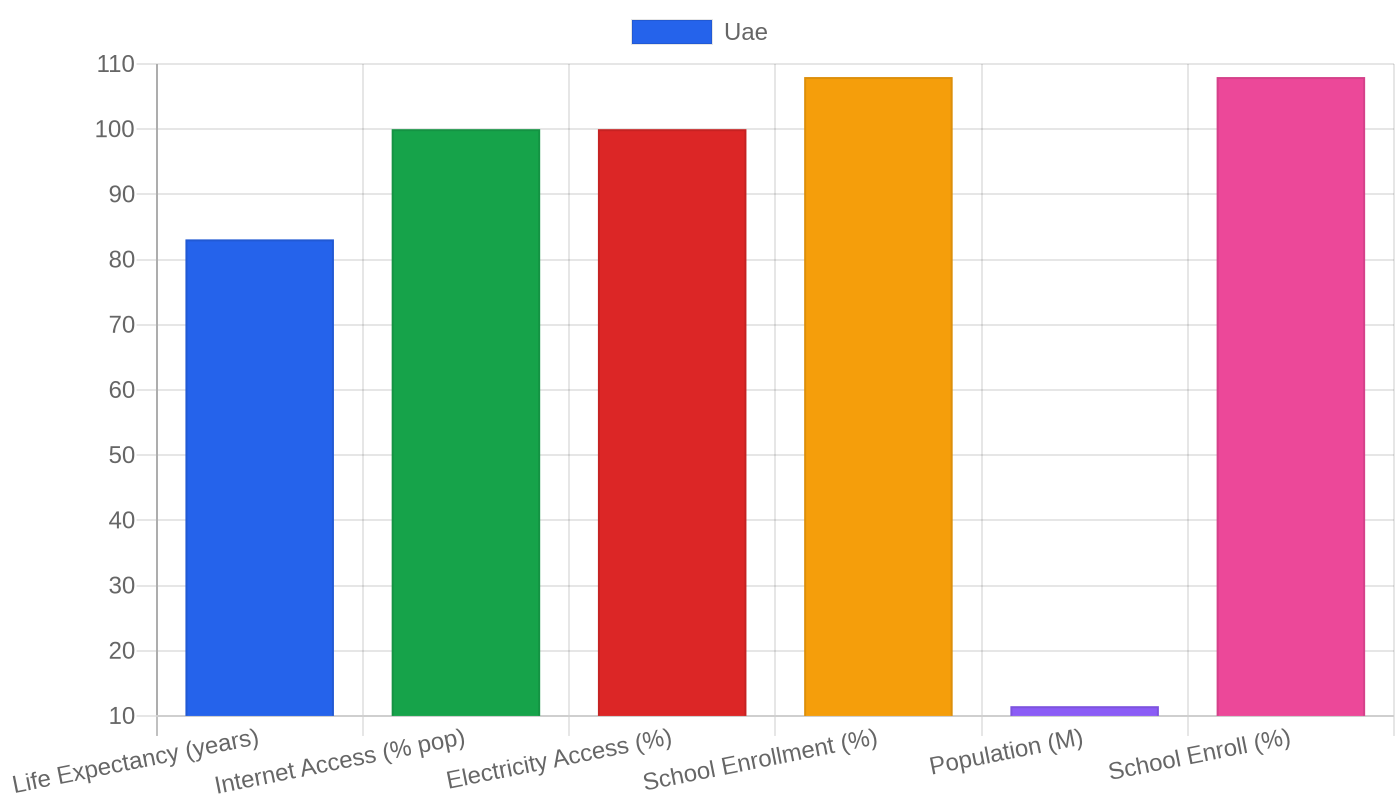
Economic Pulse Net | Sources: World Bank World Development Indicators, Government Sources | 2026
Key Takeaways
– The UAE’s economy grew at a solid 3.99% in 2024, according to the World Bank, outpacing many developed nations despite global headwinds.
– Inflation remains remarkably subdued at just 1.25%, a rare achievement in a region where price pressures often run hot.
– With a GDP per capita (PPP) of nearly $79,344, the UAE ranks among the world’s wealthiest nations, though income distribution remains uneven.
– The country’s unique political structure—a federation of seven hereditary monarchies—provides stability but concentrates power in the hands of a few ruling families.
– A population of 11.5 million, dominated by expatriate workers, creates a distinctive economic dynamic where consumption drives growth but citizenship remains tightly restricted.
The $79,000 Question — Wealth, Growth and the Inflation Mirage
The United Arab Emirates posted GDP growth of 3.99% in 2024, according to World Bank data—a respectable figure that signals continued momentum for an economy in the midst of a deliberate transformation. The headline number, while solid, tells only part of the story. What makes this growth particularly noteworthy is the context: global interest rates remain elevated, geopolitical tensions simmer across the Middle East, and the world’s energy markets continue their volatile dance.
The World Bank’s inflation figure of 1.25% is, frankly, remarkable. In an era where many economies have struggled to contain price pressures, the UAE has managed to keep consumer prices virtually flat. This is no accident. The country’s currency peg to the dollar provides monetary discipline, while heavy government subsidies on fuel, electricity, and basic goods act as a buffer against global price shocks. For residents, this means their dirham stretches further than it might in comparable Gulf states.
For policymakers, the low inflation environment provides breathing room to pursue ambitious diversification plans without the urgency of taming runaway prices.
The GDP per capita (PPP) figure of $79,343.78 from the World Bank places the UAE in rarefied air. This isn’t just oil wealth—though hydrocarbons certainly helped build the foundation. The number reflects a sophisticated services economy, world-class infrastructure, and a concentration of high-value industries from aviation to finance. But averages can deceive.
The wealth generated in Dubai’s skyscrapers and Abu Dhabi’s oil fields does not flow evenly to the 11.5 million residents, the vast majority of whom are foreign workers with limited rights and no path to citizenship. The expatriate workforce—construction laborers from South Asia, Filipino domestic workers, Western professionals—experiences this prosperity very differently.
The Price of Paradise — Housing and the Cost of Living Mirage
Housing in the UAE presents a study in contrasts. In Dubai, rents have climbed steadily as the city’s population swells and its reputation as a global hub for remote workers and wealthy expatriates grows. A one-bedroom apartment in a desirable area can command annual rents that would cover a mortgage in many Western cities. In Abu Dhabi, the market is more sedate, shaped by government employment and longer-term residency patterns.
The cost of living data provided does not offer granular breakdowns, but the low inflation figure hints at a broader reality: daily expenses for basics like food and utilities remain manageable for professionals, though quality varies dramatically by budget. The real cost of living in the UAE isn’t captured in CPI numbers alone. It’s in the school fees that run into tens of thousands of dollars annually, the health insurance premiums, and the social pressure to maintain a certain lifestyle.
For the construction worker earning 1,000 dirhams a month, the UAE is anything but cheap. For the hedge fund manager earning 100,000, it remains one of the world’s most tax-efficient places to live—no income tax, no capital gains tax, just a 5% VAT that barely registers.
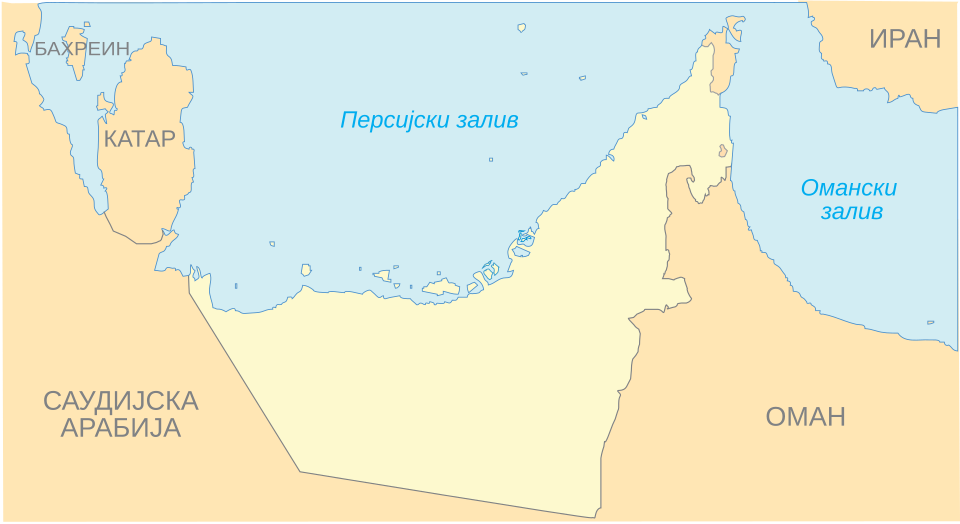
Sand, Skyscrapers and Sovereign Wealth — The Business Climate
The UAE’s business environment is built on a simple proposition: stability, connectivity, and minimal taxes. The World Bank data does not provide a specific list of top companies, but the landscape is dominated by a mix of state-linked giants—Emirates airline, Abu Dhabi National Oil Company, DP World—and a growing private sector that includes everything from property developers to fintech startups.
The country has become a magnet for regional headquarters, with multinational corporations establishing Dubai outposts to serve markets from North Africa to South Asia.
The sectors to watch are those tied to the UAE’s post-oil vision: renewable energy, where Masdar has become a global player; technology, where Dubai has aggressively courted crypto and blockchain firms; and tourism, which remains the economy’s most visible engine. The political structure—a federal semi-presidential state under a semi-constitutional monarchy, as the World Bank data describes it—provides a degree of predictability that investors value.
Seven hereditary tribal sheikhdoms, from Abu Dhabi to Umm Al Quwain, pool their revenues and coordinate policy through the Federal Supreme Council. The system concentrates power but also decision-making speed. When Dubai’s ruler wants to build a new financial district or Abu Dhabi decides to invest billions in artificial intelligence, there are no parliamentary delays or regulatory hurdles.
The Sheikhs, the Streets and the Social Contract
The political landscape of the UAE is, by design, opaque. The World Bank data describes a federation of seven “hereditary tribal monarchy-styled political units”—a careful phrasing that captures the essence of governance here. Power flows from the ruling families of each emirate, with Abu Dhabi’s Al Nahyan family holding the presidency and Dubai’s Al Maktoum family running the vice presidency and prime ministership.
There are no elections for national leadership, no political parties, no organized opposition.
Crime and safety indices are listed as unavailable in the data, but anyone who has walked through Dubai Marina at midnight or Abu Dhabi’s Corniche at dawn knows the reality: the UAE is extraordinarily safe by global standards. Petty crime is rare, violent crime rarer still. This safety is not accidental. It is maintained through pervasive surveillance, strict laws, and a legal system that offers few protections for defendants.
The social contract is clear: the state provides security, infrastructure, and tax-free living. In return, citizens—a small minority of the population—pledge loyalty, while expatriates accept that their presence is conditional and their rights limited.
The Great Pivot — Diversification in Real Time
Right now, the UAE is executing one of the most ambitious economic transformations in modern history. The data shows 3.99% growth in 2024, but the composition of that growth matters more than the headline. The non-oil economy is expanding faster than the hydrocarbon sector, driven by tourism, logistics, financial services, and technology.
Dubai’s success in attracting global talent—from British bankers to Indian software engineers—has created a self-reinforcing cycle of demand for housing, entertainment, and services.
The most telling indicator of the UAE’s current trajectory is its population: 11.5 million people, a number that has nearly doubled in a decade. These are not births; they are arrivals. The country is essentially an immigration machine, importing workers and consumers to fuel its growth. The risks are obvious—a global recession could reverse the flow—but for now, the momentum is unmistakable. The UAE is betting that it can build a post-oil economy before the oil runs out.
With the World Bank reporting a GDP per capita of nearly $80,000 and inflation below 2%, the bet is looking increasingly sound.
The Bottom Line
The UAE is a country that has turned its limitations—desert climate, small native population, dependence on hydrocarbons—into advantages through sheer force of will and strategic investment. For investors seeking exposure to Middle Eastern growth with political stability and minimal taxation, it remains the region’s standout bet.
For economists, it offers a fascinating case study in managed development, where authoritarian governance and market-friendly policies coexist in a uniquely successful—if ethically complex—synthesis. Watch this country not for its oil, but for what it is building to replace it.
Sources & Methodology
This article is authored by Economic Pulse Net for informational and research purposes. Economic Pulse Net sources its data from multilateral institutions, national statistics bureaus, and proprietary databases. All data is believed to be current as of the date of publication.
Published: July 23, 2026 | Category: Research — UAE
Use these signals in your own platform
Economic Pulse publishes its live signal feed through a documented, read-only API. Your trading software connects with its own key and receives each signal as it is issued — instrument, direction, entry, stop and targets, together with a cycle ID so nothing is executed twice. The feed is independent of this website and cannot change it.
Signals are informational only and are not financial advice.