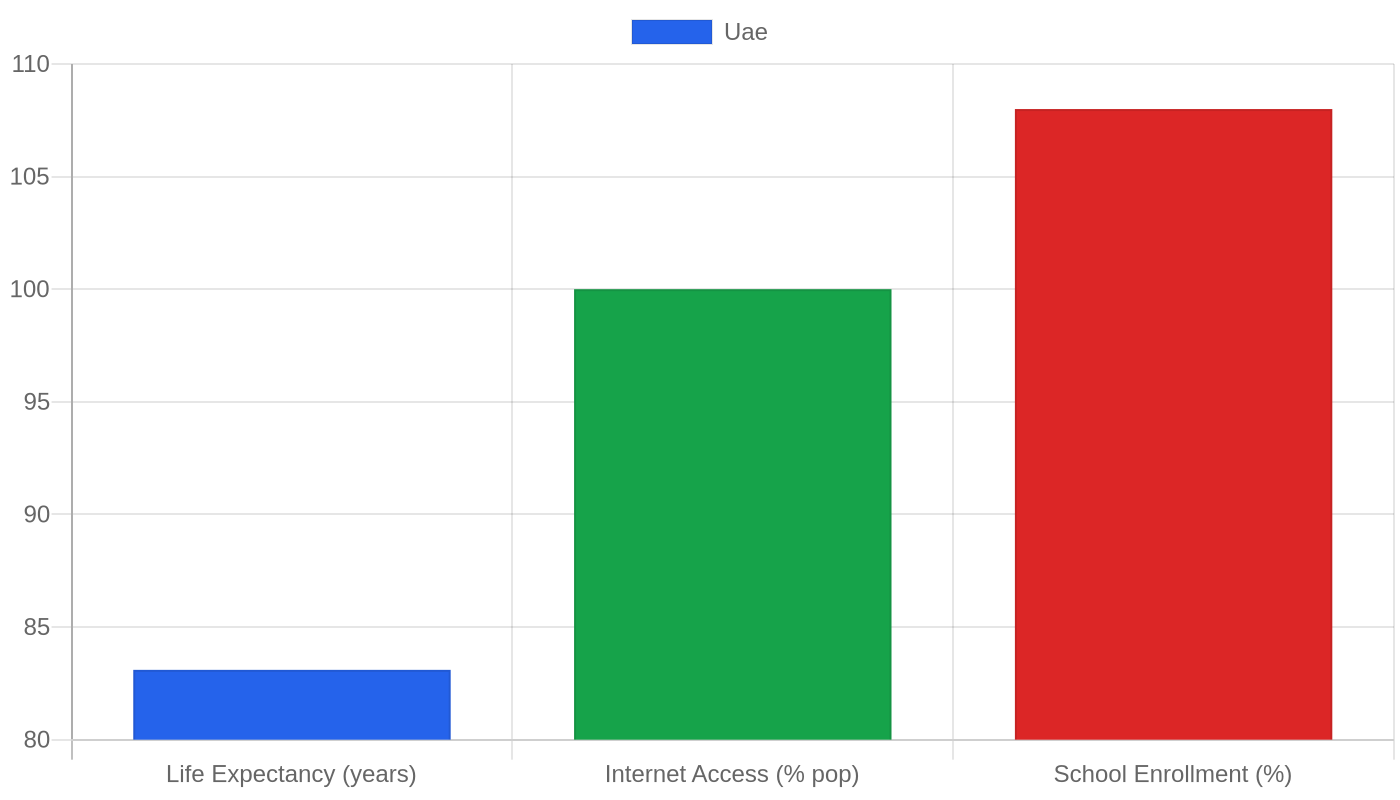
Economic Pulse Net | Sources: World Bank World Development Indicators, Government Sources | 2026
The United Arab Emirates has never been a country that whispers. From the vertigo-inducing skyline of Dubai to the quiet financial might of Abu Dhabi, this federation of seven sheikhdoms has spent decades converting oil wealth into global influence. But the story of the UAE in 2026 is not merely about petrodollars—it is about a nation aggressively repositioning itself for a post-oil era, even as global economic headwinds test its resilience.
With inflation running at a modest 1.25 percent according to the World Bank, the UAE is navigating a delicate balance between breakneck ambition and economic stability, all while operating under a unique political system that blends tribal tradition with modern statecraft.
Key Takeaways
– Low Inflation, High Ambition: The World Bank reports UAE inflation at just 1.25 percent, a remarkably stable figure that provides a solid foundation for consumer confidence and business planning.
– A Federal Experiment: The UAE operates as a semi-constitutional monarchy with seven hereditary sheikhdoms, creating a unique governance model where federal oversight meets significant local autonomy.
– Economic Diversification is Real: While oil remains the backbone, the UAE’s push into tourism, finance, and technology is reshaping its economic identity beyond hydrocarbons.
– Safety and Stability as Currency: Despite global turbulence, the UAE’s political structure and low crime environment make it an increasingly attractive destination for capital and talent.
– A Nation in Transition: The country is actively rewriting its economic playbook, moving from regional trading hub to global powerhouse.
The Economic Engine — Diversification Beyond the Pump
When economists talk about the UAE, the conversation inevitably begins with hydrocarbons. And rightly so—the discovery of oil transformed this collection of desert trading posts into one of the wealthiest nations on Earth. However, the World Bank’s latest data reveals a more nuanced picture. With inflation holding steady at 1.25 percent, the UAE is demonstrating that it can manage its economy with the precision of a Swiss watchmaker.
This stability is not accidental; it reflects deliberate policy choices aimed at attracting foreign investment and maintaining purchasing power for the millions of expatriates who call the Emirates home.
The absence of GDP growth figures in the latest World Bank data should not be read as a sign of stagnation. Rather, it reflects the challenges of measuring an economy in such rapid transformation. The UAE has moved decisively to reduce its dependence on oil revenue, investing heavily in sectors ranging from aviation to artificial intelligence. The country’s strategic location—a mere eight-hour flight from two-thirds of the world’s population—has made it an indispensable logistics and trade hub.
The Jebel Ali port complex and Dubai International Airport are not just infrastructure projects; they are economic weapons in a global competition for commerce.
Employment data remains opaque in the latest figures, but the UAE’s labor market tells a story of magnetic attraction. The country has become a magnet for skilled professionals from Europe, Asia, and Africa, drawn by tax-free salaries and a high standard of living. The government has introduced gold card residency programs and remote work visas, effectively monetizing its stability and infrastructure.
The real economic challenge facing the UAE is not generating wealth but managing the expectations of a population where expatriates outnumber nationals by a significant margin. This demographic reality shapes everything from housing policy to labor law.
The Price of Paradise — Living in the UAE’s Urban Oases
Ask anyone who has lived in Dubai or Abu Dhabi, and they will tell you the same thing: the UAE is not a cheap place to live, but it offers value that money can’t always buy elsewhere. The World Bank’s inflation figure of 1.25 percent suggests that price pressures remain contained, but this masks significant variation across the cost-of-living spectrum. Housing, in particular, commands a premium.
A modest apartment in a desirable Dubai neighborhood can easily consume a significant portion of a professional’s salary, while villas in gated communities cater to the upper echelons of the expatriate workforce.
The rent-versus-buy calculation in the UAE is uniquely skewed. With property prices in prime areas having recovered strongly from past corrections, many residents continue to prefer renting, maintaining flexibility in a transient job market. However, the government has introduced long-term visa options tied to property ownership, incentivizing a shift toward homeownership among the expatriate community.
Daily expenses—from groceries to dining out—reflect the country’s position as a global crossroads, with options ranging from budget-friendly South Asian eateries to Michelin-starred restaurants.
Utilities, transportation, and schooling represent significant line items in any UAE household budget. The country’s investment in public infrastructure, particularly the Dubai Metro, has helped moderate transportation costs, but the car remains king in this sprawling urban landscape. International schools, essential for many expatriate families, command fees comparable to those in London or New York.
The cost of living in the UAE is ultimately a story of choices—residents can live modestly or extravagantly, but the baseline for a comfortable middle-class existence remains higher than in most regional peers.
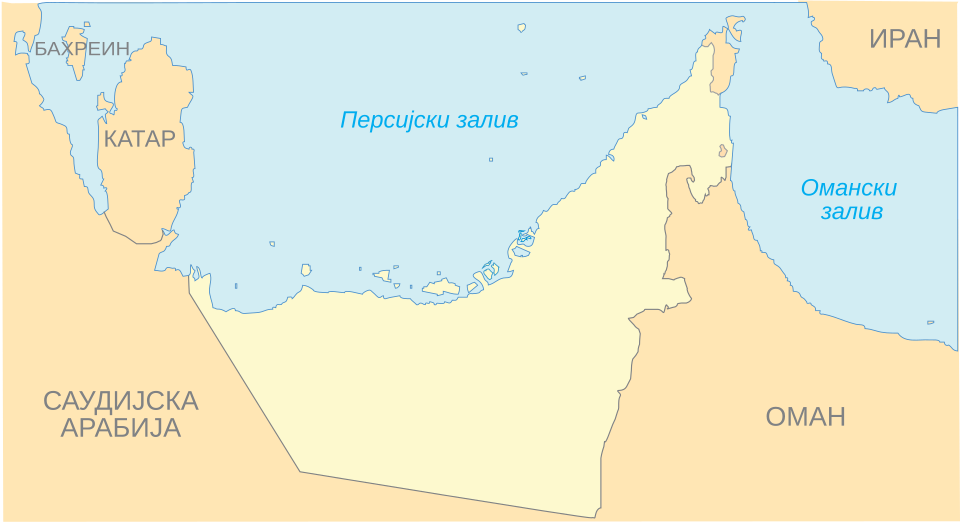
The Business Frontier — Where Global Capital Meets Gulf Ambition
The UAE has perfected the art of making business easy. The country’s top companies—ranging from Emirates Airlines to the Abu Dhabi National Oil Company—are global players that anchor the economy and drive innovation. But the real dynamism lies in the entrepreneurial ecosystem that has flourished in recent years.
Free zones, which allow 100 percent foreign ownership and offer streamlined company formation, have transformed Dubai and Abu Dhabi into launchpads for businesses targeting markets across the Middle East, Africa, and South Asia.
The investment climate is characterized by a pragmatic, pro-business regulatory environment. The government has consistently sought to reduce bureaucracy and increase transparency, recognizing that competition for capital is fierce in a region that includes financial hubs like Qatar and Saudi Arabia. The UAE’s openness to foreign talent and its strategic location make it an attractive base for multinational corporations seeking regional headquarters.
The technology sector, in particular, has seen explosive growth, with government-backed initiatives attracting startups and venture capital from around the world.
However, the business environment is not without its challenges. The UAE’s legal system, while modernized, still operates within a framework that can be opaque to outsiders. The kafala system, which ties a worker’s visa to their employer, has been reformed but remains a point of concern for human rights observers. Additionally, the country’s dependence on global trade makes it vulnerable to international economic shocks.
The UAE’s business climate is a study in contradictions—immensely welcoming to capital, yet governed by a political structure that prioritizes stability over democratic participation.
Security, Sovereignty, and the Social Contract
The UAE’s political landscape is as distinctive as its skyline. As a federal semi-presidential state under a semi-constitutional monarchy, the country is governed by a Federal Supreme Council composed of the ruling sheikhs of its seven emirates. This system, rooted in tribal tradition, has proven remarkably durable, providing political stability in a region often marked by turmoil.
While the country does not hold democratic elections in the Western sense, it has developed a social contract based on the distribution of wealth and the provision of world-class public services in exchange for political quiescence.
Safety is one of the UAE’s most underappreciated assets. Crime rates are among the lowest in the world, with the country’s strict laws and robust surveillance infrastructure contributing to a sense of security that is palpable to residents and visitors alike. Women can walk alone at night without fear; children play in public parks with minimal supervision; and the country’s roads, while busy, are governed by strict traffic laws.
This safety is a deliberate policy choice, reflecting a leadership that understands that security is a prerequisite for the foreign investment and tourism upon which the economy depends.
The quality of life in the UAE extends beyond safety. The country boasts world-class healthcare, a rapidly improving education system, and an entertainment landscape that rivals any global metropolis. The social fabric is shaped by the presence of a large expatriate population, creating a melting pot of cultures that is both enriching and, at times, challenging. The UAE’s leadership has invested heavily in creating a society that is tolerant of different cultures while maintaining conservative social norms.
This balancing act—between tradition and modernity, between openness and control—defines the UAE’s unique character and will shape its trajectory in the years to come.
The Present Moment — Navigating Headwinds with Confidence
The UAE in 2026 stands at a crossroads of its own making. With the World Bank reporting inflation at 1.25 percent, the country has room to maneuver in ways that many global economies cannot. This stability is not a matter of luck but the result of careful management and a diversified economic base. The country is actively courting the industries of tomorrow—artificial intelligence, renewable energy, and advanced manufacturing—even as it continues to profit from the hydrocarbons that built its modern state.
The current moment is defined by ambitious national strategies that extend well beyond economic policy. The UAE has positioned itself as a mediator in regional conflicts, a champion of climate action (hosting COP28), and a pioneer in space exploration with its Mars mission. These initiatives are not merely public relations exercises; they are strategic investments in the UAE’s soft power and its long-term relevance in a multipolar world.
The country’s leadership understands that in an era of global competition, visibility and influence are currencies as valuable as oil.
Yet challenges loom. Global economic uncertainty, regional geopolitical tensions, and the existential threat of climate change all cast shadows over the UAE’s sunny outlook. The country’s reliance on international trade makes it vulnerable to protectionist trends, while its demographic structure—with a large, transient expatriate workforce—creates social pressures that require careful management.
The UAE’s ability to navigate these challenges will depend on its capacity to maintain the flexibility and pragmatism that have characterized its rise. For now, the mood is one of confidence, even swagger, as the country prepares to write the next chapter of its remarkable story.
The Bottom Line
The UAE is not just a country to watch—it is a country that demands attention. For investors seeking a stable, growth-oriented environment in a turbulent region, the Emirates offer a compelling proposition. For policymakers studying models of economic diversification, the UAE provides a case study in ambitious, top-down transformation. And for anyone curious about the future of the Gulf, this federation of seven sheikhdoms is writing the blueprint.
The UAE’s journey from desert outposts to global powerhouse is far from complete, but its direction is clear. The only question is how high it can climb.
Sources & Methodology
This article is authored by Economic Pulse Net for informational and research purposes. Economic Pulse Net sources its data from multilateral institutions, national statistics bureaus, and proprietary databases. All data is believed to be current as of the date of publication.
Published: August 09, 2026 | Category: Research — UAE
Use these signals in your own platform
Economic Pulse publishes its live signal feed through a documented, read-only API. Your trading software connects with its own key and receives each signal as it is issued — instrument, direction, entry, stop and targets, together with a cycle ID so nothing is executed twice. The feed is independent of this website and cannot change it.
Signals are informational only and are not financial advice.