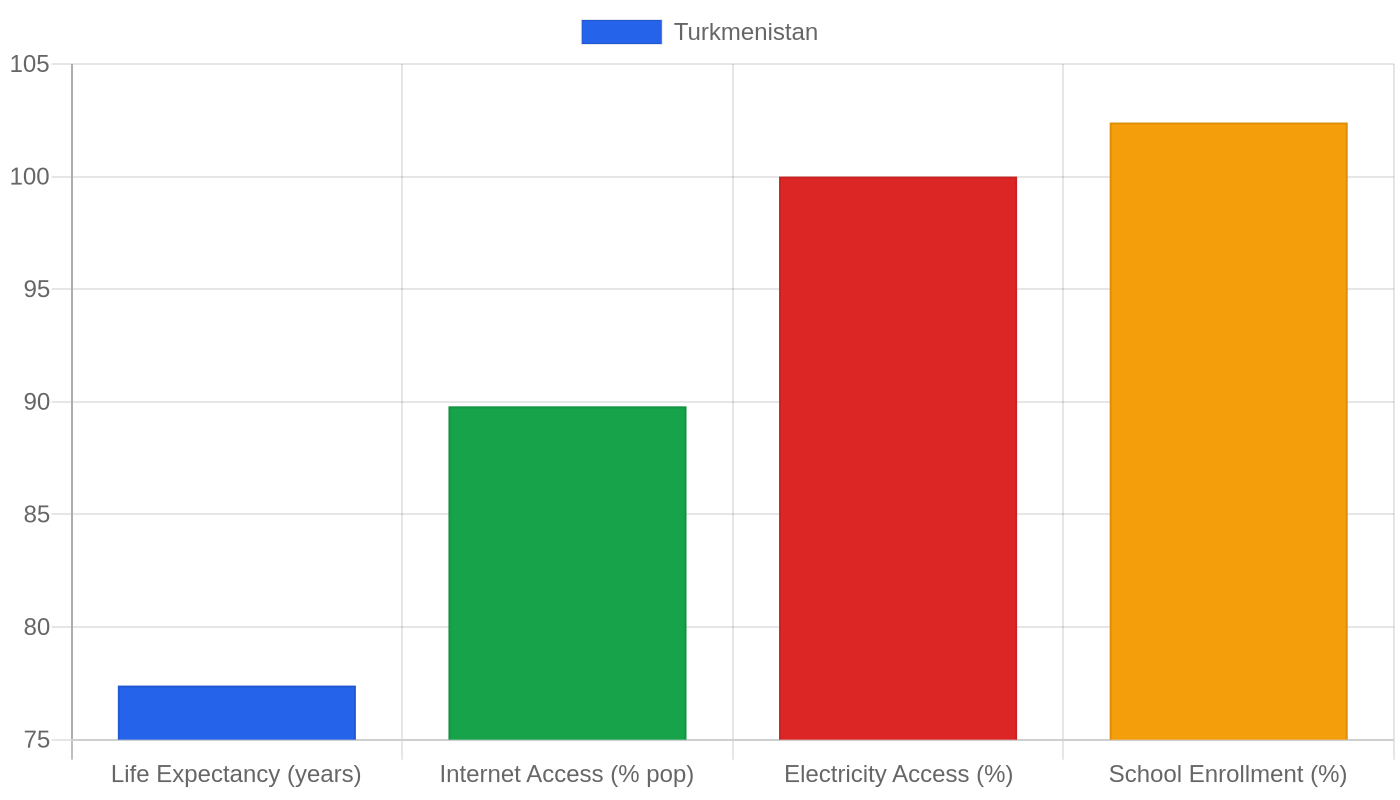
Economic Pulse Net | Sources: World Bank World Development Indicators, Government Sources | 2026
A country with the world’s fourth-largest natural gas reserves remains one of its most opaque economies — and that paradox defines everything about doing business here.
Key Takeaways
– Turkmenistan’s economy is a black box. The World Bank lists GDP growth, inflation, unemployment, GDP, GDP per capita, and GNI per capita all as “N/A” — a statistical silence that is itself the story.
– Energy is everything. The commanding heights belong to Türkmengaz and Türkmennebit, the state gas and oil champions, with telecommunications (MTS Turkmenistan) and rail (Demirýollary) rounding out the corporate landscape.
– The country is a post-Soviet creation.
After 67 years as a Soviet republic and over a century under Russian imperial rule, Turkmenistan declared independence on 27 October 1991.
– Consumer prices, crime data, and living-cost indices are all unpublished — meaning anyone considering investment or relocation is flying blind on the fundamentals.
– Watch the gas export story. With European and Asian buyers hunting for non-Russian molecules, Turkmenistan’s reserves are suddenly geopolitically precious.
An Economy Measured in Pipelines, Not Percentages
Turkmenistan presents one of the strangest puzzles in global economics: a country so richly endowed with natural resources that its leaders have historically felt no need to publish conventional statistics. The World Bank’s data dashboard for Turkmenistan reads like an empty spreadsheet — GDP growth, inflation, unemployment, total GDP, GDP per capita at purchasing power parity, and GNI per capita are all listed as “N/A.” For a journalist, that absence is a finding.
It means the country’s economic performance is assessed not through quarterly releases but through pipeline flows, export contracts, and the occasional presidential decree.
What we do know is structural. The industrial base is dominated by hydrocarbons: Türkmengaz handles gas, Türkmennebit handles oil, and together they constitute the spine of the state budget. Around them sit enablers — Demirýollary, the national railway carrier, moves freight across a landlocked expanse, while MTS Turkmenistan keeps the country connected. The presence of O′zbekiston Pochtasi in the corporate listing hints at the regional postal and logistics interconnections that survive from the Soviet era.
Without published inflation or employment figures, it is impossible to say precisely how ordinary Turkmen households are faring — but the composition of the corporate landscape tells you who holds the cards.
The deeper issue is diversification. A country whose top companies are overwhelmingly extractive or infrastructural has not yet built the broad-based private sector that generates durable middle-class jobs. Until the World Bank can publish a GDP growth number for Turkmenistan, analysts will keep reading the economy through satellite imagery of gas flares and the fine print of export agreements.
What Things Cost — and Why Nobody Outside Ashgabat Really Knows
Cost-of-living data for Turkmenistan is, like much else, unpublished. There is no credible inflation print, no rent index, no grocery basket survey available through the international databases. This is not an oversight — it reflects a governing philosophy in which economic information is treated as a strategic asset rather than a public good. For expatriates and visiting businesspeople, the practical consequence is that budgeting must be done through anecdote and embassy guidance rather than official statistics.
That said, the structure of the economy offers clues. A state that controls gas, oil, rail, and telecoms also controls the pricing of utilities, transport, and connectivity — meaning the cost of living for ordinary citizens is as much a political decision as a market outcome. Housing, in particular, is likely to be heavily influenced by state allocation and subsidised utility provision rather than a functioning mortgage market.
Without a crime index or safety index from the international databases, even the quality-of-life picture remains a matter of inference rather than measurement — a striking gap for a country of Turkmenistan’s strategic weight.
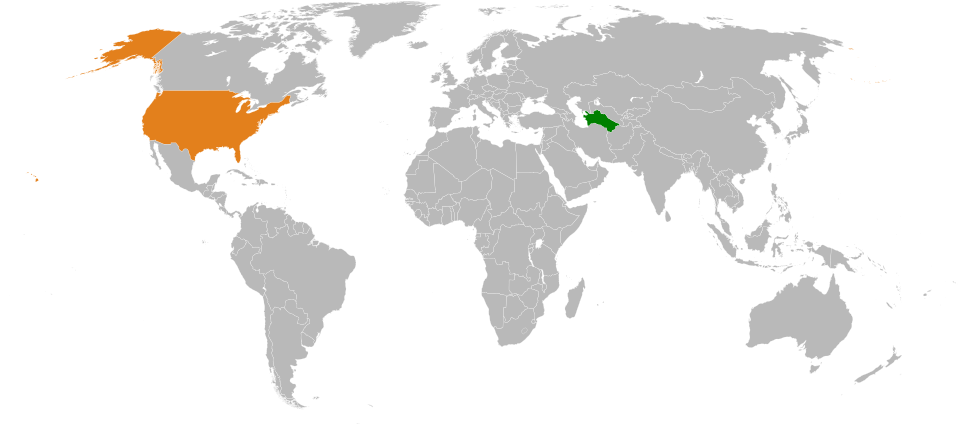
Investment Climate: Rich Subsoil, Thin Rulebook
For investors, Turkmenistan offers a proposition that is simultaneously alluring and frustrating. On the plus side, the country’s gas reserves are among the largest on earth, and Türkmengaz and Türkmennebit are the obvious counterparties for any upstream or midstream deal. MTS Turkmenistan’s presence shows that foreign telecom operators have, at times, found a workable modus vivendi with the state.
Demirýollary’s role in regional freight suggests that transport and logistics — particularly east-west rail corridors — are a sector to watch.
On the minus side, the absence of published GDP, inflation, and unemployment figures makes standard due diligence nearly impossible. You cannot model a project’s returns against a GDP growth trajectory that does not officially exist. You cannot hedge currency risk against an inflation rate that is not disclosed. The business environment, in other words, rewards relationships over spreadsheets — and that favours large, patient, state-linked players over smaller private entrants.
The companies listed here are not a market — they are a command structure with corporate names.
Stability Without Transparency: The Political Economy of Independence
Turkmenistan’s political landscape is inseparable from its history. After more than a century under Russian imperial rule and then 67 years as a Soviet union republic, the country declared independence on 27 October 1991, as the Soviet Union dissolved. That origin story — sudden sovereignty over a vast, sparsely populated, resource-rich territory — explains much about the state’s subsequent instinct to centralise control over both politics and information.
The result is a country that scores as a blank in most international indices. No crime index. No safety index. No happiness data. No unemployment rate. For a journalist, this is the hardest kind of country to write about honestly, because the usual scaffolding of comparative statistics simply isn’t there.
What can be said is that the political system has prioritised stability and sovereignty over transparency and integration — a trade-off that has preserved social order but at the cost of the data-driven governance that modern investors and multilateral lenders expect.
What’s Happening Now: A Gas Giant in a Reordering World
The most consequential story in Turkmenistan today is not a domestic reform or an election — it is the reshaping of global energy flows. As buyers in Europe and Asia reassess their supply chains, Turkmenistan’s vast gas reserves have moved from the periphery of the conversation to something closer to the centre. Türkmengaz, the state gas company, sits at the heart of any scenario in which Central Asian molecules reach new markets.
At the same time, the country’s statistical silence has become more conspicuous, not less. International institutions like the World Bank continue to list Turkmenistan’s core indicators as unavailable, which makes it difficult for lenders, insurers, and trading houses to price risk.
The telecom sector, represented by MTS Turkmenistan, and the rail network run by Demirýollary are the two non-energy sectors most likely to see incremental liberalisation, because connectivity and logistics are the prerequisites for any broader opening. Whether that opening materialises — or whether the state continues to treat information as a strategic reserve — is the defining question of the next several years.
The Bottom Line
Turkmenistan is a country you watch not because its statistics are compelling — they are absent — but because its geography and geology make it unavoidable. Energy strategists, Central Asia specialists, and infrastructure investors with a high tolerance for opacity should keep it on their radar, particularly as global gas markets realign.
For everyone else, Turkmenistan remains a reminder that in the 21st century, the decision not to publish economic data is itself an economic policy — and one with real consequences.
Sources & Methodology
This article is authored by Economic Pulse Net for informational and research purposes. Economic Pulse Net sources its data from multilateral institutions, national statistics bureaus, and proprietary databases. All data is believed to be current as of the date of publication.
Published: September 24, 2026 | Category: Research — Turkmenistan
Use these signals in your own platform
Economic Pulse publishes its live signal feed through a documented, read-only API. Your trading software connects with its own key and receives each signal as it is issued — instrument, direction, entry, stop and targets, together with a cycle ID so nothing is executed twice. The feed is independent of this website and cannot change it.
Signals are informational only and are not financial advice.