Economic Pulse Net | Sources: World Bank World Development Indicators, Government Sources | 2026
Key Takeaways
* Resource-Dependent Economy: The national economic engine is driven almost exclusively by the oil and gas sectors, dominated by state-linked giants like Türkmengaz and Türkmennebit.
Data Opacity: Standard macroeconomic indicators such as GDP growth, inflation, and unemployment figures are currently listed as N/A, reflecting a lack of transparent, internationally verified statistical reporting.
State-Dominated Market: The corporate landscape is defined by large industrial and energy monopolies, with Demirýollary (railways) and MTS Turkmenistan (telecommunications) playing pivotal roles in infrastructure and connectivity.
Post-Soviet Political Structure: The nation operates under a political framework established after its independence from the Soviet Union in 1991, maintaining a centralized governance model that influences all business operations.
Safety and Stability: Specific crime and safety indices are not publicly available, requiring investors to rely on general geopolitical assessments rather than granular security data.
The Invisible Ledger: An Economy Defined by Gas
Turkmenistan’s economic profile presents a unique challenge for international analysts: a resource-rich nation where hard data is conspicuously absent. According to the World Bank, key metrics including GDP growth, inflation CPI, unemployment rates, and even total GDP in USD are recorded as N/A. This statistical void is not merely a gap in reporting; it is a defining characteristic of the country’s economic reality.
Without precise figures on GDP per capita or GNI per capita, traditional models of economic health cannot be applied. Instead, the narrative of Turkmenistan’s economy is told through its industries rather than its spreadsheets. The country remains heavily reliant on its vast natural gas reserves, a dependency that shapes every aspect of its fiscal policy and international trade relationships.
For global investors, this lack of transparency means that risk assessment must rely on qualitative factors—such as government stability and infrastructure development—rather than quantitative trends. The absence of data suggests a closed system where economic performance is managed internally, shielding the populace from external market shocks but also isolating the country from global financial integration.
Consequently, any analysis of Turkmenistan must acknowledge that its true economic weight is likely significant due to energy exports, even if the exact tonnage or value remains obscured from public view.
The Price of Living in a Closed System
Assessing the cost of living in Turkmenistan requires navigating a landscape where standard comparative metrics are unavailable. With no official Consumer Price Index (CPI) data provided by the World Bank, it is impossible to calculate precise inflation rates or compare daily expenses against regional averages. This lack of data extends to housing markets; there are no specific figures regarding rent versus buy costs, making it difficult for expatriates or new residents to budget accurately.
However, the structure of the top companies offers indirect clues about the economic hierarchy. The dominance of state-controlled entities like Türkmengaz and Türkmennebit suggests that essential utilities and energy-related costs may be heavily subsidized or regulated by the state, potentially keeping baseline living costs lower than in free-market economies. Conversely, imported goods and services outside of basic necessities may carry premium prices due to logistical challenges and limited competition.
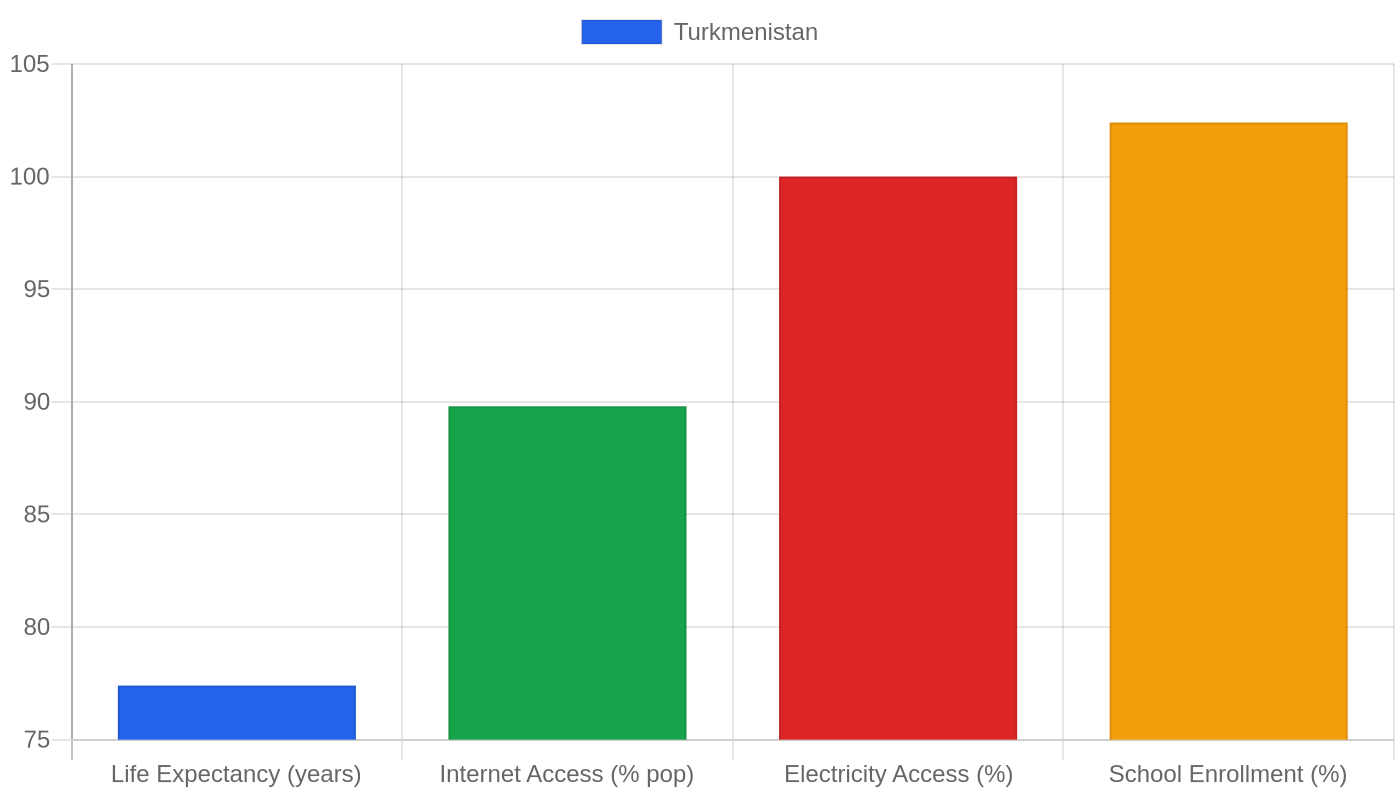
The presence of MTS Turkmenistan in the telecommunications sector indicates a modernized communication infrastructure, which often correlates with higher service fees compared to rural or less developed regions. Ultimately, while the exact dollar amount of a monthly grocery bill or apartment rent is unknown, the economic environment appears structured around state provision of essentials, creating a distinct cost-of-living profile that differs sharply from Western or neighboring Central Asian nations.
State Giants and Industrial Pillars
The business climate in Turkmenistan is characterized by the overwhelming presence of large, state-affiliated corporations that dominate critical sectors. The list of top companies reveals a clear concentration of power in the energy and industrial domains. Türkmengaz and Türkmennebit stand as the twin pillars of the nation’s wealth, controlling the extraction and distribution of oil and gas, respectively.
These entities are not just businesses; they are instruments of national policy and foreign exchange generation. Beyond energy, Demirýollary, the national railway company, plays a crucial role in logistics and domestic connectivity, linking remote resource sites to export hubs. In the telecommunications sector, MTS Turkmenistan provides essential digital infrastructure, facilitating both personal communication and business operations.
Interestingly, the inclusion of O′zbekiston Pochtasi (Industrials) in the list of top companies for Turkmenistan is anomalous and suggests either a cross-border operational partnership or a data classification error, as it is a postal service entity from Uzbekistan. Regardless of this outlier, the core message is clear: Turkmenistan’s private sector is minimal, and most significant economic activity flows through these major industrial players.
Investors looking to enter the market must navigate a landscape where partnerships with state-owned enterprises are often the only viable path to market access.
Governance, Safety, and Social Stability
Understanding the operating environment in Turkmenistan requires a deep dive into its political history and current social indices. Politically, the country emerged from over a century of Russian Empire rule and 67 years as a Soviet Union republic before declaring independence on October 27, 1991. This historical trajectory has left a lasting imprint on the governance structure, which remains highly centralized and insulated from external democratic pressures.
The political landscape is stable but opaque, with decision-making concentrated at the highest levels of government. Regarding safety, specific Crime Indices and Safety Indices are listed as N/A, meaning there is no quantifiable data on street crime, corruption levels, or personal security risks. This absence of data forces observers to rely on broader geopolitical stability assessments rather than local crime statistics.
The quality of life is similarly difficult to gauge through standard metrics like happiness indexes, which are not provided in the current dataset. However, the continuity of the post-Soviet political framework suggests a society accustomed to strong state control and limited political pluralism.
For residents and visitors alike, the primary considerations are likely related to bureaucratic navigation and adherence to local regulations rather than concerns about violent crime, given the lack of reported high-crime indicators.
Current Affairs and Strategic Positioning
In the current landscape, Turkmenistan continues to operate as a strategic energy bridge between Central Asia and global markets, despite its isolation. While recent news feeds do not provide specific updates on new reforms or election cycles, the enduring presence of state giants like Türkmengaz indicates that energy exports remain the central focus of national policy.
The lack of new live indicators suggests a status quo approach, where the government maintains tight control over economic pacing and foreign engagement. There are no visible signs of rapid liberalization or major policy shifts in the immediate short term, implying that the business environment will remain consistent with historical patterns of state-led development.
Any changes in trade agreements or infrastructure projects would likely be announced through official state channels rather than independent media outlets. The continued reliance on Demirýollary for logistics highlights an ongoing effort to maintain internal cohesion and export capacity.
As global energy demands shift, Turkmenistan’s position becomes increasingly critical, yet its closed political nature ensures that these developments will proceed on the government’s own terms, without external pressure for transparency or reform.
The Bottom Line
Turkmenistan remains a paradox for economic journalists and investors: a resource-rich nation shrouded in statistical darkness. Those who should watch this country are primarily energy traders, logistics firms, and geopolitical strategists who understand that value lies in resources, not data. The lack of GDP and inflation figures does not mean the economy is inactive; it means it is unmeasured by conventional standards.
Success in Turkmenistan requires patience, local partnerships, and a willingness to operate in a regime where state interests supersede market signals.
Sources & Methodology
This article is authored by Economic Pulse Net for informational and research purposes. Economic Pulse Net sources its data from multilateral institutions, national statistics bureaus, and proprietary databases. All data is believed to be current as of the date of publication.
Published: October 02, 2026 | Category: Research — Turkmenistan
Use these signals in your own platform
Economic Pulse publishes its live signal feed through a documented, read-only API. Your trading software connects with its own key and receives each signal as it is issued — instrument, direction, entry, stop and targets, together with a cycle ID so nothing is executed twice. The feed is independent of this website and cannot change it.
Signals are informational only and are not financial advice.