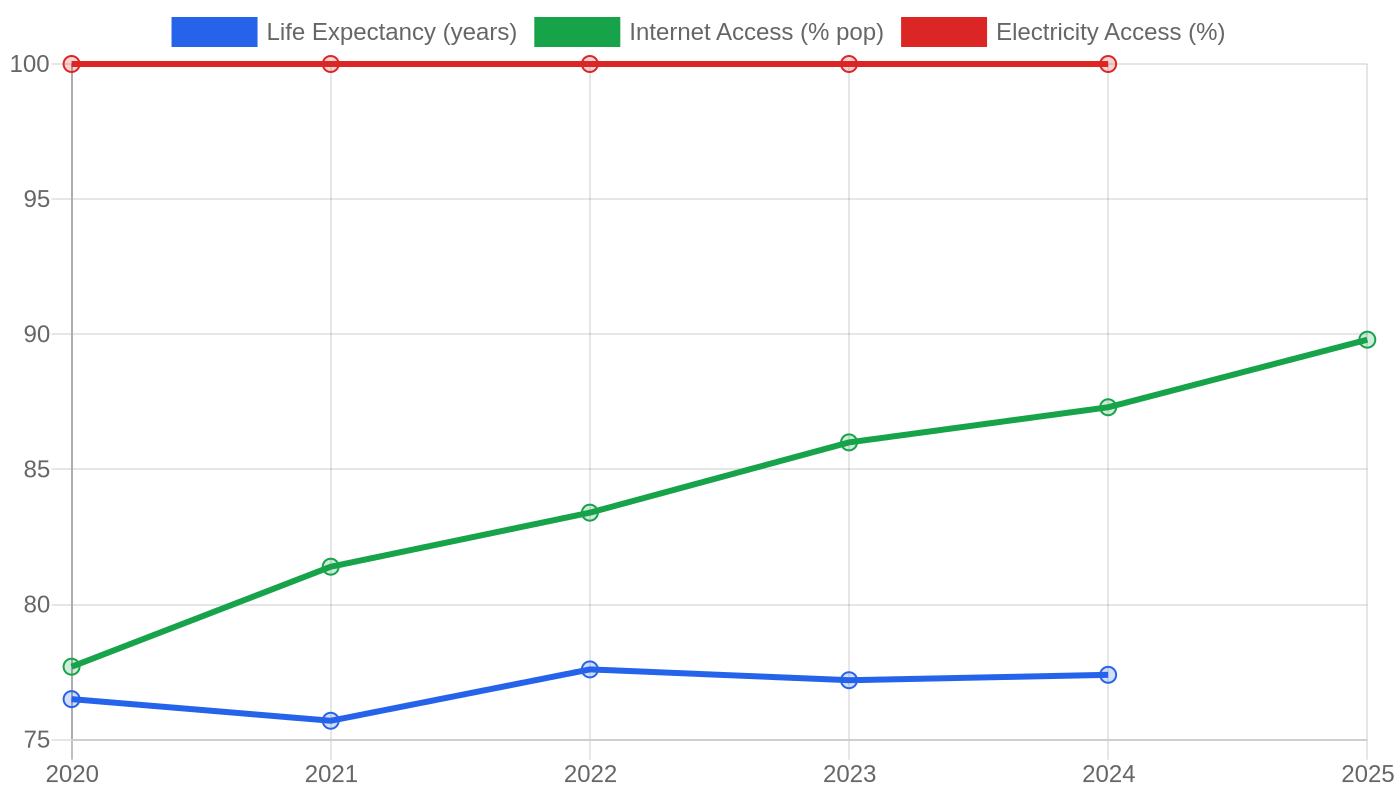
Economic Pulse Net | Sources: World Bank World Development Indicators, Government Sources | 2026
Key Takeaways
* Energy Dominance: The economy remains heavily anchored by the oil and gas sectors, dominated by state-controlled giants like Türkmengaz and Türkmennebit.
Data Opacity: Comprehensive macroeconomic indicators, including GDP growth, inflation, and unemployment figures, are currently listed as unavailable, reflecting a lack of transparent statistical reporting.
State-Led Structure: Major industrial and telecommunications operations, such as Demirýollary and MTS Turkmenistan, operate under significant state influence or ownership.
Historical Context: As a former Soviet republic that declared independence in October 1991, the nation’s political and economic structures remain deeply influenced by its century-long history within the Russian Empire and the USSR.
Safety and Stability: Specific crime and safety indices are not publicly quantified, requiring investors to rely on broader geopolitical assessments rather than granular security metrics.
The Architecture of an Isolated Economy
Turkmenistan’s economic profile is defined less by dynamic market fluctuations and more by the sheer weight of its natural resource endowments. The country possesses vast reserves of natural gas, which serve as the primary engine for its national wealth, though precise contribution metrics to the Gross Domestic Product (GDP) remain obscured from international view.
According to the World Bank, specific data points for GDP growth, inflation CPI, and unemployment rates are marked as “N/A,” indicating a significant gap in real-time economic transparency. This lack of detailed statistical disclosure makes it challenging for global analysts to gauge the immediate health of the consumer sector or the labor market. Consequently, the economy is often viewed through the lens of production capacity rather than consumption patterns.
The absence of GDP per capita PPP and GNI per capita figures further complicates efforts to assess individual prosperity or income distribution among the populace. Without these critical benchmarks, external observers must infer economic vitality primarily through the output of major energy exports and infrastructure development projects. The opacity suggests a closed system where internal economic health is determined by state planning rather than open market feedback loops.
Understanding this dynamic is crucial for any entity looking to engage with the Turkmen market, as traditional valuation models may not apply in the same way they do in emerging markets with higher data visibility.
The High Cost of Living in a Closed Market
While specific cost-of-living metrics are not provided in the available dataset, the structure of daily expenses in Turkmenistan is likely shaped by the state’s control over essential goods and services. In economies where key utilities and transportation are managed by state-owned enterprises, prices may be subsidized or fixed, creating a unique disparity between official costs and black-market realities.
Housing costs, rent versus buy dynamics, and general daily expenses are difficult to benchmark against regional averages due to the lack of standardized retail price indices. However, the presence of major players like MTS Turkmenistan in the telecommunications sector indicates a modernized, albeit restricted, digital infrastructure that consumers must pay for.
The isolation of the country means that imported goods, which constitute a significant portion of luxury or specialized items, likely carry premium price tags due to logistical complexities and limited competition. For expatriates and foreign businesses, the financial burden is often compounded by the need to navigate informal payment systems or secure housing through state allocations rather than open rental markets.
This environment creates a high barrier to entry for casual economic participation, favoring those with established local connections or state-backed contracts. The daily economic experience for the average citizen is thus mediated by availability and state provision rather than pure market forces.
Investment Landscape and Corporate Powerhouses
The corporate landscape in Turkmenistan is characterized by large, state-dominated entities that control strategic sectors of the economy. Türkmengaz and Türkmennebit stand out as the pillars of the energy sector, managing the extraction and export of the country’s most valuable resource. These companies are not merely participants in the market but are effectively the market, dictating terms for domestic and international engagement.
In the industrial sector, Demirýollary plays a critical role in logistics and transport, ensuring the movement of goods across the nation’s vast territory. Meanwhile, MTS Turkmenistan dominates the telecommunications industry, providing the digital backbone for both personal and commercial communications.
Interestingly, the list of top companies also includes O′zbekiston Pochtasi, an industrial entity from Uzbekistan, which may indicate cross-border logistical partnerships or shared infrastructure interests within the Central Asian region. For investors, the business environment is one where relationships with state-owned enterprises are paramount.
Success in this market rarely comes from disruptive innovation but rather from aligning with national priorities and securing favorable positions with these incumbent giants. The concentration of power in these few hands means that regulatory changes or policy shifts can have immediate and profound impacts on operational viability.
Safety, Politics, and Social Stability
Turkmenistan’s political landscape is rooted in its complex history, having spent over a century under the Russian Empire and then the Soviet Union before declaring independence on 27 October 1991. This long period of integration into larger imperial structures has left a lasting imprint on the nation’s governance style, which tends to prioritize stability and central control.
Regarding personal safety, specific Crime Index and Safety Index scores are not available, leaving potential residents and visitors without quantitative measures of risk. This lack of data does not necessarily imply danger, but rather a lack of public reporting mechanisms that are common in more open societies. The quality of life is therefore assessed through qualitative observations of social order and political calmness rather than statistical safety records.
The transition from a Soviet republic to an independent nation has been managed in a way that maintains strong state authority, minimizing the kind of political volatility seen in other post-Soviet states. For the average citizen, this translates to a predictable, if rigid, social environment where deviation from state norms is discouraged. The absence of vibrant civil society institutions further reinforces this top-down approach to social management.
Current Affairs and Strategic Direction
The current affairs in Turkmenistan are largely driven by the imperative to leverage its natural gas reserves in a changing global energy market. With no recent news items or live indicators provided in the dataset, the narrative focuses on the enduring structural realities of the state. The government continues to prioritize energy exports, particularly to neighboring China, as the cornerstone of its foreign policy and economic strategy.
There is little indication of rapid liberalization or democratic reform, suggesting that the political status quo will remain intact in the near term. Any developments in the telecom or industrial sectors are likely incremental, aimed at improving efficiency rather than opening up to private enterprise. The inclusion of Uzbekistan’s postal service in the top companies list hints at ongoing regional cooperation initiatives, possibly related to transit corridors or trade facilitation.
These subtle shifts in regional connectivity suggest that while internally closed, Turkmenistan is carefully engaging with its neighbors to maintain economic relevance. The focus remains on maintaining sovereignty and controlling the pace of change, ensuring that external pressures do not destabilize the internal political order.
The Bottom Line
Turkmenistan remains a unique case study in state-controlled capitalism, where energy wealth provides stability but limits transparency. Investors and researchers should watch this country primarily for developments in energy export contracts and regional transit agreements. The lack of accessible economic data requires a cautious, relationship-based approach to any business engagement.
Ultimately, Turkmenistan offers limited opportunities for conventional investment but holds strategic importance for regional energy security.
Sources & Methodology
This article is authored by Economic Pulse Net for informational and research purposes. Economic Pulse Net sources its data from multilateral institutions, national statistics bureaus, and proprietary databases. All data is believed to be current as of the date of publication.
Published: October 17, 2026 | Category: Research — Turkmenistan
Use these signals in your own platform
Economic Pulse publishes its live signal feed through a documented, read-only API. Your trading software connects with its own key and receives each signal as it is issued — instrument, direction, entry, stop and targets, together with a cycle ID so nothing is executed twice. The feed is independent of this website and cannot change it.
Signals are informational only and are not financial advice.