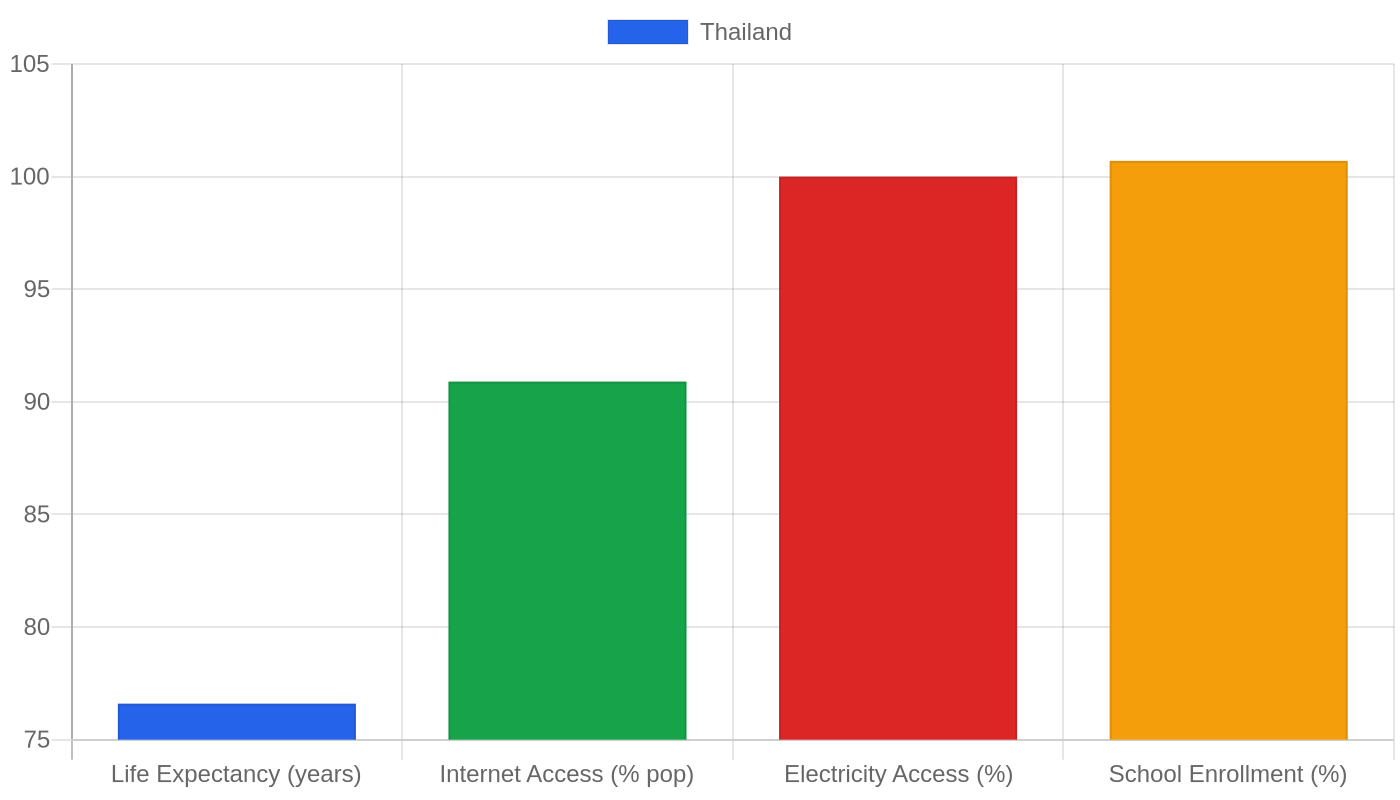
Economic Pulse Net | Sources: World Bank World Development Indicators, Government Sources | 2026
Key Takeaways
– Thailand’s GDP per capita (PPP) stands at $26,250.07 according to the World Bank, positioning it as an upper-middle-income economy in Southeast Asia, though recent growth data remains unavailable.
– The country’s political evolution from absolute monarchy to constitutional rule since 1932 continues to shape its business environment and institutional stability.
– Major listed companies span telecommunications, industrials, and consumer services, with Airports of Thailand PCL and Advanced Info Service leading market capitalization.
– Thailand’s cost of living remains competitive regionally, though housing affordability varies sharply between Bangkok and secondary cities.
– The absence of recent GDP growth and inflation data from the World Bank creates uncertainty for investors monitoring the post-pandemic recovery trajectory.
The Elephant in the Room — Thailand’s Economic Engine at Idle
Thailand’s economy, measured by the World Bank at a GDP per capita (PPP) of $26,250.07, occupies a curious position in Southeast Asia. This figure places the kingdom comfortably above neighbors like Vietnam and the Philippines, yet below Singapore and Malaysia. The number tells a story of a country that modernized rapidly during the late 20th century but now faces the challenge of escaping the “middle-income trap” that has ensnared many developing Asian economies.
The World Bank data reveals a critical gap: no recent GDP growth figure is available. For an economy that historically relied on a powerful mix of tourism, automotive manufacturing, and agricultural exports, this silence is telling. Thailand’s growth trajectory has been buffeted by political turbulence, the pandemic’s devastation of its tourism sector, and structural challenges in upgrading its industrial base.
The inflation CPI figure is also absent from the World Bank’s latest release, leaving analysts to piece together the picture from anecdotal evidence of rising food and energy costs that have squeezed household budgets across Bangkok’s sprawling suburbs and the rice paddies of Isaan.
Unemployment data remains similarly opaque. Thailand has long maintained relatively low official unemployment compared to regional peers, but this masks significant underemployment and a large informal economy.
The World Bank’s numbers suggest a statistical vacuum that itself tells a story—of an economy in transition where traditional measurement frameworks may be struggling to capture the reality of gig workers, street vendors, and the millions employed in family-run SMEs that form the backbone of domestic consumption.
The Price of Paradise — Housing and Daily Life in the Land of Smiles
Thailand’s cost of living has long been a double-edged sword. For foreign retirees and digital nomads, the kingdom offers a lifestyle where a comfortable existence costs a fraction of what it would in Tokyo or Singapore. But for the Thai middle class, particularly in Bangkok, housing costs have escalated dramatically over the past decade.
The gap between rent and buy has widened, with condominium prices in central Bangkok pushing many young professionals toward the suburbs and longer commutes on the city’s elevated rail network.
Daily expenses for essentials like street food, local transportation, and utilities remain remarkably low by international standards. A meal from a Bangkok street vendor can cost as little as 40 to 60 baht, while a monthly electricity bill for a modest apartment rarely exceeds 1,500 baht. However, these figures mask significant regional disparities. In Chiang Mai or Khon Kaen, housing costs drop by half or more compared to the capital, but job opportunities and public services thin out correspondingly.
The World Bank’s data does not provide specific cost-of-living indices, but the GDP per capita (PPP) figure of $26,250.07 suggests that purchasing power for the average Thai remains constrained relative to developed economies, even as the kingdom offers exceptional value for visitors and expatriates earning foreign currency.
Titans of Industry — Thailand’s Corporate Landscape and Investment Climate
Thailand’s stock exchange hosts a diverse array of companies that reflect the economy’s strengths and vulnerabilities. Airports of Thailand PCL stands as an industrial giant, managing the kingdom’s major international gateways and serving as a bellwether for tourism recovery. Advanced Info Service dominates the telecommunications sector, capitalizing on Thailand’s high smartphone penetration and digital economy growth.
The presence of companies like 108 Shop and 2Spot Communications in the consumer services category signals the rise of e-commerce and digital marketing, sectors that have boomed as traditional retail struggles.
The industrials category is particularly revealing, with companies like 3K Battery and Air People International pointing to Thailand’s role as a regional manufacturing hub. The kingdom has long been a center for automotive production, particularly for Japanese manufacturers, and the battery company’s presence hints at potential pivots toward electric vehicle supply chains.
Areeya Property represents the financials and real estate sector, which has seen boom-and-bust cycles tied to political stability and foreign investment flows.
The business climate in Thailand offers both opportunities and obstacles. Foreign investors appreciate the kingdom’s strategic location, developed infrastructure, and relatively skilled workforce. However, opaque regulations, occasional policy unpredictability following political changes, and the dominance of family-owned conglomerates can frustrate newcomers.
The political landscape section of the World Bank data notes Thailand’s evolution from absolute monarchy to constitutional rule in 1932, a transition that established the framework for modern capitalism but also sowed the seeds for recurring tensions between traditional elites and reformist movements.
A Kingdom of Contrasts — Safety, Politics, and the Quality of Life Equation
Thailand’s safety profile presents a study in contradictions. The Crime Index and Safety Index data from the World Bank are listed as unavailable, which is itself significant. The kingdom has long maintained a reputation as a safe destination for tourists, with violent crime rates low compared to many developing countries. Petty theft, scams targeting visitors, and traffic accidents pose more immediate risks than serious criminal violence.
However, political protests have periodically erupted into street clashes, and the southern border provinces experience a long-running insurgency that receives little international attention.
The political landscape, as documented in the provided data, traces a remarkable arc from feudal absolutism to modern statehood. Prior to 1932, Thai kings ruled as absolute monarchs or, during the Sukhothai Kingdom, as dharmarajas governing in accordance with Buddhist principles. King Chulalongkorn transformed the decentralized protectorate system into a unitary state, laying the groundwork for modern Thailand.
The bloodless revolution of June 24, 1932, carried out by the People’s Party (Khana Ratsadon), ended absolute monarchy and began Thailand’s fitful experiment with constitutional governance. This history matters for the economy because political uncertainty has repeatedly disrupted investment cycles, with coups and constitutional rewrites creating an environment where long-term planning becomes difficult.
Quality of life in Thailand extends beyond economic metrics. The kingdom offers universal healthcare through its gold card scheme, strong social bonds in rural communities, and a cultural richness that draws millions of visitors annually.
Yet the same GDP per capita (PPP) figure of $26,250.07 that signals middle-income status also highlights the limits of public services, environmental degradation in tourist hotspots, and the persistent gap between Bangkok’s glittering skyline and the agrarian poverty of the northeast.
The Waiting Game — Thailand’s Economy in Suspense
The most striking feature of Thailand’s current economic moment is the absence of data. With the World Bank providing no recent GDP growth, inflation, or unemployment figures, analysts and investors are operating in a fog. This data vacuum may reflect genuine statistical challenges in capturing an economy that has undergone dramatic structural shifts since the pandemic.
Tourism, which once accounted for roughly 12 percent of GDP and employed millions, has recovered only partially, while new sectors like data centers, electric vehicle manufacturing, and medical tourism have emerged as potential growth drivers.
The political landscape remains in flux, with the legacy of the 1932 revolution still contested. Recent years have seen youth-led protests calling for reform of the monarchy and military’s role in politics, raising questions about the stability that foreign investors prize. The telecommunications and consumer services sectors, represented by companies like Advanced Info Service and 108 Shop, continue to expand as digital adoption accelerates.
But the absence of hard economic data from the World Bank means that policymakers are navigating without a compass, relying on anecdotal evidence and partial indicators to gauge whether the economy is heating up or cooling down.
Thailand’s major trading partners, particularly China and Japan, face their own economic headwinds, and the kingdom’s export-dependent sectors feel every tremor in global demand. The industrial companies listed in the data—Airports of Thailand, 3K Battery, Air People International—are all exposed to international travel and trade flows that remain below pre-pandemic peaks.
For now, Thailand appears to be waiting: waiting for clearer data, waiting for political stability, waiting for the next wave of foreign investment that could propel it past the middle-income threshold.
The Bottom Line
Thailand deserves attention from investors who understand that its potential remains immense but conditional on political and statistical transparency. The GDP per capita (PPP) figure of $26,250.07 from the World Bank confirms a sophisticated economy with real purchasing power, but the missing growth and inflation data should give pause. For travelers, retirees, and businesses seeking a Southeast Asian base with world-class infrastructure and cultural appeal, Thailand remains compelling.
But for those requiring predictability and clear economic signals, the kingdom’s current opacity demands caution. Watch Thailand closely—when the data returns, it will tell us whether this ancient kingdom has found its footing in the modern global economy.
Sources & Methodology
This article is authored by Economic Pulse Net for informational and research purposes. Economic Pulse Net sources its data from multilateral institutions, national statistics bureaus, and proprietary databases. All data is believed to be current as of the date of publication.
Published: July 29, 2026 | Category: Research — Thailand
Use these signals in your own platform
Economic Pulse publishes its live signal feed through a documented, read-only API. Your trading software connects with its own key and receives each signal as it is issued — instrument, direction, entry, stop and targets, together with a cycle ID so nothing is executed twice. The feed is independent of this website and cannot change it.
Signals are informational only and are not financial advice.