Economic Pulse Net | Sources: World Bank World Development Indicators, Government Sources | 2026
Key Takeaways
* Deflationary Signals: Thailand is experiencing a rare economic contraction in prices, with CPI inflation registering at -0.13%, signaling weak domestic demand or significant supply-side pressures.
Growth Modest but Stable: The economy is projected to grow by approximately 2.44% in 2025, reflecting a cautious recovery rather than an explosive boom.
Labor Market Tightness: With unemployment sitting at a remarkably low 0.78%, the country faces potential labor shortages despite slower overall growth.
Digital-First Corporate Landscape: Major economic players are shifting toward consumer services and telecommunications, highlighted by firms like Advanced Info Service and 108 Shop leading the charge.
Historical Political Context: The modern state rests on a foundation of transition from absolute monarchy to constitutional governance, a legacy that continues to influence policy stability.
Economic Pulse: Growth Amidst Price Contraction
Thailand’s economic trajectory for 2025 presents a complex picture of modest expansion coupled with unusual price dynamics. According to World Bank data, the nation’s GDP is projected to grow by 2.44% this year, indicating a steady but restrained pace of recovery. However, the most striking indicator is the Consumer Price Index (CPI), which stands at -0.13%.
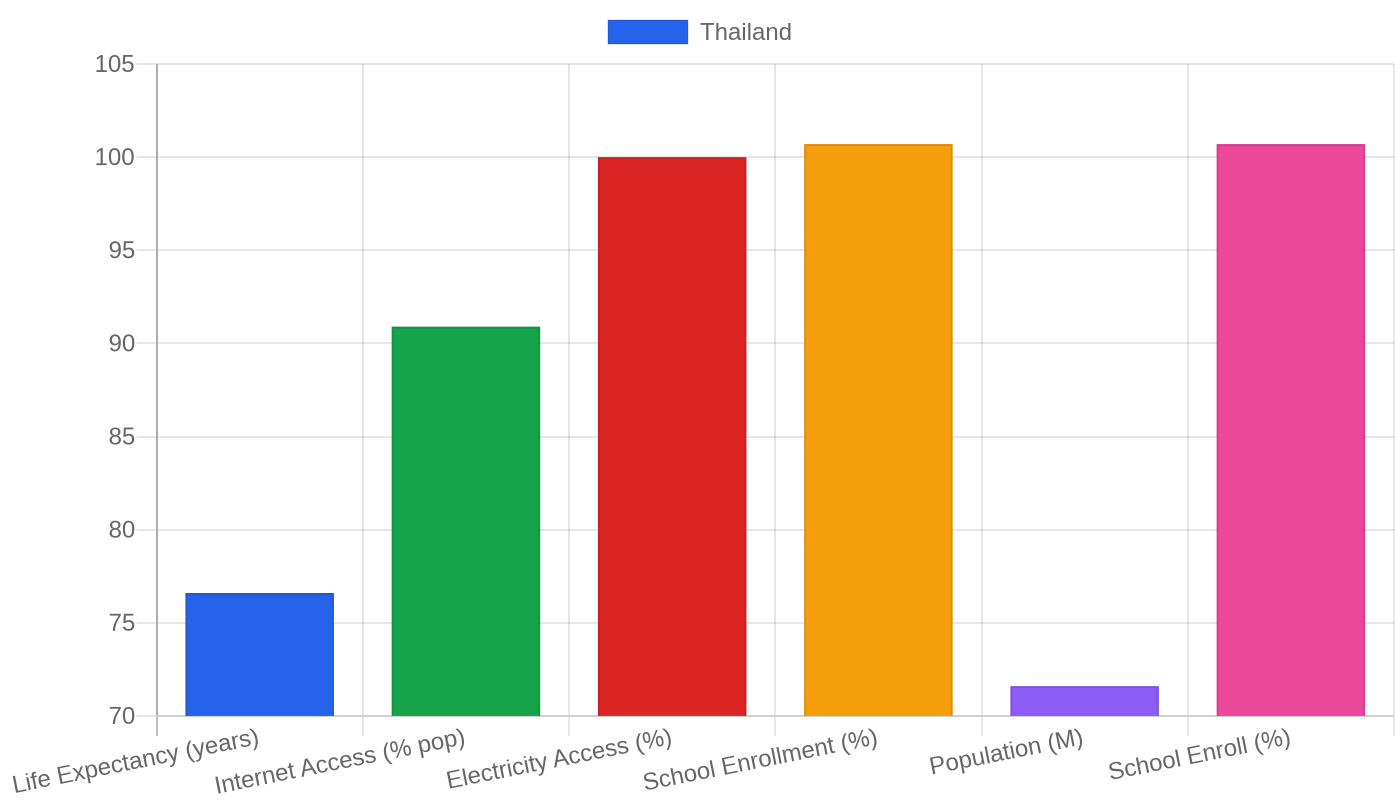
This negative inflation rate suggests that consumers are facing deflationary pressure, which can stifle business investment if not offset by strong wage growth or export demand. Despite these headwinds, the total GDP in USD remains robust at roughly $577 billion, supporting a population of over 71.6 million people. On a per-capita basis, the PPP-adjusted figure sits at $26,250, while the GNI per capita is recorded at $7,690, highlighting a disparity between purchasing power parity and nominal income levels.
The extremely low unemployment rate of 0.78% further complicates the narrative; typically, such low joblessness drives inflation up through wage pressures, yet here it coexists with falling prices. This anomaly may point to structural shifts in the labor market or specific sectoral weaknesses that are dragging down aggregate demand. Understanding this duality is crucial for investors, as it suggests an economy where jobs are plentiful, but spending power and price expectations are contracting.
Living Costs and Housing Dynamics
While precise cost-of-living metrics are not explicitly detailed in the current dataset, the macroeconomic indicators provide strong clues about household financial conditions. The negative CPI of -0.13% implies that the general cost of goods and services is either stabilizing or slightly decreasing, which could offer some relief to households struggling with previous inflation spikes.
However, the gap between GDP per capita (PPP) of $26,250 and GNI per capita of $7,690 suggests that local purchasing power is significantly higher than nominal international earnings might suggest. For residents, this means that daily expenses, including housing and utilities, may be relatively affordable compared to high-income economies, even if wages appear modest in global terms.
The low unemployment rate of 0.78% indicates that finding work is not a primary barrier to accessing these living standards, though it may also indicate a tight labor market where workers have limited bargaining power. Without specific rental yield data, one must infer that housing affordability is likely tied closely to the broader trend of deflation, potentially keeping real estate prices stable or softening them in non-tourist hubs.
This environment favors savers but challenges businesses reliant on rising consumer prices for margin expansion.
Investment & Business Climate: The Rise of Services and Tech
The corporate landscape in Thailand is undergoing a notable transformation, moving away from traditional heavy industry toward consumer-centric and digital services. Leading companies such as Advanced Info Service dominate the telecommunications sector, reflecting the critical role of connectivity in the modern Thai economy. In the consumer services space, firms like 108 Shop and 2Spot Communications are emerging as key players, suggesting a vibrant retail and digital engagement ecosystem.
Industrials remain relevant, with entities like 3K Battery and Airports of Thailand PCL ensuring that infrastructure and energy storage capabilities keep pace with growth. Education is also represented in the top tier with Aksorn Education, indicating sustained investment in human capital development. For foreign investors, the presence of these diverse sectors—from telecommunications to property management via Areeya Property—offers multiple entry points into the market.
The concentration of companies in consumer services highlights a domestic demand focus, even amidst deflationary trends. Businesses looking to enter Thailand should consider partnerships with established telecom and service providers to navigate the local regulatory and cultural landscape effectively.
Safety, Politics & Quality of Life
Safety indices for Thailand are currently listed as N/A, leaving a gap in quantifiable crime and safety data for prospective expatriates and investors. However, the political landscape offers a more defined context for long-term planning. Historically, Thailand transitioned from feudal absolutism to a unitary state under King Chulalongkorn, and later to a constitutional system following the bloodless revolution of June 24, 1932, by the Khana Ratsadon (People’s Party).
This historical shift established the framework for modern governance, balancing monarchical tradition with democratic institutions. While specific happiness data is not provided in the current dataset, the stability of the political structure since 1932 suggests a degree of institutional continuity. The absence of explicit crime statistics does not negate the importance of security considerations, but the historical resilience of the state implies a managed political environment.
Investors should monitor political developments closely, as the legacy of the 1932 revolution continues to shape the balance of power between civilian governments and other state actors. Quality of life is likely influenced by the low unemployment and moderate cost pressures, creating a baseline of social stability.
Current Affairs: Navigating Deflationary Trends
The freshest developments in Thailand center on its unique economic position in 2025-2026. With GDP growth locked at 2.44% and inflation turning negative at -0.13%, policymakers are likely grappling with how to stimulate demand without triggering currency instability. The extremely low unemployment rate of 0.78% suggests that the labor market is fully utilized, yet this has not translated into wage-driven inflation.
This scenario often prompts central banks to consider monetary easing or fiscal stimulus to encourage consumption. Recent corporate movements, such as the prominence of digital service providers like 2Spot Communications, indicate that the private sector is adapting to a digital-first reality. Meanwhile, the industrial sector, anchored by companies like 3K Battery, is focusing on sustainability and infrastructure, aligning with global trends.
The political backdrop remains static but influential, with the constitutional framework established in the early 20th century continuing to provide a predictable, if complex, governance structure. As the year progresses, the interplay between these deflationary signals and solid growth figures will define Thailand’s economic narrative.
The Bottom Line
Thailand presents a paradoxical opportunity for observers: a stable, growing economy with a nearly full labor force, yet facing deflationary pressures that challenge conventional growth models. Investors should watch this country closely, particularly those interested in consumer services, telecommunications, and industrials, where leading firms are already establishing dominance.
The historical political stability provides a reliable backdrop for long-term commitments, despite the lack of current safety index data. Ultimately, Thailand is a market where structural strengths in services and infrastructure must be balanced against the need to reignite consumer price growth.
Sources & Methodology
This article is authored by Economic Pulse Net for informational and research purposes. Economic Pulse Net sources its data from multilateral institutions, national statistics bureaus, and proprietary databases. All data is believed to be current as of the date of publication.
Published: September 30, 2026 | Category: Research — Thailand
Use these signals in your own platform
Economic Pulse publishes its live signal feed through a documented, read-only API. Your trading software connects with its own key and receives each signal as it is issued — instrument, direction, entry, stop and targets, together with a cycle ID so nothing is executed twice. The feed is independent of this website and cannot change it.
Signals are informational only and are not financial advice.