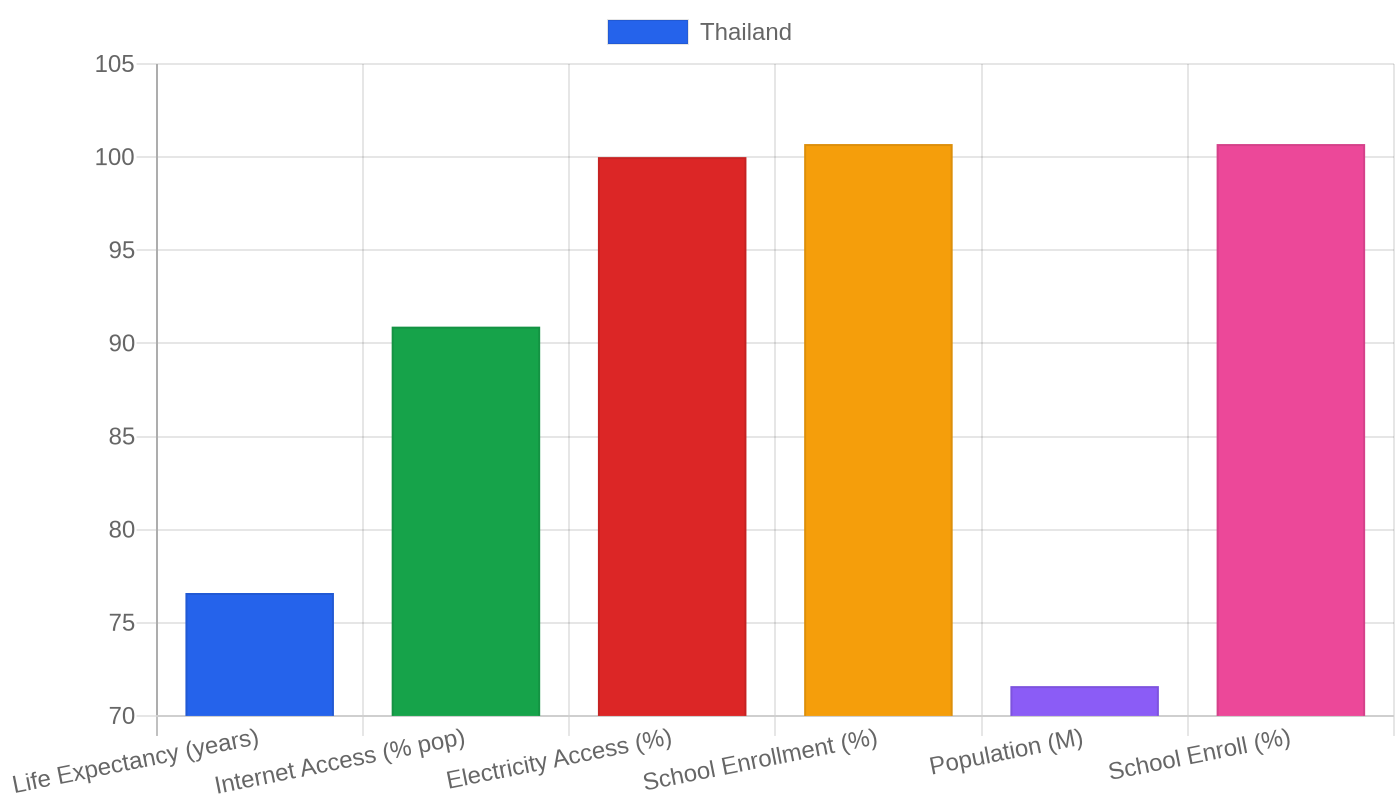
Economic Pulse Net | Sources: World Bank World Development Indicators, Government Sources | 2026
🇹🇭 Thailand 2025: Steady Growth Amidst Deflationary Pressures
Key Takeaways
- Thailand’s economy is growing at a modest pace of 2.44% in 2025, according to World Bank data, signaling stability rather than explosive expansion.
- Inflation has turned negative at -0.13%, suggesting a deflationary environment that may impact consumer spending and corporate revenues.
- The labor market remains exceptionally tight, with unemployment hovering at a mere 0.78%, indicating a robust demand for workers.
- The country’s GDP stands at approximately $577 billion, with a GDP per capita (PPP) of around $26,250, positioning it firmly as an upper-middle-income nation.
- The business landscape is dominated by service-oriented firms, including telecommunications, consumer services, and industrial logistics, reflecting a mature and diversified economy.
The Macro Picture: Stability in a Cooling Market
The economic heartbeat of Thailand in 2025 is characterized by a delicate balance between consistent growth and cooling price levels.
According to the World Bank, the country’s GDP is projected to grow by 2.44%, a figure that suggests a steady, if not rapid, expansion of economic output.
This level of growth is indicative of an economy that is resilient but not in a boom phase, likely driven by a combination of stable domestic consumption and ongoing industrial activity.
The total GDP value of approximately $577 billion underscores Thailand’s status as one of the largest economies in the region, providing a significant base for both domestic and international investors.
However, the deflationary signal is the most critical aspect of the current macroeconomic environment.
With Consumer Price Index (CPI) inflation recorded at -0.13%, the economy is experiencing a slight decline in the general price level.
In plain English, this means that goods and services are becoming marginally cheaper on average.
While this might sound beneficial for consumers, sustained deflation can lead to delayed spending as buyers wait for further price drops, which can ultimately slow down economic momentum.
The extremely low unemployment rate of 0.78% suggests that the labor market is nearly at full capacity, with very few available jobs for those seeking work.
This tight labor market could exert upward pressure on wages, potentially offsetting some of the deflationary effects on household income, but it also limits the ability of businesses to expand rapidly due to a lack of available workforce.
Living in the Land of Smiles: Cost and Affordability
For residents and visitors alike, the cost of living in Thailand continues to be a defining feature of its appeal, though the specific daily expense breakdowns are not detailed in the current dataset.
The GDP per capita on a purchasing power parity (PPP) basis is estimated at $26,250, which provides a clearer picture of the actual standard of living and purchasing power within the country compared to global averages.
This figure suggests that while nominal incomes may vary, the cost of goods and services allows for a comfortable standard of living for the middle class.
The GNI per capita stands at $7,690, highlighting the gap between the market value of economic output and the actual income available to residents, a common metric for assessing national wealth distribution.
Given the negative inflation rate, the cost of daily essentials is likely stable or slightly decreasing, which can be a relief for households facing global economic uncertainties.
The tight labor market, evidenced by the sub-1% unemployment rate, implies that wages are likely firm, helping to maintain household spending power despite the broader economic cooling.
While specific housing costs are not provided, the overall economic indicators suggest a market where affordability remains a key driver for both domestic mobility and international relocation, particularly for those seeking a high quality of life relative to their income.
Business Landscape: Services Lead the Charge
The corporate sector in Thailand is heavily weighted toward consumer services and telecommunications, reflecting a mature service-based economy.
Among the top listed companies, Advanced Info Service stands out in the telecommunications sector, a critical infrastructure component for a digitalizing society.
In the consumer services space, companies like 108 Shop and Air Andaman indicate a vibrant retail and tourism-related sector, which is historically a pillar of the Thai economy.
The presence of industrials such as 3K Battery and Air People International suggests that manufacturing and logistics remain significant contributors, providing the backbone for export-oriented production.
The diversity of these top companies, ranging from education providers like Aksorn Education to property developers like Areeya Property, illustrates a broad-based market with opportunities across multiple sectors.
The focus on consumer services hints at a domestic market that is still growing in terms of spending capacity, while the industrial presence ensures that Thailand remains competitive in global supply chains.
For investors, this mix offers a balanced portfolio of defensive consumer plays and growth-oriented industrial opportunities, all underpinned by a stable regulatory environment.
Governance and Social Stability
The political landscape of Thailand is rooted in a complex history that transitioned from feudal monarchy to a modern unitary state.
Prior to 1932, the Thai kings were absolute monarchs, ruling through a network of tributaries and local lords.
The pivotal moment in modern Thai political history occurred on June 24, 1932, when the Khana Ratsadon (People’s Party) carried out a bloodless revolution, marking the beginning of a constitutional monarchy.
This historical shift established the framework for the modern state, although the balance of power between the military, the monarchy, and elected government has remained a dynamic and often contentious issue in the decades since.
While specific crime and safety indices are not available in the current data, the political history suggests a society that has navigated significant structural changes while maintaining a degree of social order.
The stability of the currency and the consistency of economic data imply a functioning administrative state capable of managing economic policy.
The low unemployment rate further suggests that social tensions related to job insecurity are minimal, contributing to a generally stable social fabric.
However, observers should remain aware of the historical complexities in Thai governance, which can influence policy consistency and long-term planning.
Current Affairs: Navigating Deflation and Labor Constraints
The most pressing issue for Thailand’s economy in 2025 is the management of deflationary pressures.
With inflation at -0.13%, policymakers are likely focusing on stimulating demand without overheating the economy.
The near-full employment rate of 0.78% creates a unique challenge; while it is a positive indicator for workers, it limits the flexibility of businesses to scale up operations quickly without significant wage increases.
This dynamic suggests that future growth will depend heavily on productivity gains rather than simply adding more workers.
The service sector, led by telecommunications and consumer services, is likely to play a crucial role in driving this growth.
Companies like Advanced Info Service are positioned to benefit from continued digital adoption, which can boost productivity across other sectors.
The industrial players, such as 3K Battery, must navigate global supply chain shifts while maintaining competitiveness in a low-inflation environment.
The overall sentiment is one of cautious optimism, where stability is the primary goal, and the economy is expected to continue its slow but steady climb, provided that deflation does not deepen into a more severe economic slowdown.
The Bottom Line
Thailand in 2025 presents a case study in steady-state economics.
For investors, the country offers stability through its diversified service and industrial sectors, with the low unemployment rate serving as a strong indicator of domestic economic health.
However, the deflationary trend requires careful monitoring, as it could signal broader demand weaknesses.
Those looking to engage with the Thai market should focus on sectors that benefit from digitalization and consumer resilience, while keeping a close eye on policy responses to the cooling inflation rate.
It is a market for the patient, rewarding those who understand the nuances of a mature, service-driven economy navigating a period of low growth.
Sources & Methodology
This article is authored by Economic Pulse Net for informational and research purposes.
Economic Pulse Net sources its data from multilateral institutions, national statistics bureaus, and proprietary databases.
All data is believed to be current as of the date of publication. Published: September 05, 2026 |
Category: Research — Thailand
Use these signals in your own platform
Economic Pulse publishes its live signal feed through a documented, read-only API. Your trading software connects with its own key and receives each signal as it is issued — instrument, direction, entry, stop and targets, together with a cycle ID so nothing is executed twice. The feed is independent of this website and cannot change it.
Signals are informational only and are not financial advice.