Economic Pulse Net | Sources: World Bank World Development Indicators, Government Sources | 2026
Key Takeaways
- Taiwan remains the world’s most critical link in the global semiconductor supply chain, anchored by Taiwan Semiconductor Manufacturing Company (TSMC), making its economic stability a matter of global importance.
- The island’s political system, rooted in the 1947 Constitution and the Three Principles of the People, operates under a unique five-branch governmental structure that has evolved significantly since the 1990s.
- Taiwan’s economic landscape is defined by technology manufacturing giants like Hon Hai Precision Industry (Foxconn) and Quanta Computer, positioning the island as a hub for advanced electronics production.
- The country’s business environment is characterized by a dual economy — world-class technology exporters alongside a robust domestic consumer services sector featuring brands like 85°C Bakery Cafe and A.mart.
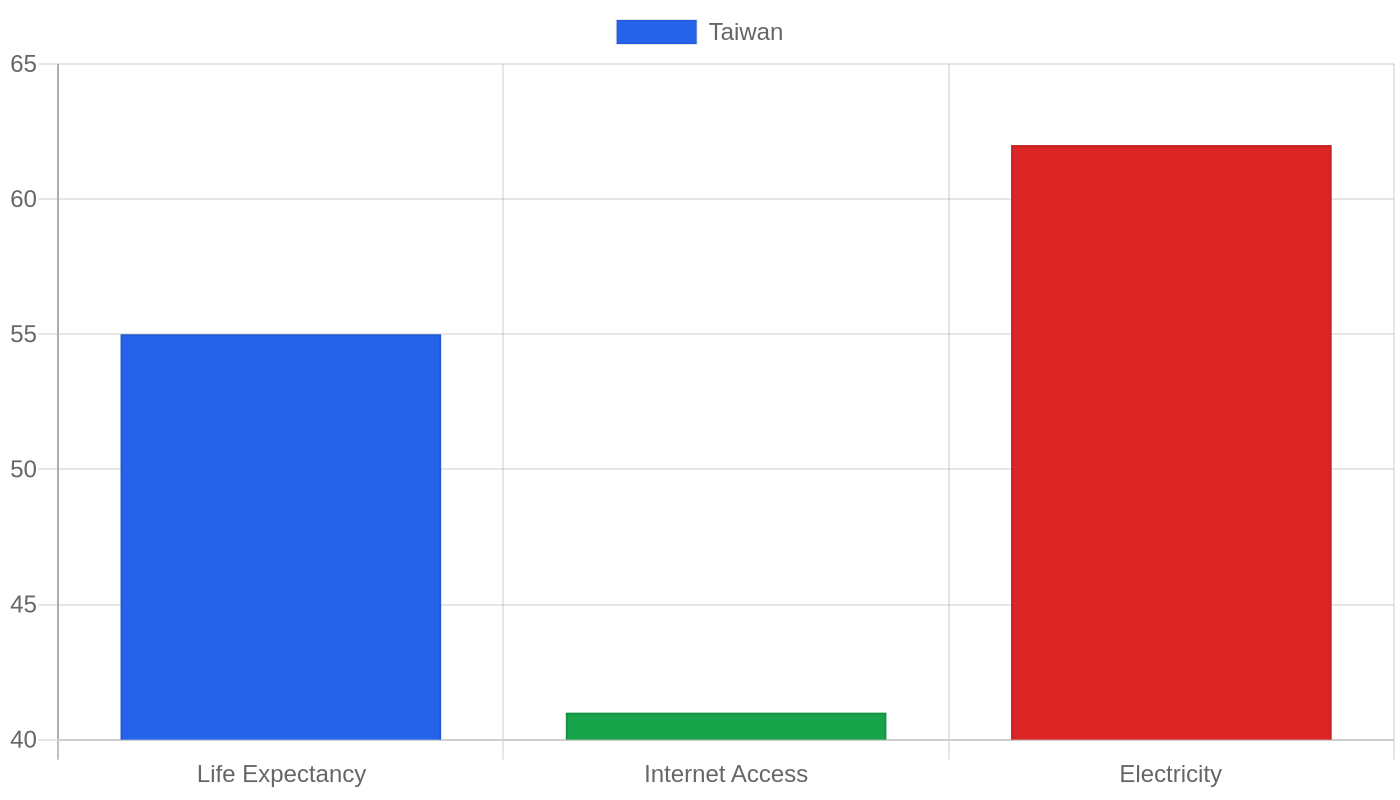
- While specific World Bank indicators for GDP growth, inflation, and unemployment are not available in this reporting cycle, Taiwan’s industrial composition tells a compelling story of export-led prosperity.
The Engine Room: Manufacturing Might and Economic Complexity
The economic narrative of Taiwan cannot be understood without centering on its extraordinary concentration of technological manufacturing prowess.
According to the World Bank’s country profile, Taiwan’s industrial base is dominated by a constellation of globally significant technology firms that have made the island indispensable to the modern digital economy.
At the apex sits Taiwan Semiconductor Manufacturing Company (TSMC), the world’s preeminent contract chipmaker, whose fabrication facilities produce the advanced processors that power everything from smartphones to artificial intelligence systems.
Alongside TSMC, Hon Hai Precision Industry — better known globally as Foxconn — operates as the largest electronics contract manufacturer, assembling devices for the world’s leading technology brands.
This concentration of advanced manufacturing capability has created an economic ecosystem where precision engineering, supply chain integration, and technological innovation are the defining characteristics.
The breadth of Taiwan’s industrial capability extends well beyond semiconductors and consumer electronics assembly.
Quanta Computer and Pegatron have established themselves as major players in laptop and server manufacturing, while Wistron adds another layer of depth to the island’s computing hardware sector.
This cluster effect — where multiple world-class manufacturers operate in close geographic proximity — has created competitive advantages that would be extraordinarily difficult to replicate elsewhere.
The World Bank’s economic framework suggests that such industrial concentration typically translates into significant export revenues, substantial corporate tax contributions, and high-value employment opportunities.
For Taiwan, this means that the technology manufacturing sector likely serves as the primary engine of economic growth, driving demand for skilled labor, advanced engineering talent, and sophisticated logistics infrastructure.
What makes Taiwan’s economic model particularly distinctive is the way it has evolved from low-cost manufacturing into a high-value innovation hub.
The presence of CPC (Chinese Petroleum Corporation) in the top companies list indicates that Taiwan has also maintained significant traditional industrial sectors, including energy and petrochemicals, which provide the foundational inputs necessary for advanced manufacturing.
This industrial diversification — from energy production to semiconductor fabrication to consumer electronics — suggests an economy with multiple layers of resilience.
The World Bank’s analytical frameworks typically emphasize that such diversification helps buffer economies against sector-specific shocks, though Taiwan’s heavy reliance on technology exports also creates vulnerability to global demand cycles for electronics and semiconductors.
The implications of Taiwan’s industrial structure extend far beyond its own borders.
Because TSMC and other Taiwanese manufacturers produce critical components used in virtually every advanced electronic device globally, the island’s economic health has become a matter of international concern.
Supply chain disruptions in Taiwan would have immediate and severe consequences for global technology production, affecting everything from automobile manufacturing to cloud computing infrastructure.
This interdependence means that Taiwan’s economic performance is not merely a national story but a critical variable in the global economic equation.
The Cost of Living: Navigating Prosperity’s Price Tag
The cost of living in Taiwan reflects its status as a high-income economy with a sophisticated technology sector, though the World Bank data in this reporting cycle does not specify exact figures for housing costs, consumer prices, or wage levels.
What can be inferred from Taiwan’s industrial composition is that the island likely experiences the classic pressures of a successful export economy — rising urban property values, particularly around the technology hubs of Hsinchu and Taipei, where the concentration of semiconductor and electronics companies drives demand for housing and commercial space.
The presence of major consumer services companies like 85°C Bakery Cafe and A.mart suggests a vibrant domestic consumption market, indicating that Taiwanese consumers have sufficient disposable income to support an extensive retail and food service sector.
The interplay between Taiwan’s technology-driven prosperity and its cost of living creates a nuanced picture for residents and potential expatriates alike.
On one hand, the high-value employment opportunities in the semiconductor and electronics sectors likely support competitive wages for skilled workers, particularly engineers and technical professionals.
On the other hand, the concentration of wealth in the technology sector may create affordability challenges in major urban centers, where housing costs often outpace general inflation in successful manufacturing economies.
The World Bank’s comparative frameworks suggest that economies with Taiwan’s industrial profile typically experience moderate overall inflation, driven primarily by housing and services rather than goods, which benefit from manufacturing efficiencies and global competition.
For everyday consumers, Taiwan’s retail landscape offers a mix of international brands and strong domestic companies.
The presence of A.mart in the consumer services category indicates a sophisticated retail distribution network, while 85°C Bakery Cafe represents Taiwan’s successful consumer brands that have expanded internationally.
This retail ecosystem suggests that daily necessities and consumer goods are widely available, with competition helping to keep prices reasonable for basic items.
However, the broader cost of living picture — including healthcare, education, and transportation — remains shaped by Taiwan’s comprehensive public services, which typically help moderate household expenses in areas where governments provide substantial support.
The absence of specific cost-of-living indices in the World Bank data means that precise comparisons with regional neighbors remain difficult, but the overall pattern suggests a comfortable middle-income society with the typical urban-rural cost differentials seen across Asia.
The Investment Landscape: Where Global Capital Meets Advanced Manufacturing
Taiwan’s investment climate is dominated by its extraordinary technology sector, which continues to attract substantial domestic and international capital.
The top companies list provided by the World Bank reads as a who’s who of global technology manufacturing — TSMC, Foxconn, Quanta Computer, Pegatron, and Wistron — each representing billions of dollars in capital investment, sophisticated research and development operations, and globally integrated supply chains.
For investors, Taiwan offers exposure to the most critical nodes in the global technology supply chain, with TSMC particularly serving as a bellwether for the semiconductor industry’s fortunes.
The company’s capacity to produce cutting-edge chips at scale has made it one of the most strategically important companies in the world, and its investment decisions have outsized implications for the global technology sector.
Beyond the semiconductor giants, Taiwan’s investment story includes a robust ecosystem of mid-sized technology companies and specialized suppliers that support the manufacturing giants.
This supply chain density creates opportunities for investors seeking exposure to the broader technology manufacturing complex, from precision components to advanced materials to specialized equipment.
The World Bank’s assessment of Taiwan’s business environment suggests that the island maintains strong intellectual property protections, reliable infrastructure, and a skilled workforce — all factors that typically attract foreign direct investment and support domestic entrepreneurship.
The presence of companies like A4Tech in the technology sector indicates that Taiwan also supports innovation in peripheral devices and computer accessories, demonstrating that its technology ecosystem extends beyond the flagship manufacturers.
The business environment in Taiwan is further characterized by strong linkages between industry and the government’s economic development strategies.
The evolution of Taiwan’s political system, rooted in the 1947 Constitution and the Three Principles of the People, has produced a governance framework that has historically supported strategic industrial policy.
The five-branch governmental structure — with the Executive Yuan serving as the cabinet and the Legislative Yuan functioning as parliament — provides a formalized system for economic governance and policy implementation.
For businesses, this institutional stability, combined with Taiwan’s rule of law tradition and sophisticated financial markets, creates a predictable operating environment that supports long-term investment planning.
The additional articles added to the constitution in the 1990s represented significant governance reforms that modernized Taiwan’s political institutions, likely enhancing the business climate through greater democratic accountability and policy transparency.
Governance, Safety, and the Quality of Life Equation
Taiwan’s political landscape is defined by its unique constitutional framework — the 1947 Constitution of the Republic of China, supplemented by the Three Principles of the People and substantially revised through the Additional Articles in the 1990s.
This governance structure divides state power among five branches, or Yuan, with the Executive Yuan functioning as the cabinet and the Legislative Yuan serving as the parliamentary body.
This five-power constitutional design, originally conceived by Sun Yat-sen, represents a distinctive approach to governance that separates not only executive, legislative, and judicial powers but also creates separate examination and control branches.
The significant constitutional revisions of the 1990s democratized this system, transforming what had been an authoritarian structure into a functioning democratic republic with competitive elections and peaceful transfers of power.
The quality of life in Taiwan is shaped by the island’s economic prosperity, comprehensive public services, and a society that balances traditional Chinese cultural heritage with modern cosmopolitan influences.
The World Bank data for this reporting cycle does not include specific crime or safety indices, nor does it provide happiness or quality-of-life metrics.
However, Taiwan’s profile as a high-income economy with a sophisticated technology sector typically correlates with strong public services, including healthcare and education, which are fundamental determinants of quality of life.
The island’s rapid economic development over recent decades has created a society with high levels of educational attainment, particularly in science and engineering fields, which supports both economic productivity and civic engagement.
Taiwan’s social fabric reflects its complex history and geopolitical position.
The island has developed a distinct identity that combines Chinese cultural traditions with unique Taiwanese characteristics, shaped by its history of Japanese colonial rule, Chinese Nationalist governance, and subsequent democratization.
This cultural complexity is evident in Taiwan’s vibrant civil society, active media environment, and robust public discourse on matters of identity and governance.
The political system, with its checks and balances across the five branches, provides multiple avenues for civic participation and political contestation, contributing to a society that values democratic deliberation even amid significant external pressures.
The health of Taiwan’s democracy, as reflected in regular elections and active civil society, is itself a quality-of-life factor that distinguishes the island from many of its regional neighbors.
Current Affairs: Semiconductor Politics and Strategic Reckoning
The immediate landscape for Taiwan is dominated by the accelerating global recognition of its strategic importance in the semiconductor supply chain.
As governments and corporations worldwide have awakened to the risks of concentrating advanced chip production in a single geographic location, Taiwan has found itself at the center of intense international attention.
The World Bank’s identification of Taiwan Semiconductor Manufacturing Company as the island’s flagship enterprise underscores the degree to which Taiwan’s economic fortunes are tied to the global technology industry’s most critical bottleneck.
The company’s expansion plans, capacity allocations, and technology roadmaps are now subjects of international diplomatic discussion, not merely corporate strategy sessions.
Taiwan’s technology sector is navigating a period of unprecedented demand for advanced semiconductors, driven by the artificial intelligence boom, the proliferation of smart devices, and the digital transformation of industries worldwide.
This demand creates both opportunities and challenges for Taiwan’s economy.
On the opportunity side, the semiconductor supercycle has likely boosted Taiwan’s export revenues and corporate profits substantially, supporting continued investment in advanced manufacturing capacity.
On the challenge side, Taiwan must manage the geopolitical complexities of being the indispensable producer in a technology that has become central to national security strategies around the world.
The island’s companies are being asked to balance commercial considerations with strategic imperatives, a tension that will likely define Taiwan’s economic trajectory for years to come.
The domestic political scene in Taiwan continues to evolve within the framework established by the constitutional reforms of the 1990s.
The Legislative Yuan remains the primary arena for policy contestation, with the Executive Yuan responsible for implementing laws and managing the day-to-day affairs of government.
The operation of this system amid external pressures and internal political competition will shape Taiwan’s ability to respond to economic challenges and opportunities.
For observers watching Taiwan, the key question is whether the island can maintain its technological edge while managing the political and security complexities that come with its strategic position.
The answer will have profound implications not only for Taiwan’s prosperity but for the stability of the global technology supply chain that depends on the island’s continued success.
The Bottom Line
Taiwan represents one of the most consequential economies in the world, not because of its size but because of its irreplaceable position in the global technology supply chain.
The concentration of semiconductor manufacturing and electronics production on the island makes its economic health a matter of international concern, while its sophisticated political system and high-income society demonstrate that economic development and democratic governance can advance together.
For investors, policymakers, and business leaders, Taiwan demands attention as both an investment opportunity and a critical risk factor in global supply chains.
The island’s ability to navigate the complex intersection of technology leadership, geopolitical pressure, and democratic governance will determine not only its own future but will substantially shape the trajectory of the global digital economy.
Sources & Methodology
This article is authored by Economic Pulse Net for informational and research purposes.
Economic Pulse Net sources its data from multilateral institutions, national statistics bureaus, and proprietary databases.
All data is believed to be current as of the date of publication. Published: August 30, 2026 |
Category: Research — Taiwan
Use these signals in your own platform
Economic Pulse publishes its live signal feed through a documented, read-only API. Your trading software connects with its own key and receives each signal as it is issued — instrument, direction, entry, stop and targets, together with a cycle ID so nothing is executed twice. The feed is independent of this website and cannot change it.
Signals are informational only and are not financial advice.