Economic Pulse Net | Sources: World Bank World Development Indicators, Government Sources | 2026
Key Takeaways
– Singapore’s economy is a high-value outlier: With a GDP of approximately $603.9 billion and a GNI per capita of $81,760, the city-state operates in a league of its own, according to World Bank data.
– Inflation is remarkably contained: The latest CPI reading from the World Bank shows inflation at just over 0.9%, a testament to careful monetary management and external resilience.
– A consumer and financial powerhouse: From global fintech players like 2C2P to beloved regional brands like Bee Cheng Hiang and Awfully Chocolate, the corporate landscape is a mix of cutting-edge services and heritage consumer goods.
– Political stability is the bedrock: As a parliamentary republic with a Westminster-style constitution, the governance framework is designed for continuity, which in turn anchors investor confidence.
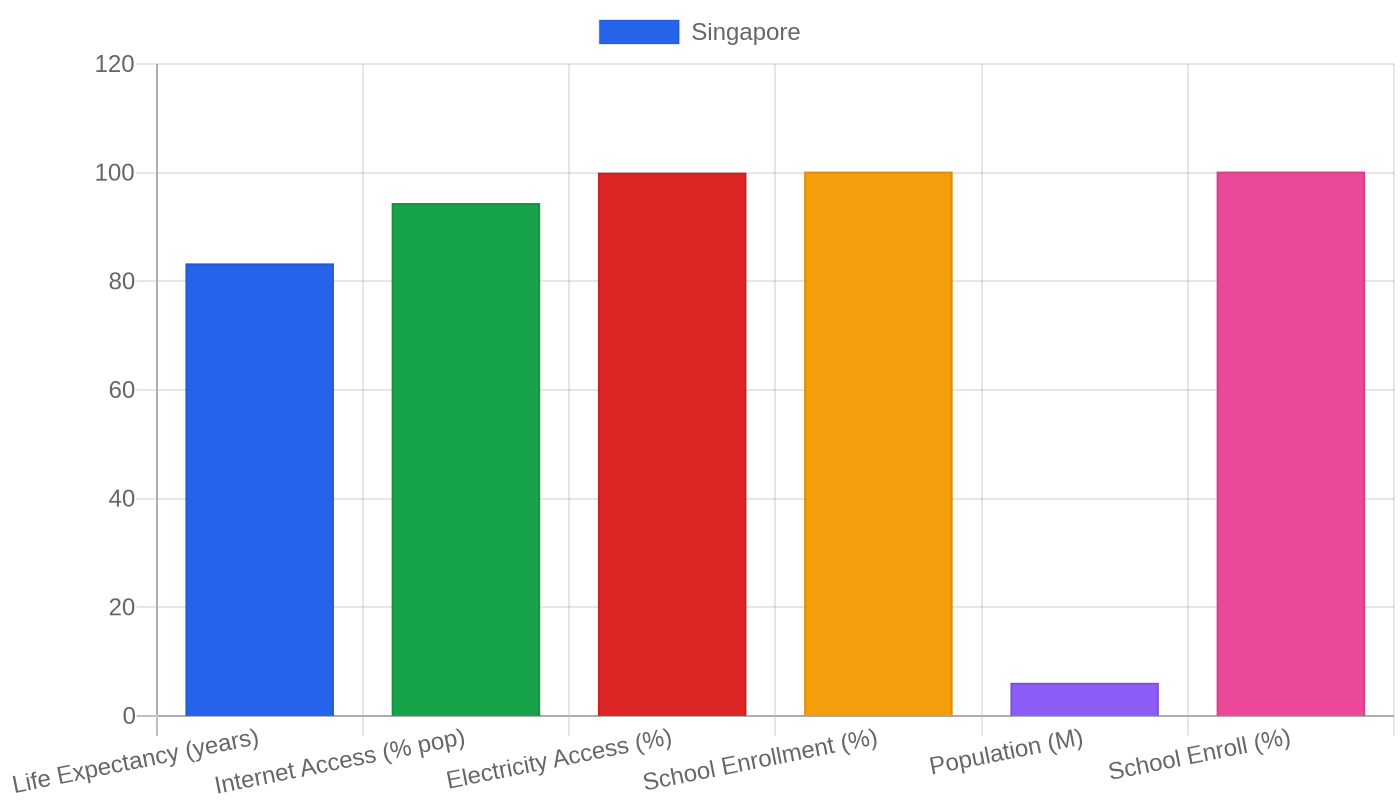
– A population of over 6.1 million: This dense, affluent market serves as a strategic gateway for the broader region, making its economic health a bellwether for Southeast Asia.
The Calm at the Center of the Storm
When the global economy is buffeted by headwinds, Singapore often feels like the eye of the hurricane. The World Bank’s latest figures paint a picture of a mature, highly developed economy that has mastered the art of equilibrium. The headline number—a Gross Domestic Product of roughly $603.9 billion—is staggering for a nation of just over 6.1 million people. But the more telling statistic is the GNI per capita of $81,760.
This figure, which measures the total domestic and foreign output claimed by residents, signals that the wealth generated here is not just passing through; it is being captured, retained, and reinvested in the local economy.
Perhaps the most impressive metric in the current data set is the inflation rate. At a mere 0.9%, the Consumer Price Index is hovering at levels that many Western central banks would envy. This is not an accident. It reflects a structural reality: Singapore’s economy is driven by high-value services, sophisticated financial intermediation, and a trade ecosystem that is deeply integrated into global supply chains.
When global commodity prices spike, Singapore’s status as a net importer can cause temporary friction, but the current data suggests that the Monetary Authority of Singapore’s policy of managing the exchange rate—rather than interest rates—is effectively anchoring domestic price stability. For the average citizen, this means that purchasing power is largely preserved, and for businesses, it provides a predictable cost environment in which to plan long-term capital expenditure.
However, the absence of a specific GDP growth figure in the latest World Bank update leaves a question mark over the pace of expansion. We know the economy is large and wealthy, but is it growing? Given the global slowdown in trade and manufacturing, it is likely that Singapore is experiencing a period of moderate, rather than spectacular, growth. The focus, therefore, shifts to productivity and innovation.
The data we have suggests a nation that is not just resting on its laurels but is actively pivoting towards higher-margin activities, ensuring that the “Swiss standard” of living in Asia remains intact.
The Price of Paradise: Living in a High-Value City
To live in Singapore is to understand the concept of a “high-quality, high-cost” equilibrium. While the cost of living data is not explicitly broken down in the current release, the macroeconomic indicators tell a compelling story. A GNI per capita of over $80,000 implies a population with significant disposable income, which inevitably drives demand for premium housing, retail, and dining.
The consumer landscape, populated by brands like Akira and 77th Street, suggests a market that is deeply engaged with lifestyle and consumer goods, not just basic necessities.
The property market here is famously one of the most valuable in the world. While specific rental and purchase indices are not provided in this data set, the presence of a large, wealthy population compressed into a 728-square-kilometer city-state creates an inherent scarcity premium on land. For the expatriate or the local professional, housing is likely the single largest monthly expense.
The government’s public housing program (HDB) has historically been the safety valve, ensuring that homeownership remains attainable for the majority of citizens, but the private condominium market operates on a different plane entirely, often driven by regional and global ultra-high-net-worth individuals looking for a safe haven.
Daily expenses, from hawker center meals to public transport, are managed carefully by the government to remain affordable relative to wages. This is a deliberate policy choice to offset the high fixed costs of housing and cars—which are famously expensive due to Certificate of Entitlement (COE) systems. The result is a bifurcated experience: rent and purchase prices are global top-tier, but the basics of daily survival are subsidized and accessible.
For a middle-class family, the calculus is manageable; for a newcomer, the initial sticker shock is real. The data implies a society where consumption is robust, but where the cost of entry to the “Singapore standard” is a significant barrier.
The Engines of Enterprise: Fintech, Food, and Security
The list of top companies provided by the data offers a fascinating cross-section of Singapore’s economic muscle. On one hand, you have 2C2P, a financial services giant that powers payment infrastructure across Asia—evidence of Singapore’s ambition to be the fintech nerve center of the region. On the other, you have heritage consumer brands like Ayam Brand and Bee Cheng Hiang, which have turned traditional Asian food products into household names across the continent.
This duality—high-tech services alongside deep-rooted consumer staples—is the secret sauce of the Singaporean economy. It is not overly reliant on any single sector, which provides a buffer against sector-specific downturns.
The industrials sector is represented by Aetos Security Management, a major player in the security and facilities management space, reflecting the high demand for safety and order in a dense urban environment. Meanwhile, Agoda, the online travel giant, anchors the consumer services and digital travel sector, capitalizing on Singapore’s status as a global travel hub.
Technology is represented by Aftershock PC, a homegrown custom computer builder, showing that local entrepreneurship can thrive even in the shadow of global tech giants. The food and beverage sector is particularly strong, with Awfully Chocolate and ABR Holdings showing that the F&B industry is not just about survival but about scaling into regional dominance.
For the investor, this landscape offers a unique proposition. Singapore is not a frontier market; it is a mature, low-risk environment where the rule of law is absolute and property rights are sacrosanct. The business climate is characterized by ease of doing business, transparent regulation, and a government that actively courts foreign direct investment. However, the high cost of labor and real estate means that the market is best suited for high-margin, high-value operations rather than low-cost manufacturing.
The sectors to watch are clearly financial technology, biomedical sciences, and regional headquarters operations for multinationals. The presence of these companies in the data confirms that Singapore is a place where businesses come to scale, not just to set up a regional office.
The Iron Fist in a Velvet Glove: Governance and Safety
Politically, Singapore is a study in controlled continuity. The data describes it as a parliamentary republic based on the Westminster system, with a Constitution that serves as the supreme law. The President is the head of state, but the governance structure is firmly in the hands of the parliamentary executive. This framework has produced a political environment that is the envy of many emerging markets: stable, predictable, and largely free of the ideological swings that plague other democracies.
While the specific crime and safety indices are not provided in this data set, it is widely understood that Singapore operates at a level of safety that is virtually unmatched globally.
The absence of a crime index number does not diminish the reality of everyday life here. The streets are safe, the police are efficient, and the justice system is strict. This is a society where the rule of law is applied rigorously, which has a profound impact on quality of life. Parents can let their children play in public parks, business deals can be conducted with confidence, and the fear of petty crime is almost non-existent.
This safety is a direct result of the political culture—a culture that prioritizes social order and meritocracy. However, this comes with a trade-off in terms of civil liberties, which are more circumscribed than in many Western nations. The government’s approach to media regulation and public assembly is strict, a fact that critics often point to, but which supporters argue is a necessary price for the stability and economic success the nation enjoys.
The quality of life, therefore, is a paradox. On one hand, it is world-class in terms of healthcare, education, infrastructure, and safety. On the other, it is a high-pressure society with a competitive education system and a fast-paced work culture. The data suggests a population that is wealthy and healthy, but the “happiness” metric is a more complex story.
The political landscape ensures that the trains run on time, but it also ensures that the social contract is clear: conform, contribute, and you will be rewarded. It is a model that has worked spectacularly well for the past five decades, and the current data suggests it remains intact.
The Road Ahead: Navigating a Shifting Global Order
Right now, Singapore is not just managing its domestic economy; it is actively repositioning itself for a world that is increasingly fragmented. The low inflation rate of 0.9% gives the authorities immense flexibility. With price pressures subdued, the government has the headroom to deploy fiscal stimulus if needed, or to maintain the accommodative monetary conditions that keep the export sector competitive. The World Bank data, while not showing a specific growth figure, implies a period of consolidation.
This is a nation that is taking a breath, assessing the geopolitical tensions in the South China Sea, the shifting supply chains out of China, and the global push for digitalization.
The presence of Agoda and 2C2P in the top companies list is a clear signal of where the future lies: digital services and travel. As the region’s middle class expands, Singapore is positioning itself as the premium service provider—the place where high-value financial transactions are cleared, where regional headquarters are based, and where the most sophisticated logistics are managed.
The current economic strategy appears to be one of “quality over quantity.” Rather than chasing high-growth, high-inflation numbers, Singapore is focusing on sustainable, high-value growth that preserves its status as a safe haven.
The immediate policy focus is likely on managing the cost of living without stoking inflation. The government’s ability to do this is aided by its massive fiscal reserves and its control over key utilities and housing. For the business community, the current environment is one of cautious optimism. The global economy is soft, but Singapore’s balance sheet is strong. The country is not immune to a global recession, but it is better insulated than almost any other nation.
The takeaway from the current data is that Singapore is entering a phase of steady, managed progress—less flashy than its rapid-growth decades, but built on a much more solid foundation. For the global investor, it remains the premier gateway to Asia; for the citizen, it remains a stable, safe, and prosperous home.
The Bottom Line
Singapore is not a story of explosive growth; it is a story of exceptional management. With a GDP of over $600 billion, a GNI per capita of over $80,000, and inflation below 1%, the World Bank data describes an economy that is mature, resilient, and strategically positioned. For investors, this is a safe harbor with significant upside in the fintech and consumer services sectors.
For policymakers in other nations, it is a case study in how to achieve prosperity through stability, strict governance, and an unwavering focus on the rule of law. This is a country to watch—not for drama, but for the quiet, consistent compounding of wealth and stability.
Sources & Methodology
This article is authored by Economic Pulse Net for informational and research purposes. Economic Pulse Net sources its data from multilateral institutions, national statistics bureaus, and proprietary databases. All data is believed to be current as of the date of publication.
Published: August 12, 2026 | Category: Research — Singapore
Use these signals in your own platform
Economic Pulse publishes its live signal feed through a documented, read-only API. Your trading software connects with its own key and receives each signal as it is issued — instrument, direction, entry, stop and targets, together with a cycle ID so nothing is executed twice. The feed is independent of this website and cannot change it.
Signals are informational only and are not financial advice.