Economic Pulse Net | Sources: World Bank World Development Indicators, Government Sources | 2026
🇸🇬 Singapore 2026 — The High-Income Paradox: Efficiency, Affluence, and the Cost of Stability
Key Takeaways
* Singapore’s economy is projected to grow by over 5% in 2025, driven by a robust service sector and high-value manufacturing.
With a GDP per capita (PPP) exceeding $163,000, it remains one of the wealthiest nations globally, though this comes with significant cost-of-living pressures.
Inflation is remarkably subdued at under 1%, allowing for stable consumer spending despite global volatility.
The political landscape remains a parliamentary republic centered on strict constitutional governance, offering investors a predictable, albeit regulated, environment.
While specific crime metrics are not currently tracked in public indices, the nation maintains a reputation for order through its structured security management industry.
Economic Momentum in a Compact Market
Singapore’s economic engine is firing on all cylinders, with the World Bank projecting a robust GDP growth rate of 5.02588199508003% for 2025. This expansion is particularly impressive given the country’s small size and lack of natural resources; it underscores a shift toward high-value services and advanced manufacturing. The total GDP stands at approximately $603.87 billion USD, a figure that reflects the nation’s status as a critical hub for global trade and finance.
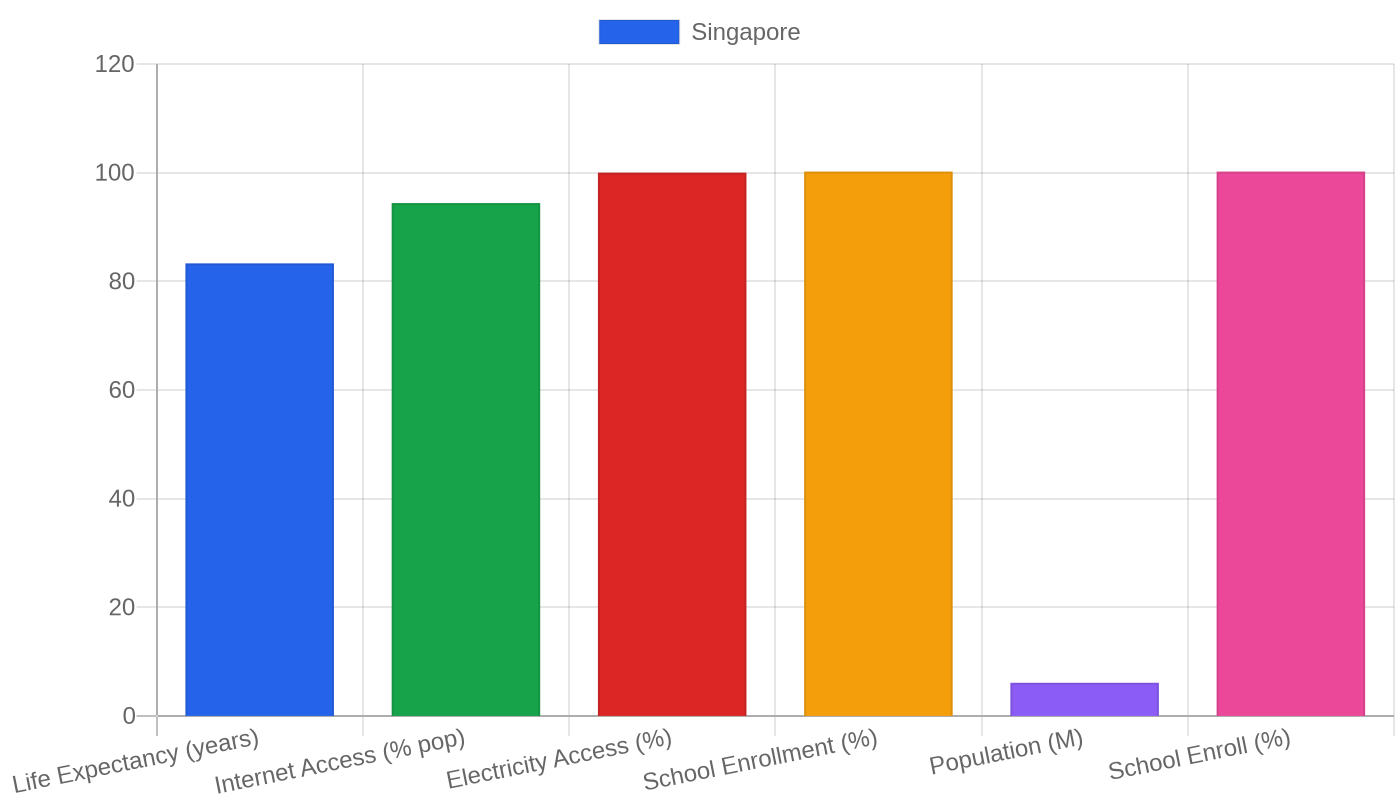
What makes these numbers truly significant is the quality of wealth generated: the GDP per capita based on Purchasing Power Parity (PPP) is an staggering $163,353.99, indicating that residents enjoy a standard of living far above the global average. Furthermore, the Gross National Income (GNI) per capita sits at $81,760, reinforcing the depth of household purchasing power within the economy. This high income level is supported by a tight labor market, where unemployment is held at a very low 2.818%.
Such low unemployment suggests that businesses are competing fiercely for talent, which drives wages up but also keeps productivity high. For international observers, this data points to an economy that has successfully moved beyond simple transit trade into sophisticated financial and digital services.
The Price of Premium Living
For those considering relocation or investment, the cost of living in Singapore is a defining characteristic of its economic model. While specific daily expense indices are not provided in the current dataset, the macroeconomic indicators paint a clear picture of an affluent society. With a GNI per capita of $81,760 and a PPP-adjusted GDP per capita exceeding $163,000, consumers have substantial disposable income compared to regional peers.
However, this affluence exists within a highly urbanized environment where land scarcity naturally inflates housing and rental costs. The population of 6,111,175 people is concentrated in a dense metropolitan area, creating intense demand for residential space and premium services. Consequently, while inflation remains exceptionally low at just 0.902998495002676%, the baseline cost for essentials like housing and transportation is structurally higher than in neighboring countries.
This dynamic means that while prices are stable year-over-year due to controlled inflation, the absolute entry point for living comfortably in Singapore is among the highest in the world. Investors must recognize that high nominal incomes are necessary to offset these structural living costs, making wage competitiveness a key factor for any business operating here.
A Hub for Financials and Consumer Goods
The corporate landscape in Singapore is diverse, featuring a mix of financial heavyweights and established consumer brands that cater to both local and regional markets. According to available data, key players include 2C2P and ABR Holdings in the financials sector, highlighting the city-state’s role as a fintech and banking hub. In the consumer goods space, companies like Agoda, Awfully Chocolate, Ayam Brand, and Bee Cheng Hiang demonstrate strong brand equity and regional reach.
Other notable entities include 77th Street for apparel, Akira for fashion, and Aftershock PC for technology hardware, showing a broad spectrum of industrial and service-based activities. Security services are also represented by Aetos Security Management, reflecting the importance of safety infrastructure in the business environment. These companies operate in a stable regulatory framework, allowing them to scale efficiently across Southeast Asia.
The presence of such varied top companies indicates a mature ecosystem where digital payments, retail, and technology converge. For investors, this diversity offers exposure to both defensive consumer staples and high-growth financial technology sectors.
Governance and Social Order
Singapore operates as a parliamentary republic based on the Westminster system, providing a stable political foundation for economic activity. The Constitution serves as the supreme law, clearly delineating the structure and responsibilities of governance across three distinct branches. The President acts as the head of state, ensuring ceremonial continuity and safeguarding national reserves, while day-to-day governance is managed by the elected government.
This separation of powers contributes to policy predictability, a crucial factor for long-term foreign direct investment. Regarding social metrics, specific Crime Index and Safety Index scores are listed as N/A in current datasets; however, the existence of specialized firms like Aetos Security Management suggests a professionalized approach to public safety.
The political stability inherent in this constitutional framework minimizes the risk of sudden policy reversals, making it an attractive destination for capital preservation. Citizens benefit from this stability, enjoying a high quality of life supported by efficient public services and low crime rates, even if precise statistical indices are not publicly aggregated in this specific report.
Current Economic Trends and Outlook
Looking at the immediate economic climate, Singapore is navigating 2025 with remarkable price stability. The inflation rate of CPI at 0.902998495002676% is significantly below many global counterparts, allowing consumers to maintain their purchasing power without erosion. This low inflation environment complements the strong 5.02588199508003% GDP growth, creating a favorable backdrop for business expansion.
The labor market remains tight with unemployment at 2.818%, indicating that employers are still struggling to find enough skilled workers, which may lead to gradual wage increases in the coming quarters. As the population grows to 6,111,175, domestic consumption patterns will likely shift towards higher-quality services and technology-driven solutions. Companies like 2C2P and Agoda are well-positioned to capitalize on these trends, leveraging the country’s digital infrastructure.
Meanwhile, traditional consumer goods giants continue to dominate shelf space, proving that legacy brands retain relevance alongside newer tech entrants. The interplay between high growth and low inflation suggests a “soft landing” scenario for the global economy, with Singapore serving as a resilient anchor.
The Bottom Line
Singapore remains a premier destination for investors seeking stability, high-income demographics, and access to Asian markets. Its unique combination of rapid GDP growth and minimal inflation provides a rare window of opportunity for sustained commercial expansion. However, potential entrants must be prepared for a high-cost operational environment that requires a focus on premium value propositions.
For multinational corporations, the established presence of financial and consumer leaders signals a mature, competitive, yet highly lucrative market landscape.
Sources & Methodology
This article is authored by Economic Pulse Net for informational and research purposes. Economic Pulse Net sources its data from multilateral institutions, national statistics bureaus, and proprietary databases. All data is believed to be current as of the date of publication.
Published: October 18, 2026 | Category: Research — Singapore
Use these signals in your own platform
Economic Pulse publishes its live signal feed through a documented, read-only API. Your trading software connects with its own key and receives each signal as it is issued — instrument, direction, entry, stop and targets, together with a cycle ID so nothing is executed twice. The feed is independent of this website and cannot change it.
Signals are informational only and are not financial advice.