Economic Pulse Net | Sources: World Bank World Development Indicators, Government Sources | 2026
🇸🇬 Singapore 2025: The High-Performance Engine Revving Up
Key Takeaways
- Robust Growth Returns: According to the World Bank, Singapore’s GDP is projected to grow by approximately 5.03% in 2025, signaling a strong rebound in economic activity.
- Unmatched Wealth Metrics: With a GDP per capita (PPP) exceeding $163,000 and a GNI per capita of $81,760, Singapore remains one of the wealthiest nations per person on the planet.
- Tight Labor Market: Unemployment stands at a low 2.818%, indicating a labor market that is nearly at full capacity, which may put subtle upward pressure on wages.
- Stable Price Environment: Inflation remains contained at 0.90%, suggesting that purchasing power is preserved even as the economy expands.
- Corporate Powerhouse: The business landscape is dominated by a mix of global financial giants and specialized consumer brands, reflecting the city-state’s diverse economic base.
The 5% Reacceleration: Inside the Economic Engine
The macroeconomic picture for Singapore in 2025 is defined by a confident reacceleration.
According to the World Bank, the country’s GDP is expected to expand by 5.02588199508003%, a figure that marks a significant departure from the sluggishness seen in many advanced economies globally.
This growth is underpinned by a massive aggregate output, with total GDP estimated at nearly $603.87 billion USD.
What makes this figure particularly striking is not just the size, but the efficiency of the economic model.
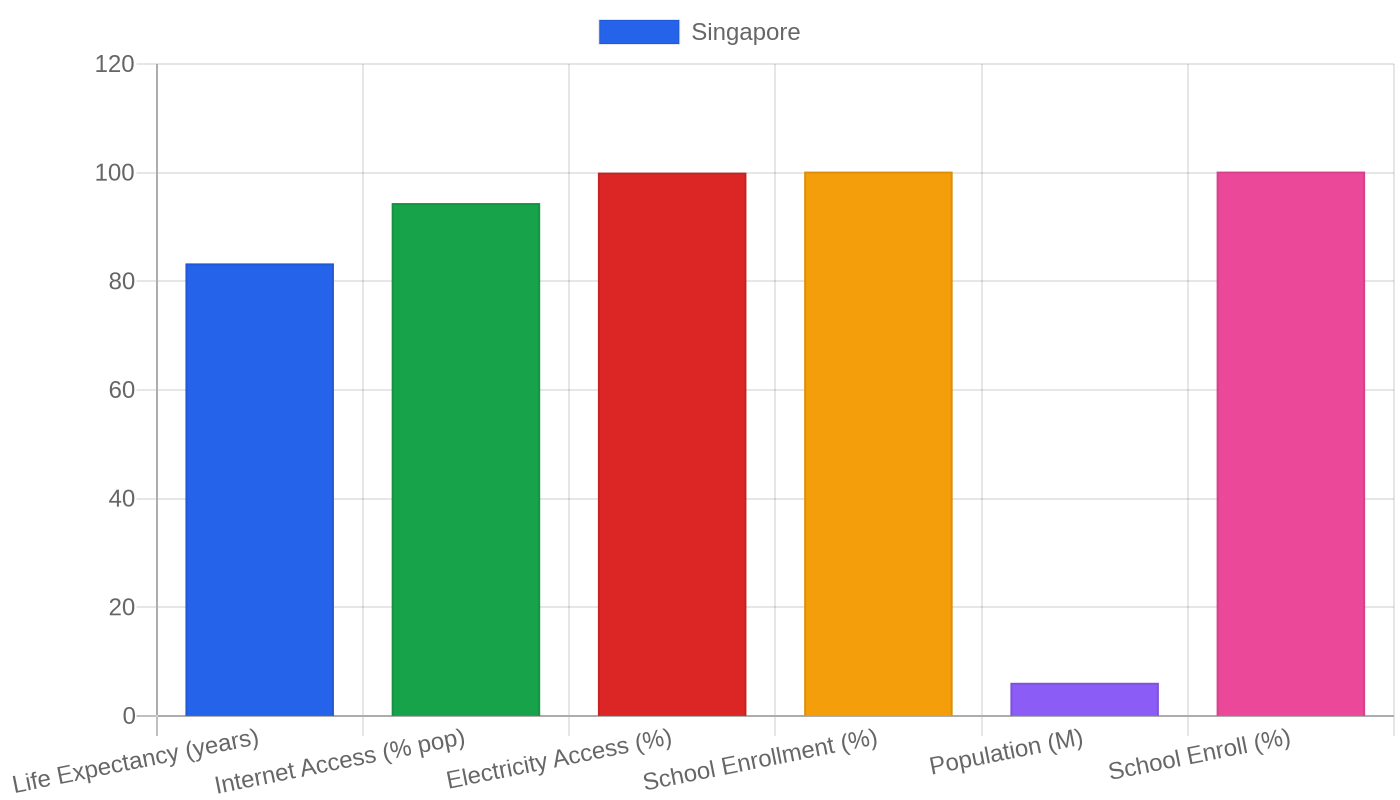
With a population of only 6,111,175 people, Singapore generates an extraordinary amount of wealth per capita.
The World Bank data places GDP per capita (PPP) at $163,353.99, a metric that highlights the extreme productivity and high-value nature of the services and financial sectors that drive the economy.
This level of per capita wealth is rare, placing Singapore in an exclusive tier of global economies where individual purchasing power is exceptionally high.
The labor market data further reinforces the narrative of a tight, high-functioning economy.
An unemployment rate of 2.818% suggests that the economy is operating close to its full potential, with very little slack in the labor supply.
In economic terms, this indicates that almost everyone who wants a job has one, which is both a sign of health and a potential constraint.
When unemployment is this low, companies often compete harder for talent, which can drive up wage costs.
However, the fact that inflation remains low suggests that this wage pressure has not yet translated into a broader spiral of rising prices.
The interplay between strong GDP growth, low unemployment, and controlled inflation creates a “goldilocks” scenario that is difficult to sustain but highly desirable for policymakers and investors alike.
Living in the Lion City: Wealth vs. Cost
While the macroeconomic numbers are dazzling, the cost of living in Singapore remains a defining feature of life in the city-state.
Although specific breakdowns of housing and daily expenses are not detailed in the provided dataset, the context of such high per capita income implies a cost structure that is among the highest in the world.
Residents and expatriates alike typically navigate a market where housing is a premium asset, and daily expenses for dining out, transportation, and services reflect the high productivity of the local workforce.
The high GNI per capita of $81,760 suggests that the average resident has significant disposable income, which helps offset the high baseline costs of living.
This dynamic creates a unique economic ecosystem where high costs are matched by high earnings, maintaining a balance that supports a high standard of living.
For the average worker, the low inflation rate of 0.90% is a critical buffer; it means that while the cost of living is inherently high, it is not rapidly increasing, allowing savings and investments to retain their value over time.
A Boardroom of Global Giants: The Business Climate
The corporate landscape in Singapore is a testament to its status as a global hub for finance and trade.
The top companies list reveals a diverse mix of sectors, from heavyweights in financials like 2C2P and ABR Holdings to consumer staples giants such as Ayam Brand and Bee Cheng Hiang.
This diversity is a key strength, ensuring that the economy is not overly reliant on a single industry.
The presence of firms like Aetos Security Management in industrials and Aftershock PC in technology indicates a robust ecosystem that supports both traditional infrastructure and modern tech innovation.
Furthermore, consumer services and goods companies like Agoda and 77th Street highlight the city-state’s role as a major destination for tourism and lifestyle consumption.
These companies are not just local players; many operate on international scales, bringing foreign exchange into the country and enhancing Singapore’s global brand.
The business environment is clearly conducive to success, as evidenced by the longevity and prominence of these firms, which have managed to thrive in a competitive, high-cost market.
Governance, Safety, and the Social Contract
Singapore operates under a parliamentary republic system based on the Westminster model, with the Constitution serving as the supreme law.
The President acts as the head of state, while the governance structure is divided into three distinct branches, ensuring a clear separation of powers and responsibilities.
This political stability is a cornerstone of the country’s economic success, providing a predictable regulatory environment that investors and businesses value highly.
While specific crime and safety indices are marked as N/A in the provided data, the general consensus and the high level of economic development suggest a society with strong social order and public safety measures.
The political landscape is characterized by a focus on long-term planning and pragmatic governance, which has allowed Singapore to navigate global crises with minimal disruption.
This stability is not just a political feature but an economic asset, as it reduces uncertainty and encourages long-term capital investment.
Current Affairs: The Pulse of 2025
The current economic climate in 2025 is defined by the momentum of the 5% GDP growth projection.
As the World Bank’s data indicates, the economy is not just recovering but expanding at a pace that suggests structural strength.
The low inflation rate of 0.90% is a particularly timely development, as it allows the central bank and government to maintain monetary policies that support growth without overheating the economy.
The tight labor market, with unemployment at 2.818%, is currently a focal point for policy discussions, as the government may need to address workforce planning to ensure that the 5% growth does not lead to skill shortages.
Businesses in the financial and consumer sectors, as represented by top firms like Agoda and ABR Holdings, are likely benefiting from the increased consumer confidence that comes with stable prices and job security.
The political system remains stable, providing a consistent backdrop for these economic developments, with no immediate signs of disruption to the governance structure.
This combination of strong growth, low inflation, and political stability positions Singapore as a standout performer in the global economic landscape for 2025.
The Bottom Line
Singapore in 2025 is a study in efficient economic management, combining high growth with stability and wealth.
It is a country for investors seeking exposure to a high-growth, low-inflation market with a stable political backdrop.
For professionals, it offers a high-cost but high-reward environment where career opportunities are plentiful and the quality of life is supported by strong public infrastructure.
The key to watching Singapore is to monitor how the tight labor market evolves and whether the 5% growth can be sustained without triggering inflationary pressures.
It remains a beacon of economic resilience and a benchmark for modern city-state development.
Sources & Methodology
This article is authored by Economic Pulse Net for informational and research purposes.
Economic Pulse Net sources its data from multilateral institutions, national statistics bureaus, and proprietary databases.
All data is believed to be current as of the date of publication. Published: September 04, 2026 |
Category: Research — Singapore
Use these signals in your own platform
Economic Pulse publishes its live signal feed through a documented, read-only API. Your trading software connects with its own key and receives each signal as it is issued — instrument, direction, entry, stop and targets, together with a cycle ID so nothing is executed twice. The feed is independent of this website and cannot change it.
Signals are informational only and are not financial advice.