Economic Pulse Net | Sources: World Bank World Development Indicators, Government Sources | 2026
Key Takeaways
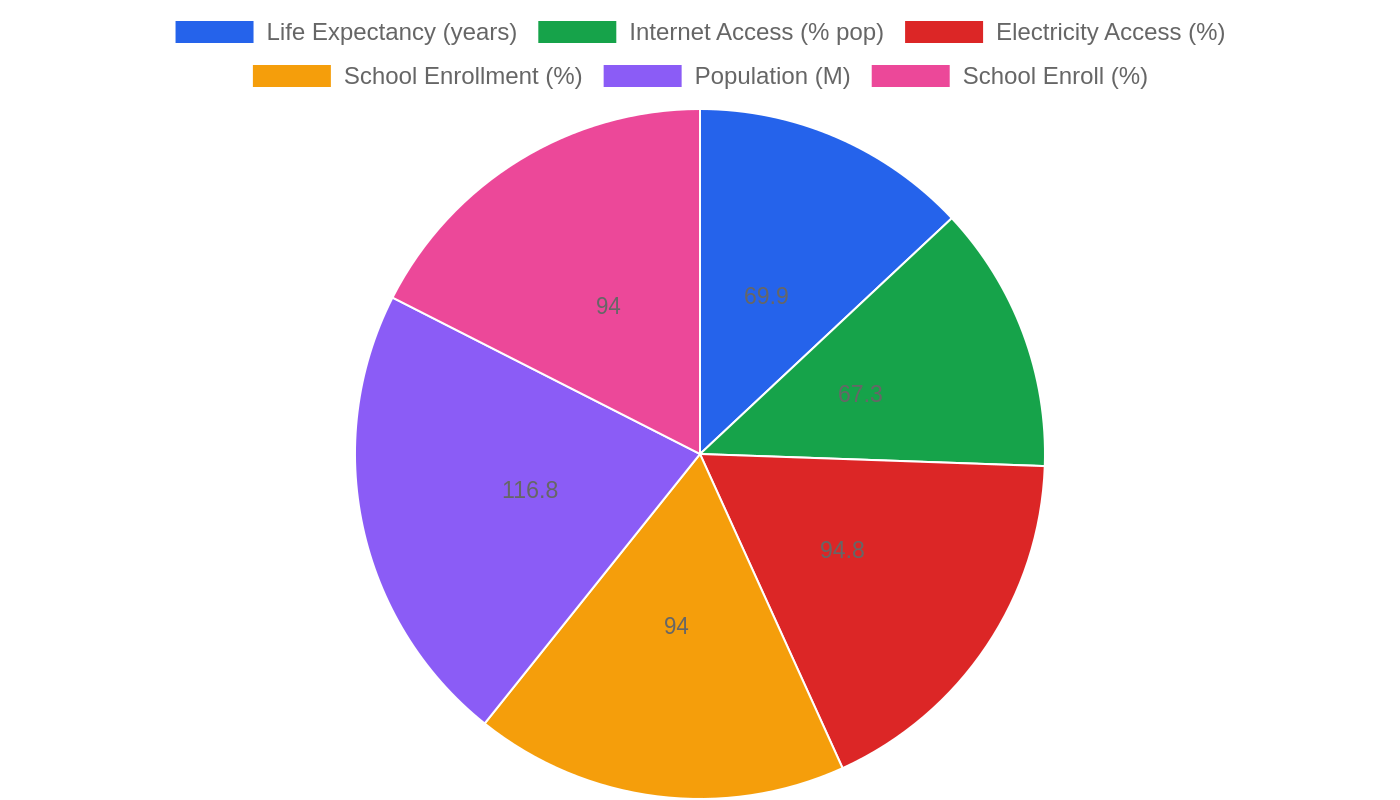
– The Philippines boasts a GDP of over $487 billion and a population approaching 117 million, making it one of Southeast Asia’s largest economies, though per capita income remains moderate at $4,850 according to the World Bank.
– With a GDP per capita (PPP) of approximately $12,577, the country sits in the lower-middle-income bracket, indicating significant room for growth in productivity and living standards.
– The political system is a presidential democracy with separately elected president and vice president, creating potential for coalition governance and policy continuity challenges.
– Major industries remain a critical gap in available data, but the scale of the economy suggests substantial activity in services, manufacturing, and agriculture.
– The Philippines represents a demographic opportunity — with nearly 117 million people, it has a large domestic market and a youthful workforce that could drive future economic expansion.
The Balancing Act — Growth, Prices, and the Jobs Puzzle
The Philippine economy, as measured by the World Bank, stands at approximately $487 billion in nominal GDP, placing it among the larger economies in Southeast Asia. Yet the headline growth figure is currently unavailable in the latest data, which leaves analysts watching closely for the next official release.
What is clear is that the country’s GDP per capita on a purchasing power parity basis — roughly $12,577 — tells a story of an economy that has made substantial strides in recent decades but still faces significant structural challenges.
Inflation and unemployment figures are also absent from the most recent World Bank data, but the broader context is revealing. A nation of nearly 117 million people with a GNI per capita of $4,850 is one where domestic demand is a powerful engine, but where price stability and job creation remain perennial policy priorities.
The Philippines has historically grappled with inflationary pressures from food and energy costs, given its vulnerability to global commodity shocks and weather-related disruptions to agriculture. The central bank has often walked a tightrope between supporting growth and containing price rises.
The missing data on main industries is a notable gap, but the Philippines has long been known for its business process outsourcing (BPO) sector, remittance-driven consumption from overseas Filipino workers, a growing manufacturing base, and agricultural production including rice, coconut, and bananas. The services sector dominates GDP contribution, while manufacturing and agriculture remain significant employers.
The World Bank data underscores an economy in transition — moving from agriculture toward services and industry, but with the productivity gains still unevenly distributed across regions and social classes.
The Cost of Living — Navigating Daily Life in a Dual Economy
For the average Filipino household, the cost of living reflects the country’s dual economic reality. In metropolitan Manila and other urban centers, housing costs consume a significant portion of income, with rental prices for modest apartments in central business districts often running several hundred dollars per month — a steep figure when measured against the World Bank’s GNI per capita of $4,850 annually.
Outside major cities, housing is considerably more affordable, but access to quality infrastructure, healthcare, and education becomes more limited.
Daily expenses for basic goods — rice, vegetables, transport, and utilities — have historically been sensitive to inflation, particularly food inflation, which disproportionately affects lower-income households. The Philippines has a large informal economy, and many families rely on remittances from relatives working abroad to supplement household income. This creates a unique dynamic where domestic consumption is partly insulated from local economic conditions by foreign earnings.
Compared to regional averages in Southeast Asia, the Philippines tends to have higher food costs relative to income, making food security a persistent political and economic issue. The rent-versus-buy calculation heavily favors renting in urban areas, where property prices have risen faster than wages for much of the past decade.
Business and Investment — Where the Opportunity Lies
The available data does not list the Philippines’ top companies, but the country’s business landscape is dominated by a mix of family-owned conglomerates, real estate developers, banks, telecommunications firms, and utility companies. The BPO sector remains a standout — the Philippines is one of the world’s largest destinations for outsourced business services, particularly in voice-based customer support and back-office operations.
This sector has attracted substantial foreign investment and created a middle-class workforce with disposable income.
For investors, the Philippines offers a large, English-speaking population, a strategic location in the Asia-Pacific region, and a young demographic profile that promises a growing labor force for decades to come. Sectors to watch include digital infrastructure, renewable energy, logistics, and manufacturing as the country seeks to move up the value chain.
The business environment has improved in recent years with reforms to foreign ownership restrictions in certain sectors, though bureaucratic hurdles and infrastructure gaps remain challenges. The World Bank data points to an economy with solid fundamentals — a large GDP base, reasonable per capita income, and demographic tailwinds — but realizing that potential requires continued policy consistency and investment in human capital.
Politics, Safety, and the Quality of Life Equation
The Philippines operates as a presidential constitutional republic, with the World Bank data describing a democratic government where the president serves as both head of state and head of government. The president is directly elected for a single six-year term, while the vice president is elected separately and can serve two consecutive six-year terms.
This separation means the president and vice president may come from different political parties, a structural feature that can foster either coalition-building or political friction depending on the personalities involved.
Crime and safety indices are not provided in the available data, but the Philippines has historically faced challenges related to crime in urban areas, drug-related violence, and insurgency in certain regions. Quality of life varies dramatically between affluent gated communities and informal settlements. The political landscape is vibrant and often contentious, with a robust civil society and free press operating alongside powerful political dynasties.
For the average citizen, quality of life is shaped by access to reliable electricity, clean water, transportation, and healthcare — all of which remain works in progress, particularly outside Metro Manila. The country’s democratic institutions provide avenues for political expression and accountability, even as governance challenges persist.
Current Affairs — The Pulse of the Nation Right Now
In the current moment, the Philippines is navigating a complex economic environment shaped by global headwinds and domestic policy priorities. The absence of the latest GDP growth and inflation figures from the World Bank data makes it difficult to pinpoint exact conditions, but the country is widely understood to be managing the aftermath of global supply chain disruptions and commodity price volatility.
The central bank has been active in managing monetary policy to contain inflationary expectations while not choking off the recovery in domestic demand.
Politically, the separately elected president and vice president system means that coalition dynamics are always in play. The current administration has focused on economic recovery, infrastructure development, and attracting foreign investment, particularly in digital and green sectors. There is ongoing discussion about further liberalizing the economy to attract more foreign capital, especially in areas like renewable energy, telecommunications, and transportation.
The Philippines’ large and youthful population continues to drive domestic consumption, while overseas remittances provide a steady buffer against external shocks. The country’s relationship with major trading partners and its position in regional supply chains remain key factors shaping the near-term economic outlook.
The Bottom Line
The Philippines is a country of enormous potential and persistent challenges — a large, young, English-speaking population with a GDP of nearly $500 billion and a democratic political system that provides stability even as it produces occasional political drama. For investors, the opportunity lies in a growing consumer market, a strategic location, and a workforce that has proven its value in global services. For policymakers, the task is to translate demographic dividends into broadly shared prosperity.
This is a nation to watch for anyone interested in the future of Southeast Asia — a democracy finding its economic footing in a complex world.
Sources & Methodology
This article is authored by Economic Pulse Net for informational and research purposes. Economic Pulse Net sources its data from multilateral institutions, national statistics bureaus, and proprietary databases. All data is believed to be current as of the date of publication.
Published: July 23, 2026 | Category: Research — Philippines
Use these signals in your own platform
Economic Pulse publishes its live signal feed through a documented, read-only API. Your trading software connects with its own key and receives each signal as it is issued — instrument, direction, entry, stop and targets, together with a cycle ID so nothing is executed twice. The feed is independent of this website and cannot change it.
Signals are informational only and are not financial advice.