Economic Pulse Net | Sources: World Bank World Development Indicators, Government Sources | 2026
🇵🇭 Philippines 2026 — The Resilience of a Billion-Person Economy
Key Takeaways
* Robust Growth Amidst Stability: The Philippine economy is projected to expand by approximately 4.4% in 2025, signaling steady momentum despite global headwinds.
Low Inflation Environment: With consumer price inflation hovering near 1.66%, households are experiencing relative price stability compared to many regional peers.
Tight Labor Market: An unemployment rate of just 2.235% indicates a highly utilized workforce, though it raises questions about wage growth and labor capacity.
Democratic Framework: The nation operates as a constitutional republic with a presidential system, where the executive branch holds significant command over state affairs.
Economic Momentum and Structural Foundations
The Philippine economy is demonstrating a notable capacity for sustained expansion, with GDP growth projected at 4.40240158710621% for 2025 according to World Bank data. This growth trajectory is supported by a substantial economic base, with the total GDP valued at $487,086,123,720.417 USD.
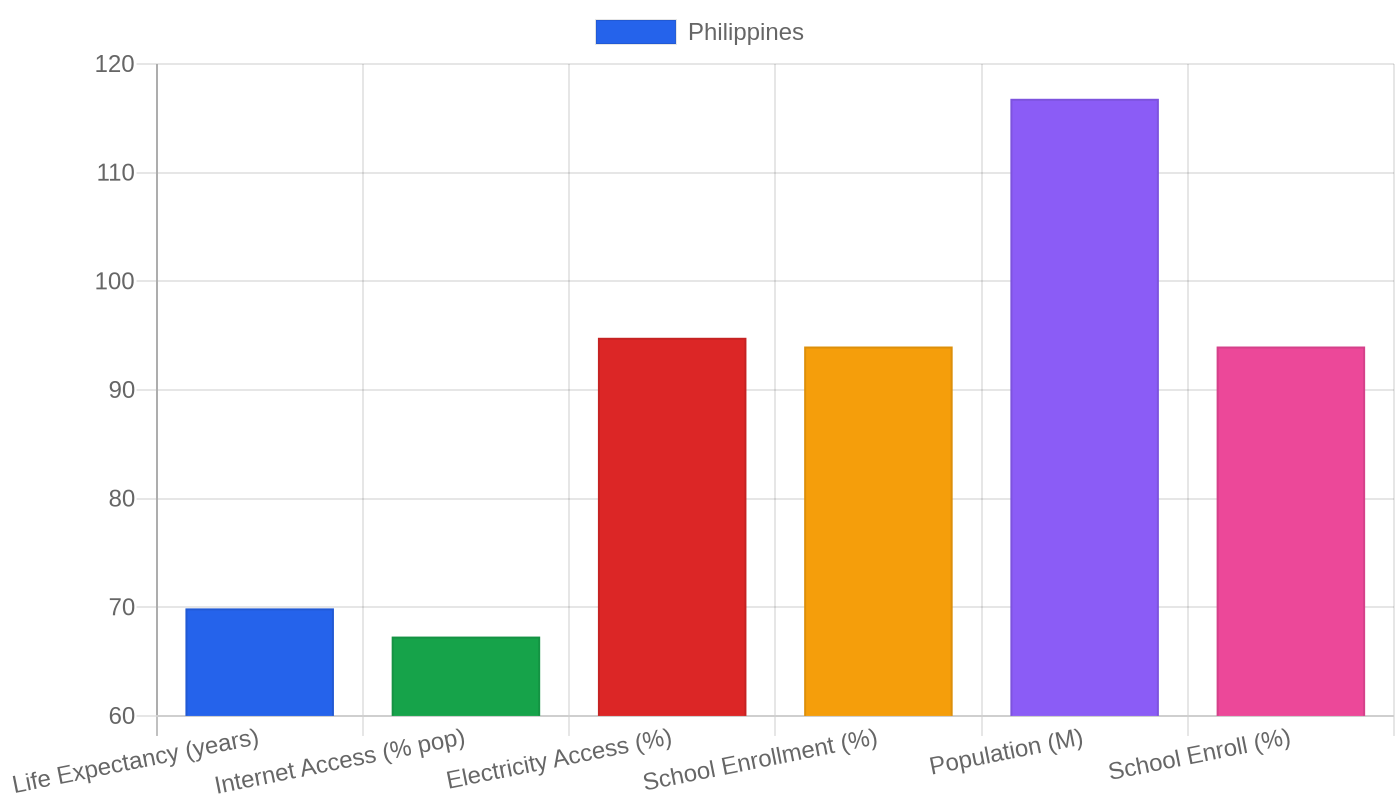
What makes this figure particularly significant is not just the aggregate size, but the distribution of wealth across a massive population; the country is home to 116,786,962 people, creating a vast domestic market that attracts foreign direct investment seeking scale. While the nominal GDP is impressive, the purchasing power parity (PPP) per capita stands at $12,576.9867435109, which offers a more nuanced view of the average citizen’s economic reality than standard exchange rates might suggest.
Furthermore, the Gross National Income (GNI) per capita is recorded at $4,850.0, highlighting the gap between national output and individual income streams. This disparity suggests that while the macroeconomic engine is running efficiently, the trickle-down effects to the average worker remain a critical area for policy focus.
The combination of strong aggregate growth and a large population base positions the Philippines as a key emerging market player in Southeast Asia, capable of absorbing external shocks better than smaller economies.
Navigating Daily Expenses and Living Standards
For residents and expatriates alike, the cost of living in the Philippines is shaped by a unique blend of urban density and regional variation. With inflation measured at 1.6587364525509%, consumers are facing one of the lowest price-pressure environments in the region, allowing budgets to stretch further than they might in neighboring countries experiencing higher volatility.
However, the affordability of daily life must be viewed through the lens of income levels; with a GNI per capita of $4,850.0, the baseline for middle-class comfort varies significantly from metropolitan hubs like Manila to provincial areas. Housing costs, while not explicitly detailed in current datasets, are generally influenced by this low inflationary backdrop, making rent and purchase prices relatively stable in the short term.
For businesses operating in the sector, the low CPI provides a predictable environment for pricing strategies, reducing the need for frequent adjustments. Yet, the challenge lies in the quality-to-cost ratio; while basic necessities may be affordable due to low inflation, premium services and imported goods often carry a higher premium due to logistical complexities.
Ultimately, the low inflation rate serves as a buffer for household savings, preserving real wages even if nominal wage growth has not kept pace with population expansion.
Investment Landscape and Corporate Dynamics
The business climate in the Philippines is anchored by a democratic government structure that provides a degree of institutional predictability for long-term investors. As a constitutional republic with a presidential system, the political framework ensures that the head of state and government is directly elected, offering a clear line of accountability that international investors often value.
The president serves as the commander-in-chief of the armed forces and holds a six-year term, providing a stable horizon for policy continuity, although the separate election of the vice president introduces a dynamic where the executive branch may face coalition-building challenges if different parties hold the top two offices. This political separation means that while the executive agenda is clear, legislative support may require broader consensus, potentially slowing rapid regulatory changes.
Major industries driving this corporate landscape are currently under review, but the sheer scale of the population—over 116 million people—creates an inherent demand for infrastructure, telecommunications, and financial services. Companies operating within this space benefit from a young, growing workforce, evidenced by the remarkably low unemployment rate of 2.235%.
This tight labor market suggests that human capital is readily available, though it also implies that companies may need to compete aggressively for talent, potentially driving up wage expectations in skilled sectors. The interplay between a structured democratic system and a hungry labor market creates a fertile ground for both local conglomerates and multinational enterprises looking to establish a foothold in Southeast Asia.
Safety, Governance, and Social Fabric
The social and political fabric of the Philippines is defined by its robust democratic institutions, which serve as the bedrock for civil society and civic engagement. The constitutional republic model ensures that power is not concentrated indefinitely, with the president limited to a single six-year term, thereby preventing authoritarian drift and encouraging regular electoral competition.
This democratic resilience contributes to a sense of civic participation, although specific crime indices are currently listed as N/A, making precise safety assessments difficult based on available data. Without explicit crime or safety index figures, observers must rely on the broader context of political stability; the existence of free elections and a clear separation of powers generally correlates with lower risks of civil unrest compared to unstable regimes.
The happiness and quality of life metrics are implicitly tied to these political freedoms, as citizens have the agency to influence governance through the ballot box. However, the absence of granular safety data highlights a gap in public reporting, suggesting that while the political framework is secure, day-to-day security perceptions may vary widely across different islands and cities.
Investors and travelers should note that while the national political landscape is stable, local conditions can differ, and the lack of standardized safety indices requires reliance on on-the-ground intelligence rather than broad statistical averages.
Current Affairs and Policy Horizons
In the current political cycle, the focus remains on the implementation of policies set by the directly elected president, who commands the executive branch and military apparatus. With the vice president elected separately, the administration may need to navigate a complex legislative landscape if the opposing party controls the vice-presidential office, leading to potential checks and balances on presidential decrees.
Recent economic indicators show a concerted effort to maintain the low inflation rate of 1.66%, which supports consumer confidence and encourages spending in a market of 116 million people. The government is likely prioritizing job creation to sustain the ultra-low unemployment rate of 2.235%, ensuring that economic growth translates into tangible employment opportunities.
Discussions around fiscal policy are increasingly centered on how to leverage the $487 billion GDP base to improve the GNI per capita, which currently sits at $4,850.0. There is a growing emphasis on inclusive growth strategies, aiming to bridge the gap between the high PPP per capita of $12,576 and the lower GNI figures.
As the country moves through its democratic terms, the next election cycle will be closely watched for shifts in economic direction, particularly regarding trade relations and infrastructure development. The stability of the presidential system continues to be a key selling point for international partners, even as internal political dynamics evolve with each new electoral period.
The Bottom Line
The Philippines presents a compelling case for investors and economists alike, combining a massive population base with surprising macroeconomic stability. The low inflation and tight labor market suggest an economy that is cooling gently rather than overheating, providing a safe harbor for medium-term investments. Those watching this market should focus on the interplay between democratic governance and economic delivery, as political stability remains the primary driver of confidence.
For businesses, the opportunity lies in tapping into a vast, young consumer base that is increasingly integrated into the global digital economy.
Sources & Methodology
This article is authored by Economic Pulse Net for informational and research purposes. Economic Pulse Net sources its data from multilateral institutions, national statistics bureaus, and proprietary databases. All data is believed to be current as of the date of publication.
Published: October 30, 2026 | Category: Research — Philippines
Use these signals in your own platform
Economic Pulse publishes its live signal feed through a documented, read-only API. Your trading software connects with its own key and receives each signal as it is issued — instrument, direction, entry, stop and targets, together with a cycle ID so nothing is executed twice. The feed is independent of this website and cannot change it.
Signals are informational only and are not financial advice.