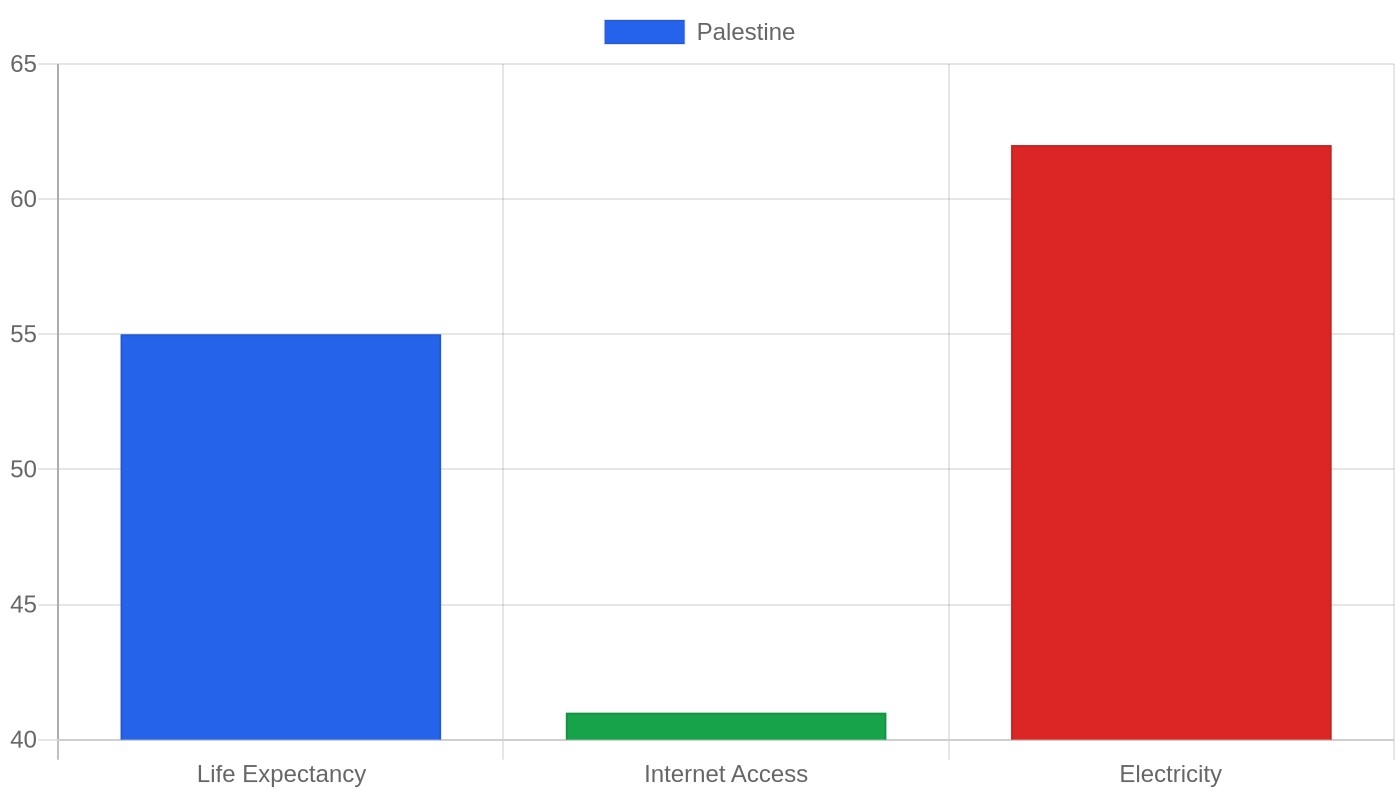
Economic Pulse Net | Sources: World Bank World Development Indicators, Government Sources | 2026
Key Takeaways
– Palestine operates a unique semi-presidential system with institutions split between the Palestinian Authority and the Palestine Liberation Organization, creating a complex governance structure that functions partly as a government-in-exile.
– Critical economic indicators from the World Bank—GDP growth, inflation, unemployment, and GDP per capita—are all listed as unavailable, reflecting the profound challenges of collecting reliable data in a fragmented and conflict-affected territory.
– The political landscape is defined by a unitary yet divided system, with the PLO’s Executive Committee acting as a de facto government-in-exile while the Palestinian Authority manages day-to-day affairs in limited areas.
– Without accessible data on cost of living, crime rates, or major industries, the Palestinian economy remains one of the most opaque and least-measured in the world, posing significant challenges for investors, policymakers, and residents alike.
The Phantom Economy — What the Missing Numbers Really Mean
When the World Bank publishes its country profiles, most nations offer a rich tapestry of figures: GDP growth rates, inflation trajectories, employment trends. For Palestine, the relevant cells are simply marked “N/A.” GDP growth: unavailable. Inflation CPI: unavailable. Unemployment: unavailable. GDP per capita: unavailable. This is not a data failure—it is a political and economic statement.
The absence of these numbers tells a story more powerful than any percentage point could. Palestine’s economy operates under conditions of extreme fragmentation, with the West Bank and Gaza Strip governed by separate authorities, subject to different restrictions, and severed from each other by barriers both physical and bureaucratic. The World Bank cannot produce reliable national aggregates because the national territory itself is not a contiguous, functioning economic unit.
What we do know is that the Palestinian economy is heavily dependent on external aid, remittances, and limited trade corridors controlled by neighboring states. Without GDP figures, we cannot calculate growth trajectories or compare living standards to regional peers. The missing inflation data suggests either hyper-volatility that defies measurement or a dollarized economy where price signals are distorted by external factors.
Unemployment—typically a lagging indicator of economic health—remains unquantified, but anecdotal evidence from humanitarian organizations consistently places it among the highest in the Middle East.
The main industries of Palestine are similarly undocumented in official data, but historical context suggests agriculture (olives, citrus, dates), small-scale manufacturing, and services (including tourism in more stable periods) form the backbone of what little formal economy exists. The missing numbers are not a bureaucratic oversight—they are the signature of an economy that cannot be measured because it cannot be controlled.
Housing and the Cost of Living — The Price of Uncertainty
Without official cost-of-living indices from the World Bank or national statistics bureaus, any discussion of Palestinian housing and daily expenses must rely on fragmentary reports from humanitarian agencies and local journalists. What emerges is a picture of extreme disparity. In Ramallah, the de facto administrative capital, rents for modest apartments can rival those in middle-income Mediterranean cities, driven by the concentration of international organizations, NGOs, and diplomatic missions.
In Gaza, by contrast, the housing crisis is measured not in price but in availability—thousands of homes have been damaged or destroyed in recurring conflicts, and reconstruction materials are subject to strict import controls.
The cost of living in Palestine is shaped by factors that defy normal economic logic. Goods that must cross checkpoints or enter through controlled borders carry inflated prices due to transportation delays, storage costs, and the risk of spoilage. Basic food staples, fuel, and construction materials all command premiums that would be unthinkable in a functioning market economy.
Rent versus buy calculations are largely academic for most Palestinians, who inherit family homes, live in extended-family compounds, or occupy informal housing without clear legal title. The housing market, like the broader economy, is not a market in the conventional sense—it is a survival system shaped by political constraints.
Investment and Business Climate — Capital in Captivity
The top companies of Palestine are not listed in global rankings, and the business environment is defined more by what is absent than what is present. Without a functioning national stock exchange that attracts foreign capital, without reliable banking integration into the international financial system, and without the legal certainty that investors demand, Palestine’s private sector operates in a state of perpetual contingency.
Sectors to watch, however speculative, include information technology—a small but resilient cluster of startups has emerged in Ramallah and Bethlehem, producing software and services for regional markets. Agriculture remains the traditional backbone, with olive oil production holding symbolic and economic significance. Remittances from the Palestinian diaspora constitute a major invisible flow of capital, funding everything from university tuition to home construction.
The business climate suffers from what economists call “sovereignty deficit.” Without control over borders, airspace, or monetary policy, Palestinian entrepreneurs must navigate a system where permits, licenses, and trade approvals are often granted by external authorities. This creates a business environment where political stability matters more than interest rates, and where access to markets matters more than tax incentives.
For the rare foreign investor willing to take the risk, the potential rewards are tied not to economic fundamentals but to the prospect of a political resolution that remains elusive.
Safety, Politics, and the Quality of Life — Governing in the Gaps
The Crime Index and Safety Index for Palestine are both listed as unavailable, but safety in the Palestinian territories is not primarily a matter of criminal statistics. It is a question of political violence, military occupation, and the periodic eruption of armed conflict. The political landscape, as documented by the World Bank and other sources, reveals a government structure of extraordinary complexity.
Palestine operates a unitary and semi-presidential system of government, with institutions associated with the Palestine Liberation Organization (PLO) forming the core of national governance.
The president of the State of Palestine is appointed by the Palestinian Central Council, not elected by popular vote—a fact that underscores the provisional nature of Palestinian statehood. The Palestinian National Council and the Executive Committee of the PLO perform the functions of a government in exile, a structure born of decades of displacement and diplomatic limbo.
This dual system—a Palestinian Authority governing parts of the West Bank, and a PLO government-in-exile claiming authority over all Palestinians everywhere—creates a political landscape that is both fragmented and resilient.
Quality of life for Palestinians is shaped by mobility restrictions, access to water and electricity, and the psychological toll of prolonged uncertainty. Without official happiness or well-being indices, it is impossible to quantify, but the humanitarian reports from organizations like the UN and the Red Cross consistently describe a population under extraordinary stress.
The political system, for all its complexity, has maintained continuity through decades of crisis—a testament to institutional endurance even in the absence of conventional statehood.
What’s Happening Now — The Politics of Permanence
The most current developments in Palestine are not captured in economic data releases or inflation reports, because the Palestinian story is not primarily an economic one. The political landscape continues to evolve within the framework of the PLO institutions, with the Palestinian Central Council, the Palestinian National Council, and the Executive Committee maintaining their functions despite the absence of a functioning state apparatus.
What is happening right now is a test of institutional survival. The semi-presidential system, with its appointed president and fragmented legislative bodies, continues to operate in the face of diplomatic isolation, internal political divisions between Fatah and Hamas, and the ongoing humanitarian crisis in Gaza. The government-in-exile structure, a relic of earlier decades, has proven remarkably durable—but it is a durability born of necessity, not of democratic vitality.
For the Palestinian economy, the immediate outlook is defined by the same factors that have defined it for years: restrictions on movement and trade, dependence on external aid, and the absence of the basic attributes of sovereignty that allow normal economic development. The missing data from the World Bank is not a temporary gap—it is a structural feature of an economy that cannot be measured because it cannot be managed.
The question for Palestinians, and for the international community, is whether this state of suspension can continue indefinitely, or whether the political and economic pressures will eventually force a transformation.
The Bottom Line
Palestine is a country that exists in political and diplomatic terms but struggles to function in economic and administrative reality. The absence of basic data from the World Bank is not an oversight—it is the defining characteristic of an economy that cannot be measured by conventional tools. Investors, analysts, and policymakers should watch Palestine not for its growth potential or market opportunities, but as a case study in how political structures endure when economic foundations are absent.
For anyone seeking to understand the limits of statehood, the costs of conflict, and the resilience of institutions under pressure, Palestine offers lessons that no spreadsheet can capture.
Sources & Methodology
This article is authored by Economic Pulse Net for informational and research purposes. Economic Pulse Net sources its data from multilateral institutions, national statistics bureaus, and proprietary databases. All data is believed to be current as of the date of publication.
Published: July 30, 2026 | Category: Research — Palestine
Use these signals in your own platform
Economic Pulse publishes its live signal feed through a documented, read-only API. Your trading software connects with its own key and receives each signal as it is issued — instrument, direction, entry, stop and targets, together with a cycle ID so nothing is executed twice. The feed is independent of this website and cannot change it.
Signals are informational only and are not financial advice.