Economic Pulse Net | Sources: World Bank World Development Indicators, Government Sources | 2026
Key Takeaways
* Resilient Growth Trajectory: Despite global headwinds, Pakistan’s economy is projected to expand by nearly 3.7% in 2025, signaling a recovery phase supported by macroeconomic stabilization efforts.
Inflationary Pressures Easing: Consumer price inflation has moderated significantly to approximately 3.5%, offering some relief to households after years of volatile price hikes.
Labor Market Dynamics: With an unemployment rate hovering around 5.4%, the nation faces the dual challenge of job creation for its massive population while maintaining fiscal discipline.
Corporate Landscape Evolution: The business environment is dominated by large conglomerates and service-oriented firms, particularly in aviation and financial sectors, reflecting a shift toward consumer services and diversified holdings.
Economic Foundations: Navigating Growth and Inflation
Pakistan’s economic outlook for 2025 presents a picture of cautious optimism grounded in stabilizing fundamentals. According to World Bank data, the country’s Gross Domestic Product (GDP) growth is projected at 3.69842668749033%, indicating a steady expansion that moves beyond stagnation. This growth occurs against a backdrop of a substantial nominal GDP of $407,307,214,476.222, which underscores the sheer scale of the national economy despite per capita constraints.
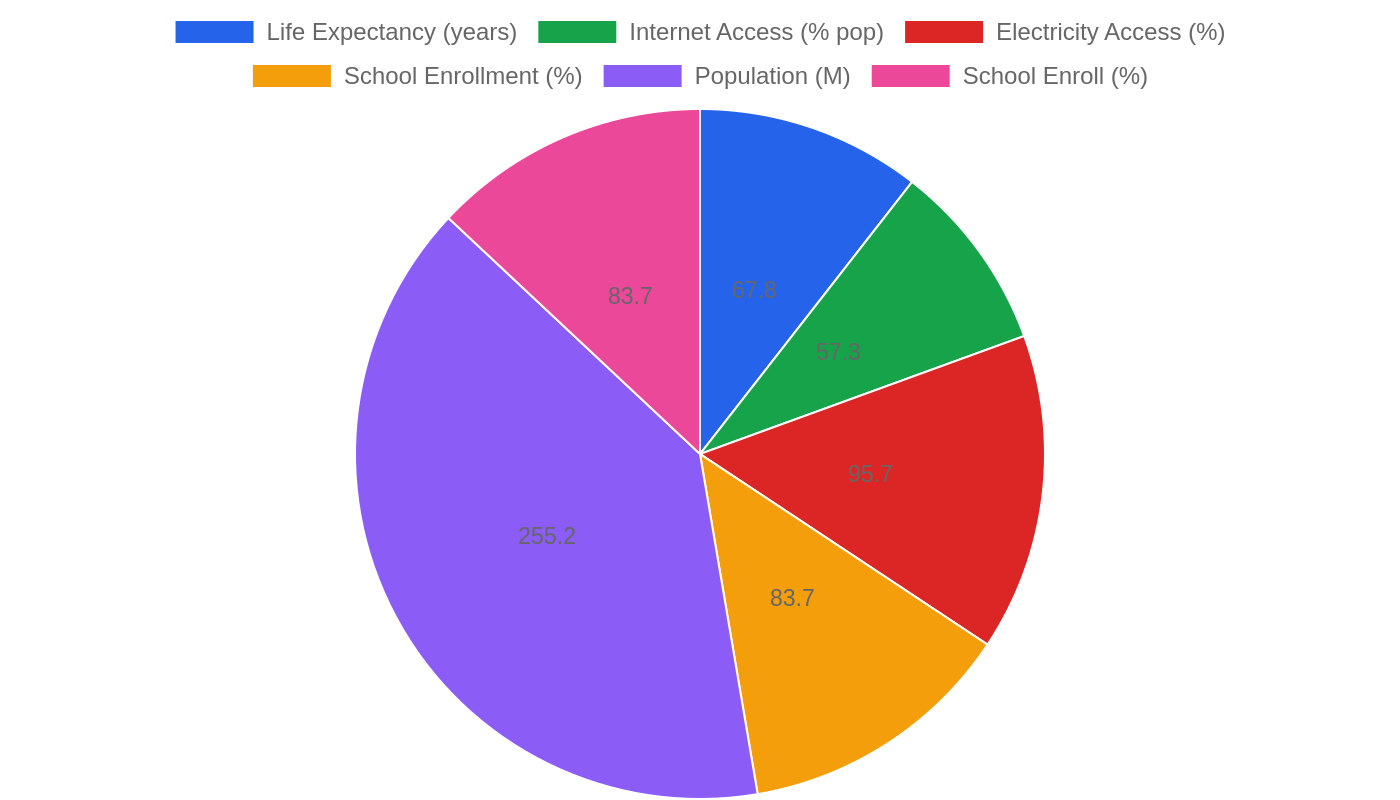
On the monetary front, inflation measured by the Consumer Price Index (CPI) has cooled to 3.54555214890893%, a critical development for restoring purchasing power and encouraging domestic consumption. However, the human cost of this macroeconomic stability remains high for the average citizen; with a population of 255,219,554.0, the GDP per capita in terms of Purchasing Power Parity (PPP) stands at 6,573.41613369925, while the Gross National Income (GNI) per capita is recorded at a modest $1,500.0.
The unemployment rate of 5.42% suggests that while jobs are being created, the labor market is not yet absorbing the workforce at the pace required to fully capitalize on demographic dividends. These figures collectively illustrate an economy in transition, where aggregate growth is visible, but individual wealth accumulation remains a distant goal for many.
Cost of Living: Daily Realities for a Growing Population
The intersection of inflation and income defines the daily economic experience for Pakistan’s citizens. With CPI inflation settling near 3.5%, the rapid erosion of savings seen in previous years appears to have slowed, providing a temporary buffer for household budgets. However, the low GNI per capita of $1,500.0 indicates that this inflationary relief does not necessarily translate into higher disposable income for the majority.
For a population exceeding 255 million, the pressure on essential goods and housing remains acute, even if headline inflation numbers look favorable. While specific housing rent-to-buy ratios are not detailed in the current dataset, the broader context of a developing economy suggests that asset ownership remains a primary method of wealth preservation rather than liquid consumption.
The disparity between the national GDP of over $400 billion and the individual income levels highlights a structural imbalance where economic output does not uniformly trickle down to living standards. Consequently, consumers are likely becoming more price-sensitive, favoring value-driven purchases as they navigate a cost-of-living environment that is stabilizing but still demanding.
Investment & Business Climate: Conglomerates and Services Lead
The corporate landscape in Pakistan is characterized by the dominance of large, diversified groups and a robust service sector. Major entities such as A. F. Ferguson & Co. in financials and the Adamjee Group and AKD Group in conglomerates represent the backbone of the industrial and financial architecture.
Notably, the presence of multiple aviation companies—including Aero Asia, Air Indus, Airblue, and AirSial—alongside Al Haj FAW Motors in consumer goods, signals a vibrant consumer services and mobility market. Basic materials also play a crucial role, evidenced by players like Aisha Steel Mills, which supports infrastructure and manufacturing needs. Industrial segments are further represented by Al-Ghazi Tractors, highlighting the importance of agricultural mechanization and heavy industry.
This concentration of major companies suggests that investment opportunities are often tied to established conglomerates with deep market penetration. For foreign and domestic investors, the business environment appears to reward those who can navigate complex regulatory frameworks while leveraging the scale of these existing corporate giants. The focus on consumer services and financials indicates a maturing market where middle-class consumption and financial inclusion are key growth drivers.
Safety, Politics & Quality of Life: Governance and Security
Understanding Pakistan requires looking beyond economics to its complex political and social fabric. The country operates as a democratic parliamentary federal republic, with Islam designated as the state religion, shaping both legal frameworks and social norms. Historically, the military’s influence in mainstream politics has been significant, creating a unique dynamic where civilian governance and military institutions interact closely.
The political timeline is marked by constitutional shifts, from the initial 1956 constitution to its suspension by Ayub Khan in 1958, followed by the 1962 constitution. The 1973 constitution, under Zulfikar Ali Bhutto, established the current parliamentary system, though it faced suspension during Zia-ul-Haq’s martial law era. Regarding personal security, specific crime and safety indices are listed as N/A in the provided data, making precise quantification of safety levels difficult.
However, the historical context of political instability suggests that quality of life is heavily influenced by policy continuity and governance effectiveness. Citizens navigate a society where religious identity and political allegiance are deeply intertwined, affecting everything from business operations to social cohesion.
What’s Happening Now: Policy Shifts and Economic Adjustments
Currently, Pakistan is navigating a period of macroeconomic recalibration aimed at sustaining growth while managing external vulnerabilities. The projected GDP growth of nearly 3.7% for 2025 reflects ongoing reforms intended to attract investment and stabilize the currency. The drop in inflation to roughly 3.5% is a direct result of tight monetary policies and supply-side interventions, marking a pivotal shift from the hyperinflationary periods of the past.
Policymakers are likely focusing on reducing fiscal deficits to maintain this positive trajectory, given the low GNI per capita which limits domestic tax bases. The corporate sector’s activity, particularly in aviation and finance, suggests that private sector confidence is slowly returning, driven by improved macro indicators. However, with unemployment at 5.42%, there is urgent pressure on the government to implement job-creation strategies that go beyond traditional agriculture.
The interplay between political stability and economic performance remains the central theme, as any disruption in governance could jeopardize the fragile progress made in curbing inflation and stimulating growth. Investors are watching closely to see if these short-term fixes evolve into long-term structural transformations.
The Bottom Line
Pakistan represents a high-potential market for investors willing to engage with its complex political and economic realities. The combination of solid GDP growth projections and easing inflation offers a compelling entry point for those focused on consumer services and financial sectors. However, the low per capita income and significant population size mean that success requires a long-term perspective and local expertise.
It is a country where macroeconomic stability is improving, but microeconomic challenges for the average citizen remain profound.
Sources & Methodology
This article is authored by Economic Pulse Net for informational and research purposes. Economic Pulse Net sources its data from multilateral institutions, national statistics bureaus, and proprietary databases. All data is believed to be current as of the date of publication.
Published: September 27, 2026 | Category: Research — Pakistan
Use these signals in your own platform
Economic Pulse publishes its live signal feed through a documented, read-only API. Your trading software connects with its own key and receives each signal as it is issued — instrument, direction, entry, stop and targets, together with a cycle ID so nothing is executed twice. The feed is independent of this website and cannot change it.
Signals are informational only and are not financial advice.