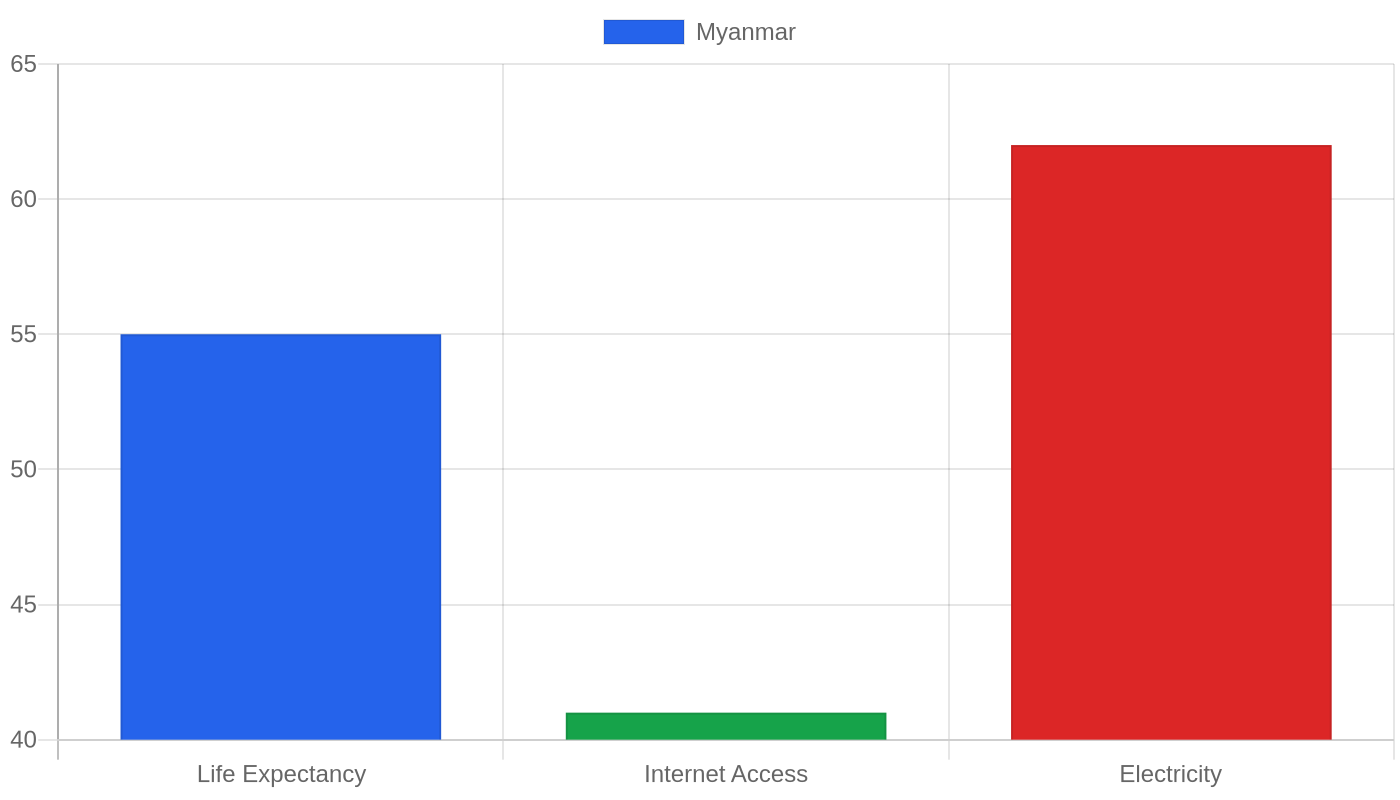
Economic Pulse Net | Sources: World Bank World Development Indicators, Government Sources | 2026
Key Takeaways
* Constitutional Complexity: Myanmar operates under a 2008 constitution that establishes a unique parliamentary system with a bicameral legislature, where the military retains significant power through appointed seats.
State-Linked Dominance: The business landscape is heavily influenced by major conglomerates and state-owned enterprises, particularly in critical sectors like oil, gas, gems, and pharmaceuticals.
Data Transparency Gaps: Current macroeconomic indicators such as GDP growth, inflation, and unemployment are not currently available from the World Bank, creating a challenging environment for standard economic analysis.
Security Uncertainty: Reliable data on crime indices and safety levels is missing, suggesting a volatile or opaque security environment that complicates risk assessment for investors and residents.
The Architecture of Power and Policy
Myanmar’s economic trajectory is inextricably linked to its distinctive political framework, which functions as a unitary assembly-independent republic. Under the provisions of its 2008 constitution, the country is governed as a parliamentary system featuring a bicameral legislature.
This structure includes an executive president who is accountable to the legislature, yet the political balance of power is skewed by a specific constitutional mandate: 25% of all legislators are appointed by the military, while the remainder are elected through general elections. This arrangement creates a dual-power dynamic that profoundly influences fiscal policy, regulatory environments, and long-term strategic planning.
For economists and policymakers, understanding this hybrid governance model is essential, as it dictates how reforms are implemented and how external investments are approved. The interplay between elected representatives and appointed military officials often results in a complex decision-making process that can either stabilize or disrupt economic initiatives depending on the prevailing political climate.
Consequently, any analysis of Myanmar’s economy must begin with an acknowledgment of this structural reality, where political stability is as much a function of military consent as it is of popular mandate.
A Business Landscape Defined by Conglomerates
The corporate sector in Myanmar is characterized by a mix of consumer-focused services and massive state-linked entities that dominate key industries. Among the most prominent players are Asia World and Htoo Group of Companies, both operating as large-scale conglomerates that likely span multiple sectors including real estate, telecommunications, and manufacturing.
These private giants compete alongside powerful state-owned enterprises such as Myanma Economic Holdings Limited, Myanma Oil and Gas Enterprise, and Myanma Gems Enterprise. The presence of Myanma Pharmaceutical Industry Enterprise highlights the government’s direct involvement in healthcare supply chains, ensuring that essential medicines remain within state control.
In the consumer services space, companies like Air Bagan and Air Mandalay provide critical connectivity, while Eleven Media Group shapes the information landscape. Additionally, Aeon Display and Security System represents the growing demand for security infrastructure, reflecting broader concerns about asset protection.
This concentration of power in both private conglomerates and state enterprises suggests that doing business in Myanmar requires navigating a web of relationships where government approval and corporate alliances are equally vital. Investors looking at these top companies must recognize that success often depends less on pure market competition and more on strategic positioning within this established ecosystem.
Living Costs and Daily Realities
Assessing the cost of living in Myanmar presents a significant challenge due to the absence of standardized data on housing costs, rent prices, and daily expenses. Without concrete figures on inflation or consumer price indices, it is difficult to compare living standards directly with regional averages or determine the purchasing power of local households.
However, the lack of transparent data itself serves as an indicator of potential volatility; in economies where official statistics are withheld or unavailable, informal markets often dictate actual prices for goods and services. Residents and expatriates alike likely face uncertainty when budgeting for essentials, as fluctuations in currency value and supply chain disruptions can rapidly alter the affordability of basic necessities.
The inability to benchmark against reliable metrics means that individuals must rely on localized knowledge and anecdotal evidence to gauge their financial health. This opacity extends to the housing market, where rental yields and property values may be influenced by factors that do not appear in formal economic reports.
Consequently, the daily experience of living in Myanmar is shaped by adaptability and resilience, as citizens navigate an economic environment where the official numbers tell only part of the story.
Safety, Politics, and Quality of Life
The quality of life in Myanmar is deeply intertwined with its political landscape and security conditions, both of which are currently shrouded in ambiguity regarding measurable outcomes. While the constitutional framework provides a formal structure for governance, the reality on the ground is reflected in the unavailability of crime and safety indices.
When official metrics for crime rates and personal safety are marked as “N/A,” it often points to either a breakdown in data collection systems or a sensitive political environment where such information is not freely disseminated. This gap makes it nearly impossible to quantify the risks associated with travel, business operations, or daily commuting.
The political system, with its military-appointed legislative block, creates a stable-yet-rigid hierarchy that prioritizes national sovereignty and institutional continuity over rapid liberalization. For the average citizen, this translates to a society where social cohesion is maintained through strong state structures, but where individual freedoms and transparency may be secondary to collective order.
Understanding this trade-off is crucial for anyone assessing the human dimension of Myanmar’s development; the nation offers a unique cultural and historical richness, but one that exists within a tightly managed political container.
What’s Happening Now: The Institutional Status Quo
Currently, the defining feature of Myanmar’s current affairs is the continued operation of its existing political and economic institutions without significant recent shifts reported in the provided data. The country remains firmly anchored in its 2008 constitutional framework, with no immediate changes to the balance of power between the elected president and the military-appointed legislators.
Business operations continue to be driven by the established major players, including the conglomerates and state enterprises listed in the corporate sector, indicating a degree of operational continuity despite broader global uncertainties. There are no recent reports of new economic reforms, election cycles, or major policy pivots that would signal a transition period. Instead, the focus appears to be on maintaining the status quo within the defined parameters of the unitary assembly-independent republic.
This stability, however fragile, allows businesses like Air Mandalay and Myanma Oil and Gas Enterprise to continue their core functions without the disruption of sudden regulatory overhauls. For observers, the “now” in Myanmar is characterized by endurance rather than transformation, with the political and economic systems functioning as designed under the current constitutional order.
The Bottom Line
Myanmar presents a case study in resilience and complexity, where economic activity persists within a rigidly structured political framework. Potential investors and analysts should approach the country with caution, recognizing that the absence of transparent macroeconomic data necessitates a reliance on qualitative assessments and on-the-ground intelligence.
The dominance of state-linked enterprises and military-influenced governance means that opportunities are best pursued through established partnerships and deep local knowledge. Ultimately, Myanmar remains a niche market for those willing to navigate its unique blend of traditional industry, state control, and constitutional complexity.
Sources & Methodology
This article is authored by Economic Pulse Net for informational and research purposes. Economic Pulse Net sources its data from multilateral institutions, national statistics bureaus, and proprietary databases. All data is believed to be current as of the date of publication.
Published: October 19, 2026 | Category: Research — Myanmar
Use these signals in your own platform
Economic Pulse publishes its live signal feed through a documented, read-only API. Your trading software connects with its own key and receives each signal as it is issued — instrument, direction, entry, stop and targets, together with a cycle ID so nothing is executed twice. The feed is independent of this website and cannot change it.
Signals are informational only and are not financial advice.