Economic Pulse Net | Sources: World Bank World Development Indicators, Government Sources | 2026
Key Takeaways
* Structural Ambiguity: Official macroeconomic indicators such as GDP growth, inflation, and unemployment are currently unreported by the World Bank, reflecting significant data gaps in one of the world’s most complex economic environments.
Digital Leapfrogging: The telecommunications sector is dominated by key players like Hormuud Telecom and Golis Telecom Somalia, signaling a robust private-sector-led digital infrastructure despite broader institutional challenges.
Federal Political Framework: The nation operates as a federal parliamentary representative democratic republic, with the President serving as both head of state and commander-in-chief, selecting the Prime Minister to lead the government.
Private Sector Resilience: Major domestic entities span financial services, consumer goods, and media, including First Somali Bank, Bosaso Tannery, and Eastern Television Network, indicating active local capital formation.
Security Data Void: Comprehensive crime and safety indices are not currently available, necessitating caution for any business or travel planning based on official statistical metrics.
The Invisible Economy: Macro-Economic Realities
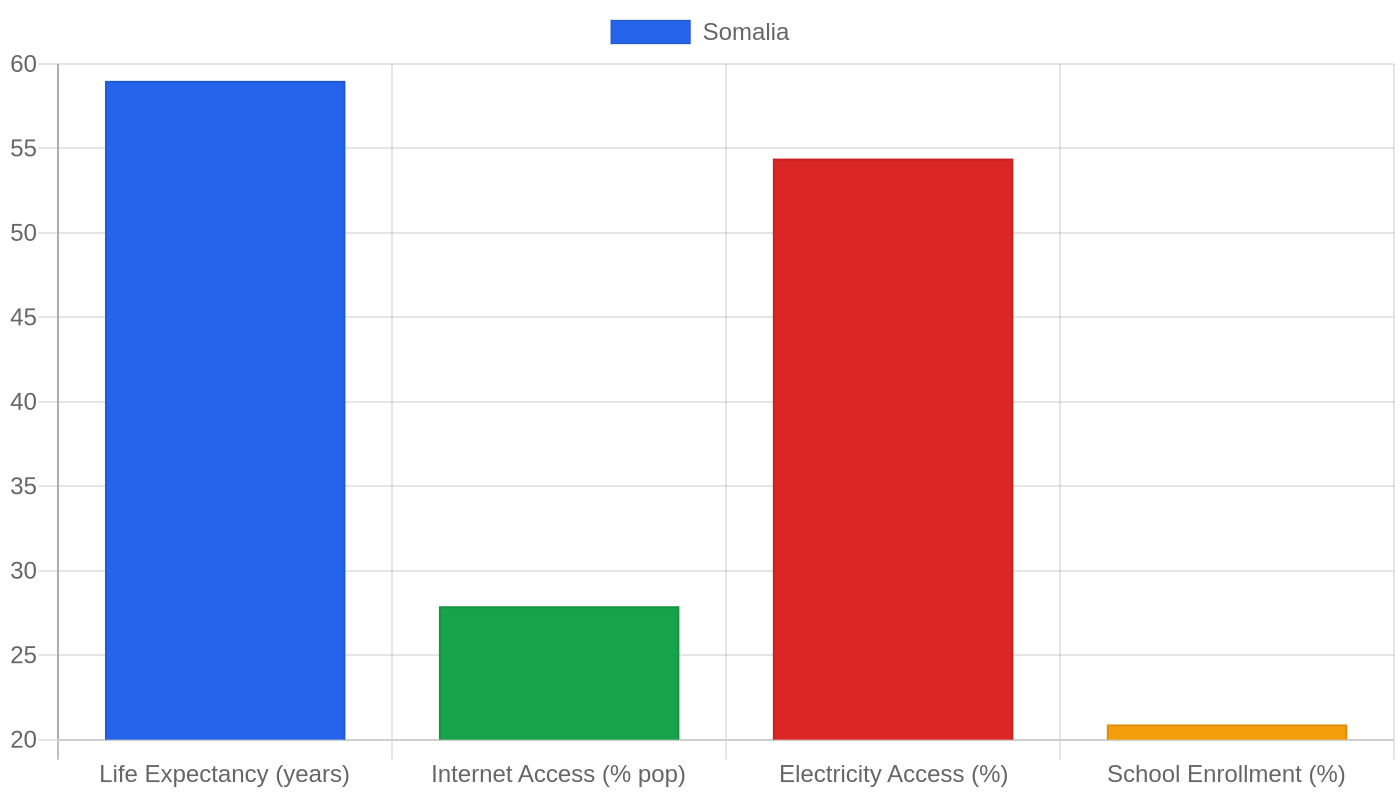
When analyzing the economic landscape of Somalia through the lens of international institutions, the first challenge is not policy but visibility. According to the latest data from the World Bank, critical macroeconomic indicators—including GDP growth, inflation (CPI), unemployment rates, total GDP in USD, GDP per capita (PPP), GNI per capita, and even population figures—are listed as “N/A.” This absence of standardized data does not mean the economy is stagnant; rather, it highlights the profound difficulty in capturing the output of a nation where informal trade, remittances, and pastoralism often dwarf formal sector contributions.
For investors and policymakers, this data vacuum creates a high-risk environment where traditional valuation models fail. Without baseline figures for inflation or employment, assessing purchasing power parity or labor market health becomes an exercise in estimation rather than calculation. Consequently, economic analysis must rely heavily on proxy indicators, such as the activity levels of major telecom firms or banking transactions, to infer general economic momentum.
The lack of reported GDP growth suggests that either the formal economy is too small to register statistically or that the mechanisms for national accounting are still under reconstruction. This opacity forces external observers to look beyond headline numbers and examine the operational health of specific industries to understand the country’s true economic pulse.
Daily Life and Cost Structures
For residents and expatriates alike, the cost of living in Somalia is shaped less by national CPI reports—which are unavailable—and more by localized market dynamics and supply chain logistics. While specific rent-to-buy ratios or daily expense benchmarks are not provided in the current dataset, the presence of diverse consumer service companies offers clues about urban economic activity.
Entities like Hargeisa Taxi and Air Somalia indicate established transportation networks, while Hafun Fishing Company points to active local food production sectors. In the absence of national inflation data, price stability likely varies significantly between Mogadishu’s urban centers and rural regions, driven by security conditions and import dependencies.
Housing costs are generally inferred to be higher in secure, commercially active zones due to limited inventory and heightened demand from returning diaspora and foreign NGOs. However, without concrete housing indices, these costs remain anecdotal rather than statistical. The daily expense profile is likely dominated by essentials, with technology and telecommunications services playing a disproportionate role in household budgets given the dominance of firms like Hormuud Telecom.
This suggests a cost structure where connectivity is a primary utility, potentially displacing other traditional household expenditures.
Investment Climate and Corporate Landscape
The investment landscape in Somalia is characterized by a vibrant, albeit fragmented, private sector that has stepped in where public infrastructure has lagged. The corporate roster reveals a diversified mix of interests, with Financials holding a prominent position through institutions like Bank of Somaliland, Central Bank of Somalia, and First Somali Bank.
These entities suggest a growing, though perhaps unstable, formal banking sector attempting to channel domestic savings and remittances into productive investments. In the telecommunications space, Hormuud Telecom and Golis Telecom Somalia stand out as critical infrastructure providers, likely driving much of the country’s digital transformation and mobile money adoption.
Industrials and Consumer Goods are represented by Bosaso Tannery and Hafun Fishing Company, indicating that local resource processing remains a viable, if niche, investment avenue. Meanwhile, the media sector, featuring Eastern Television Network and Air Somalia, reflects a thriving information economy that supports civic engagement and commercial advertising.
For foreign investors, the business environment is defined by this strong private-sector resilience but complicated by the lack of transparent regulatory frameworks. The presence of multiple central and commercial banks implies ongoing efforts to stabilize the currency and manage liquidity, which are prerequisites for sustained foreign direct investment.
Safety, Politics, and Governance
Governance in Somalia is structured as a federal parliamentary representative democratic republic, a complex system designed to balance central authority with regional autonomy. The President serves as the head of state and commander-in-chief of the Somali Armed Forces, wielding significant executive power while selecting the Prime Minister to lead the head of government.
This political arrangement aims to provide stability in a region historically plagued by fragmentation, yet the operational reality on the ground remains challenging. Regarding personal security, both the Crime Index and Safety Index are recorded as “N/A,” meaning there are no standardized statistical measures to guide risk assessment for travelers or businesses.
This lack of safety data is a significant barrier to tourism and large-scale retail investment, as potential visitors cannot gauge the security environment through conventional metrics. The political landscape, therefore, relies heavily on qualitative assessments of federal relations and security operations rather than quantitative indices. Quality of life indicators are similarly obscured, with no happiness or well-being data available to complement the political and economic picture.
Investors must navigate this uncertainty by focusing on localized security arrangements and political risk insurance rather than relying on broad national indices.
Current Affairs and Business Developments
While specific recent news events are not detailed in the provided dataset, the structural elements of the economy point to ongoing developments in the financial and telecommunications sectors. The continued operation and prominence of firms like First Somali Bank and Hormuud Telecom suggest that credit intermediation and digital connectivity are expanding despite broader macroeconomic uncertainties.
The existence of a Central Bank of Somalia indicates active monetary policy efforts, even if their outcomes are not reflected in published inflation or GDP figures. Business developments appear to be driven by private enterprise innovation rather than top-down industrial policy, as seen in the diversity of companies ranging from tanneries to taxi services.
This bottom-up economic activity suggests that reforms, if they occur, are likely focused on improving the ease of doing business for SMEs and integrating the informal sector into the formal economy. The political framework remains stable in its constitutional design, with the federal system continuing to define the relationship between the central government and regional states.
Any shifts in policy would likely target enhancing the capacity of financial institutions to handle increased transaction volumes from the growing telecom and diaspora remittance sectors.
The Bottom Line
Somalia presents a unique case study in economic resilience amid institutional opacity. Investors should watch this country primarily for opportunities in telecommunications, financial services, and local consumer goods, where private companies are driving growth independent of national statistical reporting. The lack of reliable macroeconomic data requires a cautious, micro-level approach to market entry, focusing on individual company performance rather than national trends.
Ultimately, Somalia’s economic future depends on strengthening its federal governance structures and improving data collection to attract sustainable foreign investment.
Sources & Methodology
This article is authored by Economic Pulse Net for informational and research purposes. Economic Pulse Net sources its data from multilateral institutions, national statistics bureaus, and proprietary databases. All data is believed to be current as of the date of publication.
Published: October 20, 2026 | Category: Research — Somalia
Use these signals in your own platform
Economic Pulse publishes its live signal feed through a documented, read-only API. Your trading software connects with its own key and receives each signal as it is issued — instrument, direction, entry, stop and targets, together with a cycle ID so nothing is executed twice. The feed is independent of this website and cannot change it.
Signals are informational only and are not financial advice.