Economic Pulse Net | Sources: World Bank World Development Indicators, Government Sources | 2026
Key Takeaways
– Mongolia’s economy remains overwhelmingly dependent on its state-owned mining giants, with coal and copper dominating export revenues.
– The political system, a semi-presidential representative democratic republic, is navigating a delicate balance of power between a directly-elected president and a prime minister.
– The corporate landscape is a unique fusion of state capitalism and market infrastructure, anchored by the powerful Erdenes Mongol holding company and the Mongolian Stock Exchange.
– For investors, the country presents a high-risk, high-reward frontier where the world’s demand for green energy metals meets the logistical and governance challenges of a landlocked nation.
The Great Khural’s Balancing Act: An Economy on the Brink
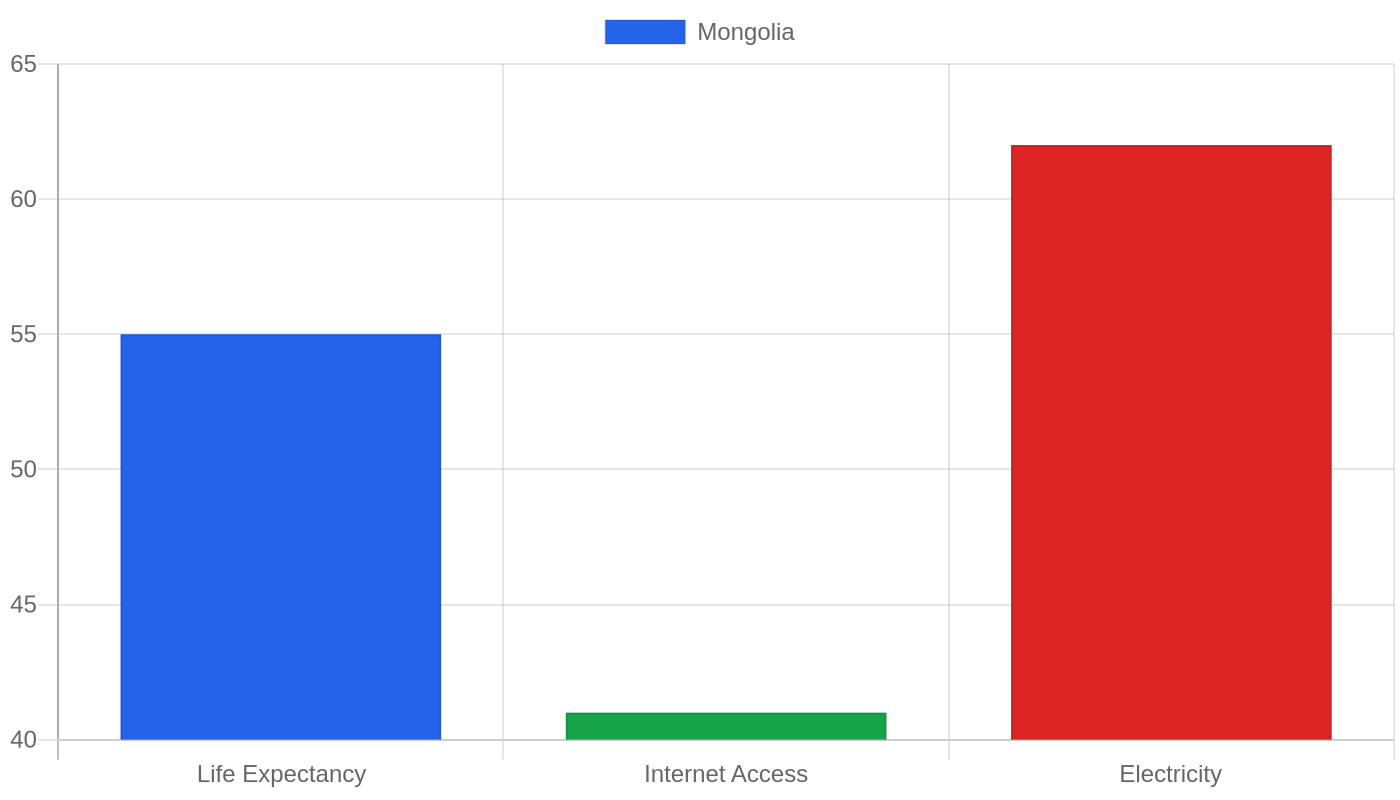
The economic narrative of Mongolia is written in the earth itself. While the World Bank’s latest data does not provide a current snapshot of GDP growth, inflation, or unemployment, the structural reality of this nation is clear: it is a commodity superpower in waiting, tethered to the whims of global resource prices.
The absence of fresh macro figures does not diminish the story; rather, it highlights a persistent challenge for analysts trying to track an economy that can swing violently with the price of a single cargo of coal. The fundamental drivers remain intact, with the extraction and processing of minerals serving as the primary engine of national wealth.
This reliance creates a profound vulnerability. When global demand for steel-making coal or copper cathode surges, Ulaanbaatar’s coffers swell, and the local currency strengthens. Conversely, a downturn in Beijing’s manufacturing sector or a global slowdown sends ripple effects through the entire domestic economy, impacting everything from government salaries to the construction of new apartment blocks in the capital.
The lack of diversified industry means that the country’s economic health is essentially a leveraged bet on the Asian supply chain. The service sector, while growing, remains largely ancillary to the mining behemoths that dominate the landscape, leaving the nation exposed to the boom-and-bust cycles that have defined resource-rich frontiers for centuries.
The Cost of the Frontier: Housing and Daily Life in Ulaanbaatar
While precise cost-of-living indices are not available in the current data set, the economic structure implies a stark bifurcation in daily life. For the urban population concentrated in Ulaanbaatar, the cost of living is heavily influenced by the nation’s import dependence; fuel, vehicles, and a significant portion of consumer goods must traverse vast distances by rail or truck, inflating prices well beyond what one might find in coastal Asian hubs.
This logistical premium is a tax on every citizen, from the price of a loaf of bread to the cost of a new smartphone. The rental market, driven by rural-to-urban migration and a growing professional class, puts pressure on modern housing, while the traditional *ger* districts on the city’s outskirts offer a lower-cost, but less secure, alternative.
The decision between renting and buying is a central life choice for many Mongolians. With mortgages often tied to the health of the banking sector—dominated by players like the State Bank and the Development Bank of Mongolia—homeownership is a marker of stability but remains out of reach for many young families. Meanwhile, the price of basic utilities and heating during the brutal winter months consumes a significant portion of household budgets.
This economic pressure cooker is a daily reality that shapes public sentiment and political discourse, making the cost of living a far more immediate concern than abstract GDP figures for the average citizen.
The State’s Heavy Hand: Investment and the Corporate Landscape
The Mongolian economy is a fascinating case study in state-led development. The corporate sector is anchored not by private entrepreneurs but by a constellation of state-owned or state-linked entities that control the strategic heights of the economy. Erdenes Mongol, the holding company, sits atop this pyramid, managing the government’s stakes in the nation’s most valuable assets, including the massive Erdenes Tavantolgoi coal deposit and the Erdenet Mining Corporation.
This structure means that for international investors, doing business in Mongolia often means negotiating with the state, either directly or through its proxies. The presence of the Development Bank of Mongolia further cements this dynamic, as it acts as the primary conduit for state-directed credit into infrastructure and industrial projects.
Despite this dominance, there is a parallel infrastructure for private capital. The Mongolian Stock Exchange (MSE) represents the country’s ambition to create a modern financial marketplace, though its liquidity remains thin and its fortunes are tied to the mining sector. The presence of vital utilities like Ulaanbaatar Railway and MIAT Mongolian Airlines underscores the logistical bottlenecks that any enterprise must navigate.
For a foreign investor, the opportunity lies in the secondary and tertiary sectors—supply chain logistics, equipment maintenance, and value-added processing—that are currently underserved. However, the pervasive role of state-owned enterprises creates a tricky playing field where political connections can be as important as economic fundamentals.
Stability in the Steppe: Safety, Politics, and the Quality of Life
Mongolia’s political landscape is defined by its unique hybrid system—a semi-presidential representative democratic republic. This structure creates a constant, dynamic tension between the directly-elected president and the prime minister, who heads the executive branch. While this system is designed to provide checks and balances, it often leads to political gridlock and policy uncertainty, as the two leaders may hail from rival factions or hold conflicting visions for the country’s development.
This political maneuvering occurs against a backdrop of a generally safe society, where violent crime is not a dominant concern for most residents, despite the economic disparities. The social fabric remains strong, rooted in nomadic traditions of hospitality and community, even as urbanization strains traditional support networks.
The quality of life, however, is a mixed bag. While Ulaanbaatar boasts a vibrant arts scene and a young, educated population eager to engage with the global economy, it also struggles with severe air pollution during the winter months and significant infrastructural deficits. The political system’s focus on resource extraction often overshadows long-term investments in healthcare, education, and environmental protection.
For the average citizen, the “Mongolian Dream” is not just about economic growth; it is about the ability to live in a clean, safe environment with access to opportunity. The current political class, however, is often perceived as being more focused on dividing the resource pie than on baking a larger, more diversified one.
The Tectonic Shift: What’s Happening in Mongolia Right Now
The most pressing issue in Mongolia today is the urgent, existential push to diversify an economy that is dangerously over-reliant on a single sector. The global energy transition, while a long-term threat to coal demand, is simultaneously a massive opportunity for Mongolia’s vast copper reserves, which are essential for electrification.
The government’s focus is now on attracting foreign direct investment to develop new mining projects and, crucially, to build the infrastructure needed to process these minerals domestically rather than exporting raw ore. This involves navigating complex negotiations with international partners and the state-owned Erdenes Mongol to secure the financing and technical expertise required for the next generation of mega-mines.
Simultaneously, there is a visible push to modernize the financial sector, with the Mongolian Stock Exchange seeking to attract listings from private companies and to deepen its capital markets. The government is also grappling with the social consequences of its mining boom, including wealth inequality and regional disparities. The political debate is no longer just about how to extract resources, but about how to manage the revenues transparently and invest them in a sustainable future.
As the world’s demand for critical minerals intensifies, Mongolia stands at a crossroads; the decisions made by the president, the prime minister, and the State Great Khural in the coming months will determine whether the country becomes a diversified, resilient economy or remains a captive of its own geological fortune.
The Bottom Line
Mongolia is a country for the patient and the bold. It offers tremendous upside for investors in the energy and mining sectors, but it demands a tolerance for political complexity and commodity price volatility. For policymakers and economists, it is a critical case study in the challenges of managing natural resource wealth in a democratic framework. Watch Mongolia not for its headline numbers, but for its strategic maneuvering between global superpowers and its internal struggle to build a post-mining future.
Sources & Methodology
This article is authored by Economic Pulse Net for informational and research purposes. Economic Pulse Net sources its data from multilateral institutions, national statistics bureaus, and proprietary databases. All data is believed to be current as of the date of publication.
Published: August 03, 2026 | Category: Research — Mongolia
Use these signals in your own platform
Economic Pulse publishes its live signal feed through a documented, read-only API. Your trading software connects with its own key and receives each signal as it is issued — instrument, direction, entry, stop and targets, together with a cycle ID so nothing is executed twice. The feed is independent of this website and cannot change it.
Signals are informational only and are not financial advice.