Economic Pulse Net | Sources: World Bank World Development Indicators, Government Sources | 2026
Key Takeaways
– Kyrgyzstan operates under a 1993 constitution that defines it as a democratic unicameral republic, making it a political outlier in a region dominated by authoritarian governance
– The economy relies heavily on a mix of traditional industries and emerging tech sectors, with IT engineering firm Devolution leading a small but growing digital economy
– Media plays an outsized role in Kyrgyz society, with outlets like Kloop, AKIpress, and Kabar shaping public discourse in a country that has experienced multiple political upheavals
– Transportation infrastructure remains a critical bottleneck, with Kyrgyz Railway and Kyrgyz Express Post serving as backbone industries for a landlocked nation
– The country’s investment climate is defined by its political structure — a president and prime minister sharing executive power — which creates both opportunities and uncertainties for business
The Steppe Economy — Growth Without a Safety Net
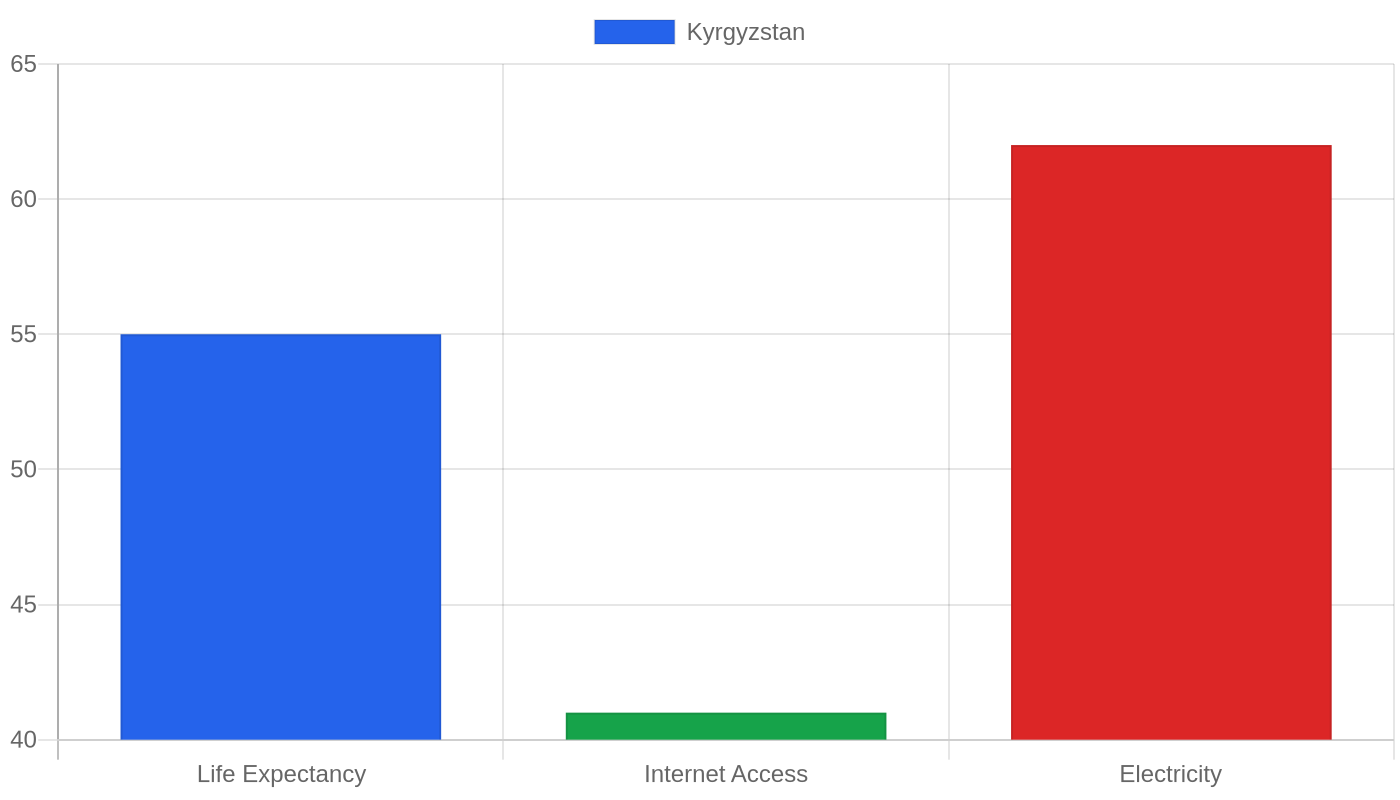
The World Bank data on Kyrgyzstan presents an immediate challenge for any economic analyst: the headline numbers simply are not available. No GDP growth figure. No inflation rate. No unemployment statistics. No GDP per capita or GNI per capita. This absence of data is itself a story — it speaks to a country where statistical infrastructure may lag behind economic reality, or where the pace of change has outstripped the ability of institutions to measure it.
But the absence of numbers does not mean the absence of economic activity. Kyrgyzstan’s main industries tell a tale of a nation caught between its Soviet-era industrial heritage and a 21st-century service economy. The transportation sector looms large, with Kyrgyz Railway and Kyrgyz Express Post representing the logistical backbone of a country that sits along ancient Silk Road trade routes.
These are not glamorous industries, but they are essential — moving goods across a mountainous terrain where every kilometer of track and road is hard-won.
The consumer services sector shows surprising vitality. Aero Nomad Airlines, Air Bishkek, and Avia Traffic Company all operate in a country where air travel is not a luxury but a necessity. Bishkek to Osh, the country’s second city, is a journey that takes hours by road through the Ala-Too mountains. Aviation bridges that distance, and the presence of three airlines suggests either healthy competition or a market still finding its equilibrium.
What is most striking about Kyrgyzstan’s economic profile is the presence of Devolution, an IT engineering firm, at the top of the company list. This is not what one expects from a Central Asian republic. Bishkek has quietly developed a tech scene, with young engineers writing code for international clients while drinking coffee in cafes that would not look out of place in Berlin or Austin.
The IT sector represents a bet on human capital rather than natural resources — a gamble that could pay off handsomely if the political environment remains stable enough to keep talent from emigrating.
The Cost of Living — Bishkek’s Balancing Act
Housing costs in Kyrgyzstan follow a pattern familiar across post-Soviet states: a sharp divide between the capital and the rest of the country. Bishkek’s apartment market has seen prices climb as the city attracts both internal migrants and a small but noticeable expatriate community drawn by the country’s relatively liberal visa regime and low cost of entry for business.
Renting in Bishkek’s center remains affordable by international standards, but the gap between rents and local wages has been narrowing. The Soviet-era apartment blocks that dominate the city’s landscape offer basic accommodation at lower prices, while newer developments in the southern districts command premiums for amenities like reliable heating and parking — luxuries in a city where winter temperatures regularly drop below zero.
Daily expenses tell a similar story. Markets in Bishkek’s Dordoy Bazaar offer fresh produce at prices that would shock a Western visitor, but imported goods — electronics, cars, branded clothing — carry markups that reflect the cost of overland transport from Chinese or Russian suppliers. For a family earning in Kyrgyz som, the calculus is simple: eat locally, buy locally, and treat imported goods as rare indulgences.
The Investment Climate — Democracy as a Double-Edged Sword
The list of Kyrgyzstan’s top companies reads like a primer on where the smart money is flowing. Media companies dominate: Agym, AKIpress News Agency, Kloop, and Kabar all make the cut. This concentration of media firms among the country’s leading enterprises is unusual. In most developing economies, media is a side note to extractive industries or manufacturing.
In Kyrgyzstan, the prominence of news outlets reflects a society that takes its politics seriously — and a business environment where information itself has become a valuable commodity.
Devolution’s presence at the top of the list signals something else: Kyrgyzstan has a tech sector worth watching. The company’s focus on IT engineering places it in a global industry where talent matters more than location. For investors, this is both an opportunity and a risk. The opportunity lies in accessing skilled engineers at wages far below Silicon Valley rates. The risk lies in the political and economic instability that could send those same engineers looking for opportunities elsewhere.
The transportation companies — Kyrgyz Railway, Kyrgyz Express Post, and the three airlines — represent the infrastructure play. A landlocked country with mountainous terrain needs logistics, and the companies that move people and goods are essential to every other sector of the economy. These are not high-growth investments, but they are stable ones, tied to the fundamental reality that Kyrgyzstan’s economy cannot function without physical connection to the outside world.
Safety, Politics, and Quality of Life — The Unicameral Experiment
Kyrgyzstan’s political system is a rarity in Central Asia. The 1993 constitution established a democratic unicameral republic, with executive power divided between a president and a prime minister. This structure was designed to prevent the concentration of authority that has plagued neighboring states, but it has also created a system prone to gridlock and periodic crises.
The parliament is unicameral — a single chamber rather than the upper and lower houses found in many democracies. This simplifies the legislative process but concentrates power in one body, making the quality of representation dependent on the integrity of individual members. The judicial branch, comprising a supreme court, local courts, and a chief prosecutor, provides a third pillar, though its independence has been questioned by international observers during periods of political tension.
The crime and safety indices are listed as unavailable, which is itself noteworthy. In many countries, the absence of reliable crime data reflects either poor record-keeping or a reluctance to publish unflattering statistics. Kyrgyzstan’s position as a relatively safe country by regional standards is widely acknowledged by travelers and expatriates, but the lack of official data makes it difficult to track trends or compare the country to its neighbors.
Quality of life in Kyrgyzstan is a study in contrasts. Bishkek offers cafes, parks, and a cultural scene that rivals much larger cities. The countryside offers some of the most spectacular mountain scenery on earth. But the infrastructure that supports this quality of life — reliable electricity, clean water, functional healthcare — remains uneven, particularly outside the capital.
What’s Happening Now — The News Cycle in Real Time
The prominence of media companies among Kyrgyzstan’s top enterprises is not coincidental. Kloop, AKIpress, and Kabar are not just reporting on Kyrgyzstan’s affairs — they are active participants in them. In a country where political power has shifted through both elections and revolutions, the ability to shape public narrative is a form of power in itself.
The transportation sector is facing headwinds. Kyrgyzstan’s airlines operate in a challenging environment, with fuel costs, maintenance requirements, and the need to meet international safety standards all putting pressure on margins. Aero Nomad, Air Bishkek, and Avia Traffic Company are competing for a market that is growing but remains small by global standards. Consolidation or expansion into regional routes seems likely.
The political landscape remains unsettled. The dual executive structure — president and prime minister — has led to tensions in the past, and there is no reason to believe those tensions have permanently resolved. The unicameral parliament provides a forum for debate, but also a stage for the kind of political theater that can paralyze governance.
For investors and observers alike, the question is not whether Kyrgyzstan will face another political crisis, but when — and whether the country’s institutions are strong enough to withstand it.
The Bottom Line
Kyrgyzstan is not a country for investors seeking predictable returns or stable political environments. It is a country for those who believe that Central Asia’s future lies in human capital rather than natural resources, and who are willing to accept volatility in exchange for the chance to be part of something new. The IT sector, the media landscape, and the transportation infrastructure all point to a nation that is building its future in real time.
Watch Kyrgyzstan if you are interested in democratic experiments in unlikely places, or if you believe that the next great tech hub might emerge not from a coastal metropolis but from a mountain valley in the heart of Asia.
Sources & Methodology
This article is authored by Economic Pulse Net for informational and research purposes. Economic Pulse Net sources its data from multilateral institutions, national statistics bureaus, and proprietary databases. All data is believed to be current as of the date of publication.
Published: July 21, 2026 | Category: Research — Kyrgyzstan
Use these signals in your own platform
Economic Pulse publishes its live signal feed through a documented, read-only API. Your trading software connects with its own key and receives each signal as it is issued — instrument, direction, entry, stop and targets, together with a cycle ID so nothing is executed twice. The feed is independent of this website and cannot change it.
Signals are informational only and are not financial advice.