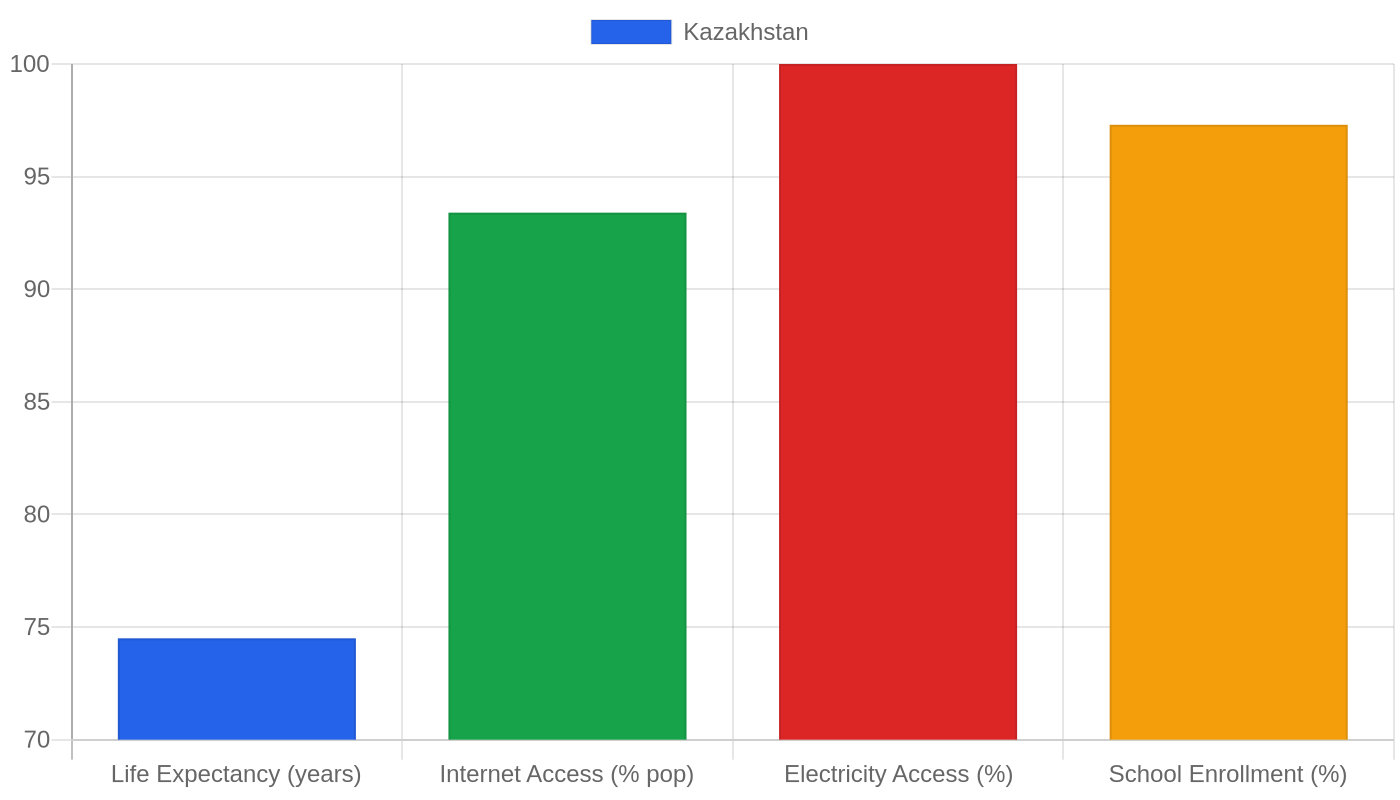
Economic Pulse Net | Sources: World Bank World Development Indicators, Government Sources | 2026
Key Takeaways
– Kazakhstan remains a presidential republic with a strong executive, currently led by Kassym-Jomart Tokayev, who succeeded long-time leader Nursultan Nazarbayev in 2019.
– The economy is anchored by heavy industry and basic materials, with major companies like Kazakhmys, KazakhGold, and Bogatyr Access Komir dominating the corporate landscape.
– Financial sector strength is evident through major banks such as Halyk Bank, Eurasian Bank, and BTA Bank, suggesting a mature banking infrastructure relative to regional peers.
– Consumer services and aviation are emerging sectors, led by Air Astana, Berkut Air, and Euro-Asia Air, pointing to growing connectivity and domestic consumption.
– Political stability has been the hallmark of Kazakhstan’s post-Soviet trajectory, though the transition of power in 2019 marked a significant moment for the country’s governance narrative.
The Economic Engine — Minerals, Money, and Momentum
Kazakhstan’s economic story is written in the language of geology. The country sits on vast reserves of natural resources, and its corporate roster reads like a mining and metals index. Kazakhmys and KazakhGold are not just companies; they are pillars upon which the nation’s export revenues are built. The World Bank data underscores a structure where basic materials — copper, gold, coal, and oil — form the bedrock of economic activity.
Bogatyr Access Komir, one of the world’s largest coal producers, exemplifies the scale of extraction that defines the Kazakh economy.
The financial sector provides the circulatory system for this resource wealth. Halyk Bank, Eurasian Bank, and BTA Bank represent a banking landscape that has matured significantly since the turbulent years following independence. These institutions facilitate the capital flows necessary for mining operations, infrastructure projects, and the growing consumer economy.
The presence of multiple major banks suggests a financial ecosystem capable of supporting both corporate giants and retail customers, though the concentration in extractive industries creates exposure to global commodity price cycles.
What the World Bank data does not provide in precise GDP or inflation figures, the corporate landscape reveals through its composition. Kazakhstan is not a diversified manufacturing hub or a tech startup paradise — it is a resource economy with a sophisticated financial overlay. The absence of technology or consumer goods giants among the top companies tells its own story: value creation remains tied to what lies beneath the soil rather than what can be built above it.
This structural reality shapes everything from employment patterns to foreign investment flows, and it explains why global commodity demand remains the single most important variable in Kazakhstan’s economic equation.
Living on the Steppe — The Cost of Daily Life
Without specific cost-of-living indices from the World Bank, one must look to the structure of the economy to understand what daily life demands of ordinary Kazakhs. The dominance of extractive industries creates a dual economy: well-paid workers in mining and energy sectors versus those in services and agriculture who face tighter margins.
Housing costs in major cities like Nur-Sultan and Almaty reflect this divide, with modern apartments commanding prices that strain middle-class budgets while older Soviet-era housing stock remains more accessible.
The presence of three aviation companies among the top corporations — Air Astana, Berkut Air, and Euro-Asia Air — hints at the vast distances that define Kazakhstan’s geography and the premium placed on mobility. For most citizens, however, daily expenses are shaped by the country’s continental climate and its position as a landlocked nation.
Food, utilities, and transportation consume significant portions of household income, and the cost of imported goods reflects the logistical challenges of supply chains that must cross multiple borders. Compared to other Central Asian economies, Kazakhstan has historically offered a higher standard of living, but the gap between urban professionals in the financial sector and rural communities dependent on agriculture or mining remains pronounced.
Where Capital Meets Opportunity — Investment and Business Climate
Kazakhstan offers a distinctive proposition for investors: a resource-rich economy with established financial infrastructure and political continuity. The top companies list reads like a portfolio of Kazakhstan’s competitive advantages. For investors in basic materials, Kazakhmys and KazakhGold provide exposure to copper and gold markets through established operations.
Bogatyr Access Komir offers access to thermal coal markets, while the financial sector presents opportunities through Halyk Bank and Eurasian Bank for those seeking to play Kazakhstan’s domestic economic growth.
The aviation sector deserves particular attention. Air Astana has become a regional success story, connecting Kazakhstan to international markets and facilitating both business travel and tourism. The presence of three aviation companies among the top corporations suggests that the government has prioritized connectivity as a development strategy — a logical approach for a country that spans two continents and needs to overcome geographic isolation.
For business travelers and investors, this means that Kazakhstan is increasingly accessible, with modern airport infrastructure and growing route networks.
The political landscape, as described in the data, provides a framework of stability. Kazakhstan is officially a democratic, secular, constitutional unitary republic, with a president who holds veto power and serves as commander-in-chief. The prime minister chairs the cabinet, supported by three deputy prime ministers and sixteen ministers. This structure has provided continuity since independence, with only two presidents — Nursultan Nazarbayev from 1991 to 2019 and Kassym-Jomart Tokayev since 2019.
For investors, this political continuity has been a significant advantage compared to more volatile neighbors, though it also raises questions about the depth of democratic institutions and the predictability of policy transitions.
Safety, Stability, and the Quality of Life Equation
Kazakhstan’s political landscape offers a portrait of managed stability. The transition from Nazarbayev to Tokayev in 2019 was the first transfer of power in the country’s independent history, and it proceeded without the turmoil that has characterized leadership changes in some post-Soviet states. The president’s ability to veto legislation and command the armed forces provides a concentration of executive authority that has maintained order but also concentrated decision-making power.
For residents and visitors, this political stability translates into predictable governance and generally safe urban environments.
The quality of life in Kazakhstan reflects its status as a middle-income country with significant regional disparities. Major cities offer modern amenities, international schools, and healthcare facilities that approach Western standards for those who can afford them. Rural areas, particularly those dependent on agriculture or aging industrial infrastructure, present a different reality with limited access to services and economic opportunity.
The country’s secular constitution and ethnically diverse population have generally fostered social harmony, though economic inequality remains a persistent challenge. For expatriates and international business travelers, Kazakhstan offers a comfortable lifestyle in its urban centers, with safety levels that compare favorably to many emerging markets, though crime data from the World Bank is not available to provide precise comparisons.
Winds of Change — Kazakhstan’s Current Trajectory
The transition from Nazarbayev to Tokayev continues to shape Kazakhstan’s political and economic direction. Tokayev, who assumed the presidency in 2019, has signaled a desire for gradual reform while maintaining the stability that has characterized the Nazarbayev era. The political structure remains intact — a presidential system with a prime minister and cabinet — but there are signs of evolution in how power is exercised and how economic policy is formulated.
The corporate landscape provides clues about current dynamics. The prominence of financial institutions like Halyk Bank, Eurasian Bank, and BTA Bank suggests that the banking sector is undergoing consolidation and modernization, positioning itself to support both resource extraction and a growing consumer economy. The aviation sector’s strength indicates that connectivity and mobility remain priorities, with Air Astana and its competitors expanding routes and services.
For basic materials companies like Kazakhmys and KazakhGold, the global energy transition and commodity demand cycles will determine their trajectory, while Bogatyr Access Komir faces the long-term question of coal’s role in a decarbonizing world.
The government’s approach to economic management appears to balance continuity with adaptation. The sixteen ministers in the cabinet cover the full range of governance functions, and the three deputy prime ministers suggest a focus on coordinating economic policy across different sectors.
For businesses operating in Kazakhstan, the key question is whether the Tokayev administration will accelerate reforms to diversify the economy away from resource dependence or maintain the current structure that has delivered stability but limited structural change.
The Bottom Line
Kazakhstan deserves the attention of investors and businesses seeking exposure to Central Asian resource wealth with political stability and established financial infrastructure. The country offers access to critical minerals, a functioning banking system, and a government that has demonstrated continuity in leadership and policy direction.
For those watching global commodity markets, Kazakhstan’s major companies — from Kazakhmys to Halyk Bank — provide direct exposure to the region’s economic fortunes. The transition to the Tokayev era presents both opportunity and uncertainty, but for now, Kazakhstan remains the steppe giant that commands attention from anyone serious about the economic future of Eurasia.
Sources & Methodology
This article is authored by Economic Pulse Net for informational and research purposes. Economic Pulse Net sources its data from multilateral institutions, national statistics bureaus, and proprietary databases. All data is believed to be current as of the date of publication.
Published: July 22, 2026 | Category: Research — Kazakhstan
Use these signals in your own platform
Economic Pulse publishes its live signal feed through a documented, read-only API. Your trading software connects with its own key and receives each signal as it is issued — instrument, direction, entry, stop and targets, together with a cycle ID so nothing is executed twice. The feed is independent of this website and cannot change it.
Signals are informational only and are not financial advice.