Economic Pulse Net | Sources: World Bank World Development Indicators, Government Sources | 2026
Key Takeaways
– Solomon Islands operates as a constitutional monarchy under King Charles III, with a parliamentary system that can dissolve itself before a full four-year term, creating periodic political volatility.
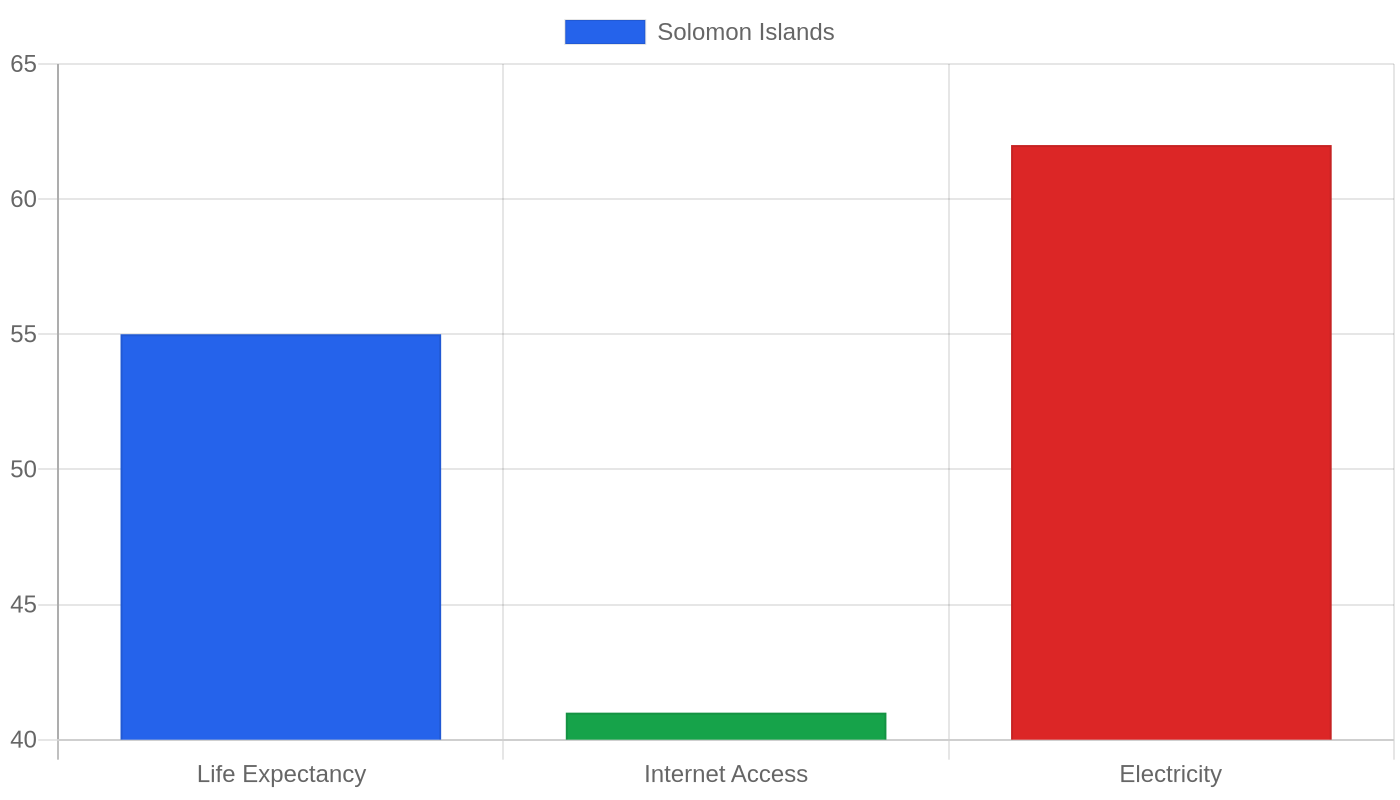
– The country’s economic data remains largely opaque, with no recent GDP growth, inflation, unemployment, or per capita income figures available from the World Bank, reflecting significant statistical capacity challenges.
– As a Pacific Island nation, Solomon Islands faces structural economic vulnerabilities including geographic isolation, small market size, and exposure to climate-related shocks.
– The political landscape is defined by a unicameral 50-member parliament and a Governor-General appointed for five-year terms, with potential for early dissolution adding uncertainty to governance.
– Despite data gaps, the country’s strategic location in the Pacific has drawn increasing international attention, with implications for trade, aid, and diplomatic alignment.
The Missing Numbers — What the Data Silence Tells Us
When the World Bank publishes no GDP growth figure, no inflation rate, no unemployment statistic, and no per capita income estimate for a country, the absence itself becomes a story. Solomon Islands, a sprawling archipelago of hundreds of islands in the southwestern Pacific, exists in a statistical twilight that hinders both domestic policymaking and foreign investment.
The World Bank’s data gaps for this nation are not an oversight — they reflect profound challenges in data collection across remote, often inaccessible island communities, a limited formal economy, and a governance structure that has historically struggled with institutional capacity.
Without reliable GDP figures, it is impossible to say with precision whether the Solomon Islands economy is expanding or contracting. Inflation, a critical measure of purchasing power for ordinary citizens, remains unquantified by the World Bank. Unemployment — a politically sensitive metric everywhere — is similarly absent from the international record. This statistical vacuum means that international donors, investors, and even the government itself are navigating economic policy with incomplete maps.
What is clear is that Solomon Islands remains a predominantly subsistence-based economy, with most of its population engaged in small-scale agriculture, fishing, and forestry. The formal cash economy is concentrated in Honiara, the capital, and a handful of export sectors such as timber, palm oil, and gold.
The absence of data from the World Bank should not be mistaken for economic stability — it is more accurately read as a signal of how far the country has to go in building the basic institutional infrastructure of a modern state.
The Price of Paradise — Housing and Daily Life in Honiara
For the roughly 80,000 residents of Honiara, the cost of living tells a story that no World Bank spreadsheet can fully capture. Without official CPI figures from the World Bank, one must turn to anecdotal evidence and regional comparisons to understand the pressures facing ordinary Solomon Islanders. Housing in Honiara is notoriously expensive relative to local incomes, driven by limited land availability, rapid urbanisation, and a construction sector that relies heavily on imported materials.
Rent for a modest two-bedroom home in a reasonable neighbourhood can consume the majority of a formal-sector salary, pushing many families into informal settlements on the city’s periphery where services are scarce.
Daily expenses for food, transportation, and utilities are inflated by the country’s geography. Solomon Islands imports a significant portion of its staple goods — rice, flour, canned fish, fuel — from Australia, New Zealand, and increasingly China. Shipping costs, port inefficiencies, and the thinness of the domestic market mean that prices in Honiara are substantially higher than in comparable Pacific capitals.
For the majority of Solomon Islanders who live in rural areas and rely on subsistence agriculture, cash expenses are lower, but access to healthcare, education, and consumer goods remains severely limited. The absence of World Bank cost-of-living data does not mean the problem does not exist — it means the problem is not being measured, which is itself a form of neglect.
Business in the Balance — Investment Climate and Corporate Landscape
The Solomon Islands business environment is shaped by small scale, high costs, and growing geopolitical competition. The World Bank provides no list of top companies, but the formal economy is dominated by a handful of players in natural resources — logging operations, palm oil plantations, gold mining at the Gold Ridge mine, and tuna fishing. These sectors are heavily dependent on export markets and foreign capital, making them vulnerable to global commodity price fluctuations and shifts in trade policy.
The absence of a robust domestic manufacturing base means that nearly everything except raw resources must be imported, creating chronic trade deficits and pressure on foreign exchange reserves.
For investors, the Solomon Islands offers both opportunity and risk. The country’s vast maritime zone holds potential for fisheries development, and its forests — though increasingly depleted — remain a source of tropical hardwoods. The political landscape, however, introduces significant uncertainty. As a constitutional monarchy with a parliamentary system, Solomon Islands has seen frequent changes of government, often through votes of no confidence rather than elections.
The Governor-General, appointed by the Parliament for a five-year term, represents King Charles III as head of state, but real executive power rests with the Prime Minister and cabinet. The 50-member unicameral parliament can dissolve itself before completing its four-year term, creating a cycle of instability that deters long-term investment. For businesses considering entry, the message is clear: patience, local partnerships, and a tolerance for political risk are essential.
Politics, Safety, and the Quality of Life Question
The World Bank provides no Crime Index or Safety Index for Solomon Islands, but the reality on the ground is well-documented by regional observers and humanitarian organisations. Honiara has experienced periodic outbreaks of civil unrest, most notably the riots of November 2021 that saw widespread looting and arson in the capital’s Chinatown district.
These events were triggered by political tensions and grievances over economic inequality, and they highlighted the fragility of social order in a country with limited police capacity and a young, underemployed population. Outside the capital, crime rates are generally lower, but tribal and land disputes can escalate into violence, and the state’s reach is limited in many rural areas.
Politically, Solomon Islands is navigating a complex transition. The constitutional framework — a parliamentary system under a constitutional monarchy — provides formal stability, but the reality is more fluid. The Governor-General, chosen by Parliament, serves as the representative of King Charles III, but the day-to-day political contest is fierce and often personal. Elections are held every four years, but early dissolutions are common, meaning governments rarely serve full terms.
This political churn has real consequences for quality of life: public services are inconsistent, infrastructure projects stall with each change of government, and citizens cannot rely on the state for basic needs.
The absence of happiness or wellbeing data from the World Bank is telling — in a country where many people live outside the formal economy, traditional measures of quality of life may miss the resilience of community networks, but they also miss the deep frustration of those left behind by modernisation.
The Geopolitical Pivot — What Is Happening Right Now
Solomon Islands is currently at the centre of one of the most consequential geopolitical shifts in the Pacific. In 2022, the government signed a security pact with China, breaking with its traditional reliance on Australia and the broader Western security architecture. This decision, made under Prime Minister Manasseh Sogavare, has reshaped the country’s international relationships and drawn intense scrutiny from the United States, Australia, New Zealand, and Japan.
The security agreement allows for Chinese police and military presence in the country, and it has been followed by increased Chinese investment in infrastructure, telecommunications, and port facilities. Critics warn that Solomon Islands is trading long-term sovereignty for short-term aid; supporters argue that the country is simply diversifying its international partnerships in a way that serves its national interest.
Domestically, the political landscape remains fluid. The Parliament, elected for four-year terms, faces ongoing pressure from both internal factions and external actors. The Governor-General, representing King Charles III, plays a largely ceremonial role, but the real power struggle is between pro-China and pro-Western factions within the political elite. The 50-member unicameral parliament has seen shifting alliances, and the possibility of early dissolution or a vote of no confidence remains ever-present.
For citizens, the most immediate concern is the cost of living, which continues to rise as global food and fuel prices feed through to local markets. Without official inflation data from the World Bank, the government’s policy response remains reactive rather than strategic. The coming months will test whether Solomon Islands can balance its new geopolitical alignment with the basic economic needs of its people.
The Bottom Line
Solomon Islands is a country that matters far more than its size or economic output would suggest. For investors, it offers frontier-market exposure to natural resources and fisheries, but with political risk that demands careful navigation. For policymakers in the Pacific and beyond, it is a test case of whether small island states can maintain sovereignty in an era of great-power competition.
For the Solomon Islanders themselves, the immediate challenge is simpler and more profound: building an economy that works for everyone, in a world that is suddenly paying very close attention.
Sources & Methodology
This article is authored by Economic Pulse Net for informational and research purposes. Economic Pulse Net sources its data from multilateral institutions, national statistics bureaus, and proprietary databases. All data is believed to be current as of the date of publication.
Published: July 22, 2026 | Category: Research — Solomon Islands
Use these signals in your own platform
Economic Pulse publishes its live signal feed through a documented, read-only API. Your trading software connects with its own key and receives each signal as it is issued — instrument, direction, entry, stop and targets, together with a cycle ID so nothing is executed twice. The feed is independent of this website and cannot change it.
Signals are informational only and are not financial advice.