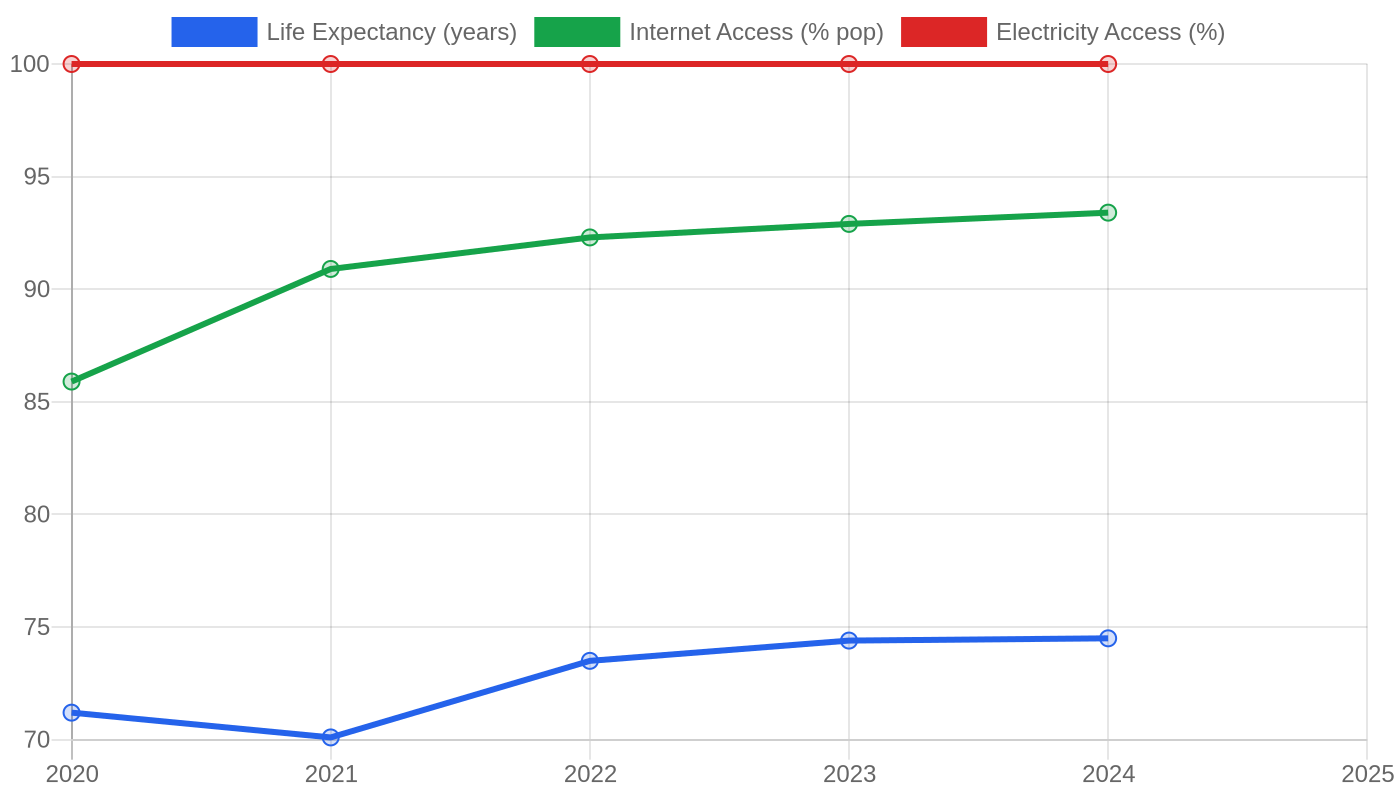
Economic Pulse Net | Sources: World Bank World Development Indicators, Government Sources | 2026
Key Takeaways
– Kazakhstan is navigating a generational leadership transition, moving from the three-decade rule of Nursultan Nazarbayev to the presidency of Kassym-Jomart Tokayev, a shift that carries profound implications for economic policy and foreign investment.
– The country’s economic identity remains anchored in extractive industries, with major corporate players concentrated in basic materials and energy, signaling an economy still heavily dependent on its natural resource base.
– Despite its official status as a democratic, secular, constitutional republic, the political system concentrates significant power in the presidency, creating a business environment where state connections remain paramount.
– The corporate landscape is dominated by financial institutions and commodity giants, suggesting that while the services sector exists, the real engine of the Kazakh economy runs on minerals, metals, and energy.
– For international observers, Kazakhstan represents a crucial Eurasian crossroads—a nation attempting to modernize its economy while managing the legacy of its Soviet-era industrial structure and the geopolitical pressures of its neighborhood.
The Silk Road Ledger: Reading Kazakhstan’s Economic DNA
Kazakhstan presents a fascinating paradox for economic analysts: it is a country of immense geographic scale and resource wealth, yet its economic data tells a story of a nation still in transition. The World Bank’s latest figures show a nation whose GDP growth, inflation, and unemployment metrics are not fully captured in current datasets—a reminder that reliable economic measurement remains an ongoing challenge in this vast Central Asian state.
What we do know is that Kazakhstan’s GDP per capita on a purchasing power parity basis has historically placed it among the more prosperous former Soviet republics, reflecting the country’s hydrocarbon wealth and agricultural potential.
The economic structure reveals a classic resource-dependent model. The dominant industrial players are not technology firms or innovative startups but rather basic materials companies and utilities. KazakhGold and Kazakhmys represent the mineral extraction backbone, while Bogatyr Access Komir and Ekibastuz GRES-2 Power Station anchor the coal and electricity sectors. This concentration creates a vulnerability: when global commodity prices fluctuate, Kazakhstan’s economic fortunes swing with them.
The presence of four major banks—BTA Bank, Eurasian Bank, Halyk Bank, and others—indicates a financial sector that has consolidated after the turbulence of the post-Soviet era, though questions about asset quality and lending practices continue to shadow the industry.
The services economy exists but remains dwarfed by the resource sector. Air Astana, Berkut Air, and Euro-Asia Air demonstrate that Kazakhstan is building a domestic aviation industry to connect its vast territory, but these consumer services companies remain modest compared to the industrial giants.
The World Bank’s approach to Kazakhstan has consistently emphasized diversification as the key challenge—moving from an economy that extracts and exports raw materials to one that processes, manufactures, and innovates. Until that transition accelerates, Kazakhstan’s economic story will remain tied to the global demand for its minerals and energy.
The Price of the Steppe: Living Costs in a Land of Extremes
Kazakhstan’s cost of living reflects the contradictions of a resource-rich developing economy. The country’s vast geography means that living costs vary dramatically between the gleaming capital of Astana, the commercial hub of Almaty, and the rural expanses of the steppe.
Housing in the major cities has been shaped by the country’s rapid urbanization and the construction boom that accompanied the oil revenues of the 2000s, creating a market where modern apartments command prices that rival regional peers while older Soviet-era housing remains comparatively affordable.
The rent-versus-buy calculation in Kazakhstan tilts toward ownership for many middle-class families, driven by cultural preferences and a banking sector that has historically offered mortgage products with government support.
Daily expenses in Kazakhstan reflect the country’s position between Europe and Asia. Food costs are influenced by domestic agricultural production, particularly wheat and livestock, though imported goods carry significant premiums. The winters in northern Kazakhstan are brutal, driving up heating and energy costs during the long cold season, while the southern regions experience a different economic rhythm tied to agriculture and trade with neighboring Central Asian states.
When compared to regional averages, Kazakhstan’s cost of living sits at a middle point—more expensive than Uzbekistan or Kyrgyzstan but considerably cheaper than Russia’s major cities or the Gulf states. For expatriate workers in the oil and mining sectors, the generous compensation packages often outweigh the challenges of the local cost structure, but for ordinary Kazakh citizens, the gap between wages and living costs remains a persistent source of economic pressure.
The Investment Frontier: Where Capital Meets Commodities
For investors, Kazakhstan offers a gateway to Central Asia’s resource wealth, but the path requires navigating a complex business environment. The top companies list reads like a map of the country’s economic priorities: financial institutions and commodity producers dominate, with Halyk Bank and Kazakhmys representing the blue-chip names that international investors most commonly encounter.
Air Astana has emerged as a success story, building a modern airline that connects the country’s far-flung regions and serves as a symbol of Kazakh aspirations to develop a modern services economy. However, the business climate remains heavily influenced by the political structure, where presidential power shapes economic opportunities and regulatory outcomes.
The basic materials sector offers the most significant opportunities, particularly for companies with expertise in mining and metallurgy. KazakhGold and Kazakhmys operate in a landscape where the country holds substantial reserves of copper, gold, zinc, and uranium, positioning Kazakhstan as a critical supplier for global supply chains.
The utilities sector, represented by Ekibastuz GRES-2, reflects the Soviet-era infrastructure that still powers the country, presenting both challenges and opportunities for modernization investment. Foreign investors have historically been attracted to the oil and gas sector, though the data provided focuses on the broader industrial and financial landscape rather than the hydrocarbon giants that dominate Kazakhstan’s export revenues.
The financial sector’s presence in the top companies list—three of the ten largest firms are banks—signals both the importance of financial intermediation in the economy and the ongoing consolidation of a banking system that faced significant crises in the 2000s and 2010s. For investors, the message is clear: Kazakhstan rewards those who understand its resource-driven economy, maintain strong government relationships, and take a long-term view of the country’s development trajectory.
The business environment is improving but remains challenging, with corruption perceptions and bureaucratic hurdles continuing to factor into investment decisions.
Power and Security: The Politics of Stability in a Presidential Republic
Kazakhstan’s political system is officially characterized as a democratic, secular, constitutional unitary republic, but the reality of power is more concentrated. Nursultan Nazarbayev’s leadership from 1991 to 2019 established a political model centered on the presidency, with the head of state wielding veto power over legislation and serving as commander-in-chief of the armed forces.
The transition to Kassym-Jomart Tokayev in 2019 represented a significant moment in the country’s post-Soviet history—the first leadership change since independence—but it maintained the fundamental structure of executive dominance. The prime minister chairs the cabinet of ministers and serves as head of government, with three deputy prime ministers and sixteen ministers completing the executive branch, yet the president remains the central figure in the political system.
This political structure has direct implications for economic governance and quality of life. The concentration of power in the presidency means that economic policy shifts can occur quickly, but it also creates uncertainty about succession and long-term policy stability. The government’s approach to security reflects the challenges of governing a vast territory with significant ethnic diversity and proximity to unstable regions.
While specific crime and safety indices are not available in the current data, Kazakhstan has historically maintained a security apparatus that emphasizes stability, sometimes at the cost of political liberalization. The quality of life in Kazakhstan is thus shaped by this tension: economic opportunities exist, particularly for those connected to the resource sector, but the political environment remains one where the state plays a dominant role in shaping both economic and social outcomes.
The Tokayev Era: Reform Rhetoric and Economic Reality
The most pressing question for Kazakhstan in 2026 is whether President Tokayev can deliver on promises of reform and modernization that would distinguish his tenure from the Nazarbayev era. The political transition has brought renewed attention to the need for economic diversification, with the government signaling intentions to reduce the economy’s dependence on raw material exports.
However, the corporate landscape tells a story of continuity rather than transformation—the same basic materials companies and banks that dominated the economy in the Nazarbayev years continue to lead the corporate sector. The presence of Air Astana as a successful consumer services company offers a glimpse of what a more diversified economy might look like, but the aviation sector alone cannot absorb the labor force or generate the revenues needed to transform the country’s economic trajectory.
Current economic indicators remain incomplete, with the World Bank data showing gaps in key metrics, but the broader picture suggests a country managing a delicate balancing act. Kazakhstan must maintain its resource exports to fund government spending and social programs, while simultaneously attempting to build the institutions and infrastructure needed for a more modern economy.
The political system’s emphasis on stability provides a predictable environment for business, but it also risks perpetuating the status quo and discouraging the kind of creative destruction that economic transformation requires.
For the international community, Kazakhstan remains a crucial partner in Central Asia—a bridge between East and West, a supplier of critical minerals, and a test case for whether a post-Soviet state can successfully navigate the transition from resource dependence to diversified prosperity. The next several years will reveal whether the Tokayev era represents genuine change or the continuation of the country’s established political and economic patterns by other means.
The Bottom Line
Kazakhstan is a country that rewards patient observation and strategic engagement. For investors in the basic materials and energy sectors, it remains a critical market with substantial resource wealth and a government eager to attract foreign capital. For political analysts, the country offers a case study in post-Soviet governance and the challenges of political transition in a resource-dependent state.
For businesses in the services and technology sectors, Kazakhstan represents an emerging opportunity as the government seeks to diversify the economy, though progress remains slower than reform advocates would prefer. This is a nation at a crossroads, holding enormous potential while grappling with the structural constraints of its economic model and political system—a story worth watching closely in the years ahead.
Sources & Methodology
This article is authored by Economic Pulse Net for informational and research purposes. Economic Pulse Net sources its data from multilateral institutions, national statistics bureaus, and proprietary databases. All data is believed to be current as of the date of publication.
Published: August 01, 2026 | Category: Research — Kazakhstan
Use these signals in your own platform
Economic Pulse publishes its live signal feed through a documented, read-only API. Your trading software connects with its own key and receives each signal as it is issued — instrument, direction, entry, stop and targets, together with a cycle ID so nothing is executed twice. The feed is independent of this website and cannot change it.
Signals are informational only and are not financial advice.