Economic Pulse Net | Sources: World Bank World Development Indicators, Government Sources | 2026
Key Takeaways
- Kazakhstan remains a political paradox: officially a “democratic, secular, constitutional unitary republic,” yet shaped by nearly three decades of single-leader rule followed by a carefully managed transition.
- The corporate landscape is dominated by extractive and financial heavyweights—Kazakhmys, KazakhGold, and Halyk Bank—underscoring an economy still anchored in commodities.
- Aviation and consumer services are punching above their weight, with Air Astana leading a surprisingly active regional airline sector.
- The political handover from Nursultan Nazarbayev to Kassym-Jomart Tokayev marks a pivotal generational shift, but the institutional architecture remains largely untouched.
- For investors, the story is one of vast resource wealth meeting gradual, cautious modernization—a frontier market with real heft but persistent opacity.
The Long Game: An Economy Built on What Lies Beneath
Kazakhstan’s economic narrative is written in the periodic table.
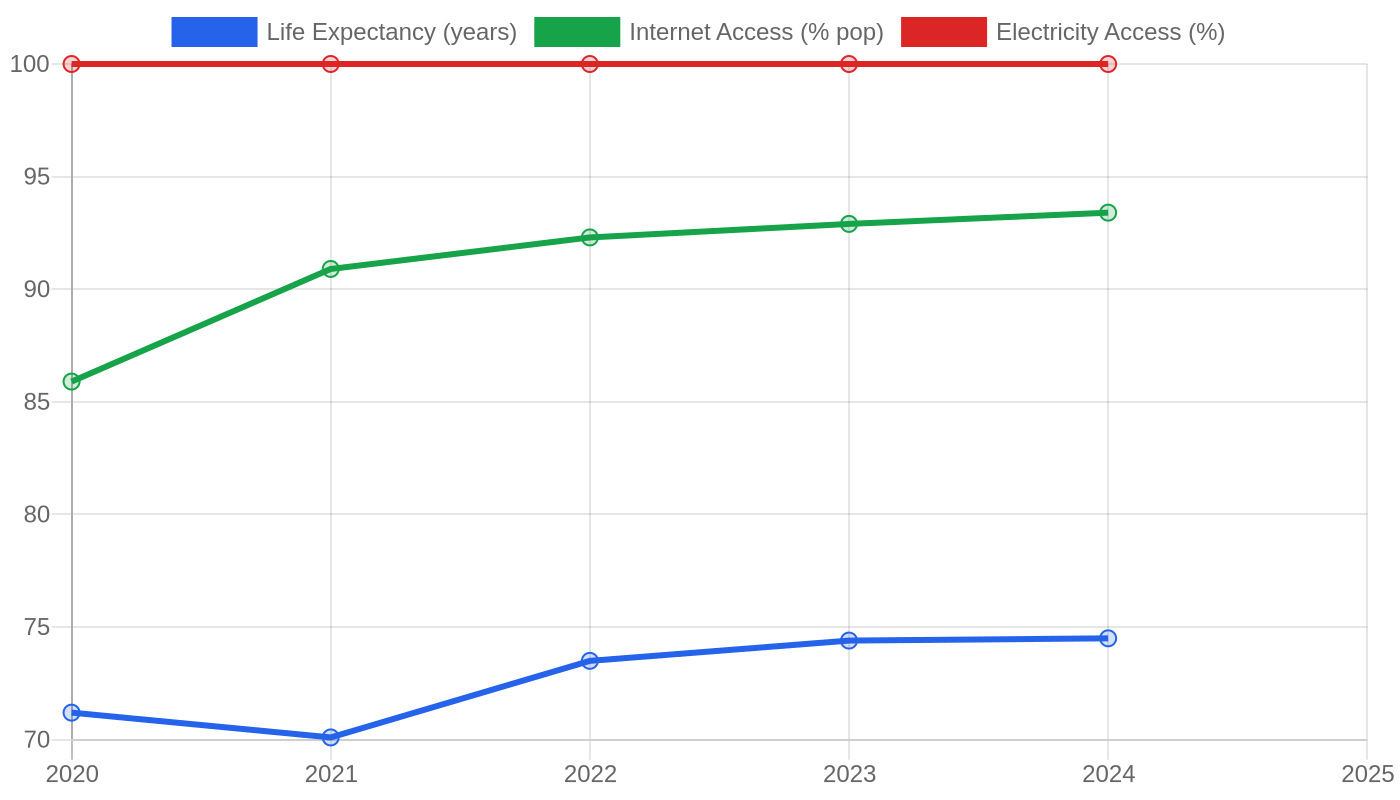
The World Bank’s latest data release shows a country in a holding pattern—growth figures are unavailable, inflation is unmeasured in the current cycle, and unemployment data has yet to be published.
But the absence of fresh numbers does not diminish the structural reality: this is an economy that has historically run on hydrocarbons, uranium, and base metals, and it continues to do so.
The corporate roster tells the story more vividly than any aggregate statistic.
Kazakhmys, one of the world’s largest copper producers, remains a cornerstone of the domestic industrial base.
KazakhGold, despite its name, represents the precious metals sector that has attracted steady international interest.
On the energy side, Ekibastuz GRES-2 Power Station stands as a Soviet-era colossus—one of the world’s largest power plants—still generating electricity for a grid that struggles with aging infrastructure.
The financial sector, meanwhile, is anchored by Halyk Bank and BTA Bank, institutions that have weathered multiple banking crises and emerged as the gatekeepers of credit in a dollar-sensitive economy.
The World Bank’s framework suggests a classic resource-dependent trajectory: growth when commodity prices cooperate, stagnation when they do not.
The absence of current GDP per capita or GNI figures means we cannot update the ledger, but the structural picture remains one of a middle-income nation with outsized geological endowments and a persistent struggle to diversify beyond them.
The Price of Living on the Steppe
Cost-of-living data for Kazakhstan has not been published in the current World Bank update, but the available corporate and demographic signals paint a picture of a country with a bifurcated urban-rural reality.
The consumer services sector, led by Air Astana, Berkut Air, and Euro-Asia Air, suggests a growing middle class with disposable income sufficient to support domestic air travel—no small feat in a country the size of Western Europe.
Housing costs in Almaty, the commercial capital, have historically run well above the national average, while the new capital, Astana, has seen a construction boom driven by government relocations and prestige projects.
The rental market in major cities is thin by global standards, with ownership heavily favored as a cultural norm and an inflation hedge.
For the average household, food and utilities consume a significant share of income, and the country’s harsh continental climate—with winter temperatures routinely dropping below minus 30 degrees Celsius in the north—imposes real energy costs that are only partially subsidized by the state.
Without current CPI data from the World Bank, we cannot quantify the recent inflation trajectory, but the regional context suggests Kazakhstan faces the same pressures as its Central Asian neighbors: imported inflation, currency volatility, and the constant tug-of-war between the tenge and the dollar.
Where the Money Moves: Titans, Traders, and the Business of Extraction
Kazakhstan’s investment climate is a study in controlled openness.
The government has long welcomed foreign capital into the extractive sectors—copper, gold, coal, and oil—while maintaining a tighter grip on finance, media, and strategic infrastructure.
The presence of Bogatyr Access Komir, a major coal producer, and Ekibastuz GRES-2 underscores the continued importance of coal in the energy mix, even as global pressure mounts to decarbonize.
For investors, the appeal is straightforward: Kazakhstan offers some of the world’s most significant untapped mineral reserves, a relatively stable security environment compared to other Central Asian states, and a government that, under President Tokayev, has signaled a desire for modernization—albeit at a cautious pace.
The banking sector, long a source of concern, has consolidated and stabilized, with Halyk Bank emerging as a regional powerhouse.
Yet the business environment remains challenging for smaller players.
The World Bank’s data does not provide a current ease-of-doing-business ranking, but the composition of the top companies—dominated by extractive industries and state-linked financial institutions—suggests that connections remain as important as capital.
Air Astana’s success as a consumer-facing brand is the exception that proves the rule: a well-run company that has thrived despite, not because of, the broader business climate.
Power, Politics, and the Price of Stability
Kazakhstan’s political landscape is officially that of a democratic, secular, constitutional unitary republic—but the reality is more nuanced.
Nursultan Nazarbayev ruled from 1991 to 2019, a tenure that spanned the entire post-Soviet period, before handing power to Kassym-Jomart Tokayev.
The transition was managed, not contested, and the institutional architecture remains heavily centralized.
The president holds the power to veto parliamentary legislation and serves as commander-in-chief of the armed forces, while the prime minister chairs the cabinet and serves as head of government.
The current cabinet includes three deputy prime ministers and sixteen ministers—a structure that reflects the administrative weight of a country of nearly 20 million people spread across a vast territory.
Public safety data is not currently available, but the country’s crime and safety indices have historically shown a mixed picture: low rates of violent crime in urban centers, but persistent concerns about corruption and the rule of law.
For the average citizen, the trade-off is clear: stability and order in exchange for limited political pluralism.
The Tokayev succession has brought a generational shift in personnel but not in the fundamental power structure.
The question for the coming years is whether the “democratic, secular” language of the constitution will be matched by actual institutional reform, or whether the steppe’s traditional pattern of strongman rule will persist in new packaging.
The Tokayev Era: Signals of Change, Structures of Continuity
The most significant development in Kazakhstan right now is the slow, deliberate recalibration of power under Kassym-Jomart Tokayev.
Since assuming office in 2019, Tokayev has walked a careful line: distancing himself from the Nazarbayev era’s most egregious excesses while avoiding any direct confrontation with the former president’s extensive network of influence.
The political system remains a unitary republic with a strong executive, but there are signals of opening—discussions of electoral reform, a more assertive parliament, and a foreign policy that seeks to balance relations with Russia, China, and the West.
The economic agenda is similarly cautious.
The government has spoken of diversification, of moving beyond raw material exports, of building a knowledge economy.
The aviation sector’s growth, with Air Astana expanding its regional footprint, suggests some momentum in services.
But the structural dependence on extractive industries remains, and the global energy transition poses an existential question for a country whose wealth is literally dug out of the ground.
The World Bank’s data gap—no current GDP, inflation, or unemployment figures—makes it difficult to assess whether the Tokayev reforms are translating into measurable economic progress.
What is clear is that Kazakhstan is at a crossroads, and the choices made in the next few years will determine whether it emerges as a modern, diversified economy or remains a resource-rich state caught between larger powers.
The Bottom Line
Kazakhstan is a country to watch for anyone interested in the intersection of resource wealth, political transition, and geopolitical positioning.
For investors, the opportunities lie in the extractive sectors and the gradual opening of consumer markets; for policymakers, the country offers a case study in managed transition; for businesses, it represents a challenging but potentially rewarding frontier.
The World Bank’s data gaps are a reminder that transparency remains a work in progress.
But beneath the missing statistics lies a real economy, a real society, and a real political drama unfolding on the Eurasian steppe.
Watch this space—the next act is just beginning.
Sources & Methodology
This article is authored by Economic Pulse Net for informational and research purposes.
Economic Pulse Net sources its data from multilateral institutions, national statistics bureaus, and proprietary databases.
All data is believed to be current as of the date of publication. Published: August 30, 2026 |
Category: Research — Kazakhstan
Use these signals in your own platform
Economic Pulse publishes its live signal feed through a documented, read-only API. Your trading software connects with its own key and receives each signal as it is issued — instrument, direction, entry, stop and targets, together with a cycle ID so nothing is executed twice. The feed is independent of this website and cannot change it.
Signals are informational only and are not financial advice.