Economic Pulse Net | Sources: World Bank World Development Indicators, Government Sources | 2026
Indonesia enters 2026 as a study in contrasts.
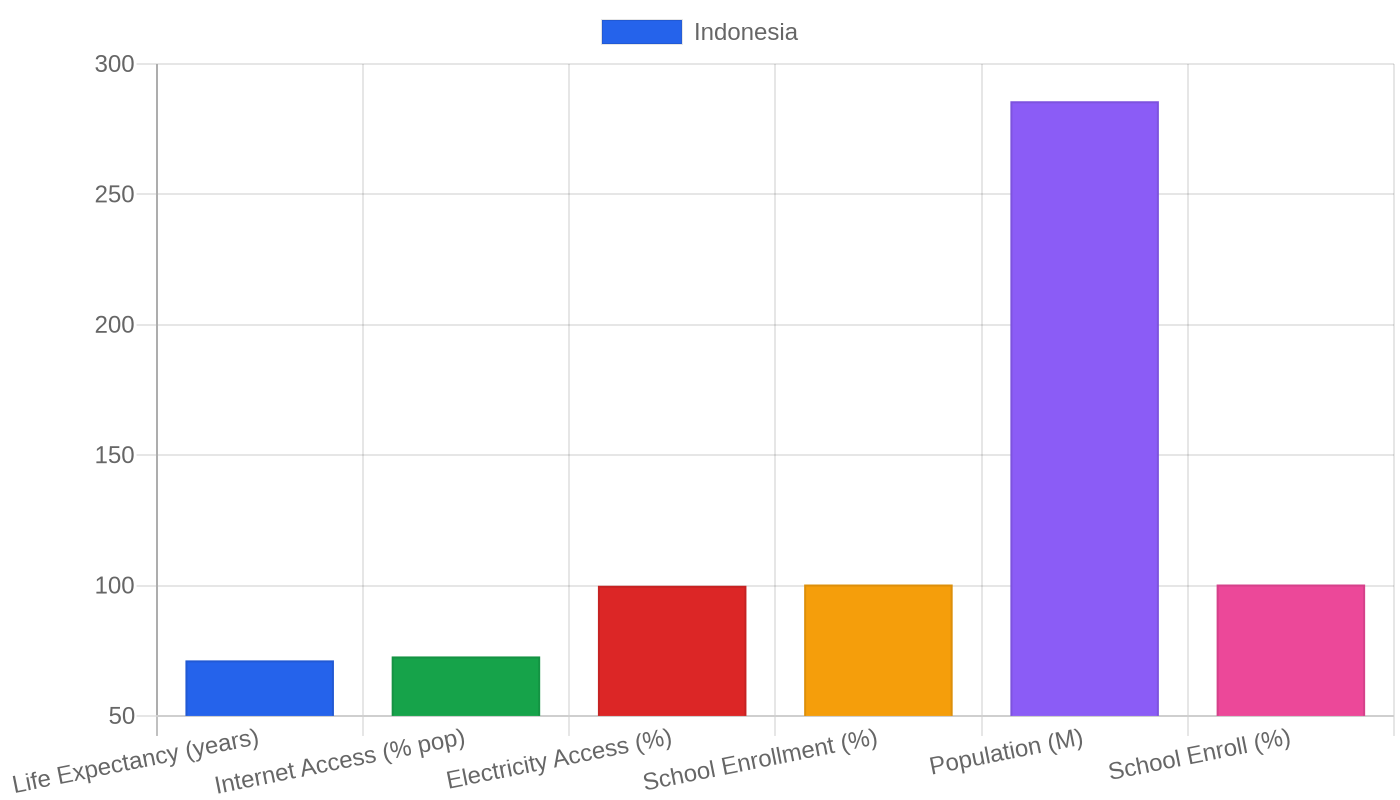
It is a nation of nearly 286 million people—the world’s fourth most populous—that has successfully navigated global headwinds to post steady growth, yet it remains a country where the average citizen earns a fraction of the GDP per capita suggests.
With inflation under control, unemployment at historic lows, and a political system that has matured since the fall of the New Order, Southeast Asia’s largest economy is positioning itself as a beacon of stability.
But beneath the surface of macroeconomic health lie questions about whether the engines of private enterprise can truly accelerate, and whether the state’s dominance in key sectors is a source of strength or a bottleneck.
This feature examines the data, the business landscape, and the political currents shaping the Indonesian story—a narrative of cautious optimism with the throttle only half-open.
Key Takeaways
- Steady, Not Stellar Growth: The World Bank reports GDP growth of 5.1% for 2025, a rate that is the envy of many Western economies but represents a continuation of Indonesia’s “golden corridor” of around 5%—enough to reduce poverty, but not enough to leapfrog into high-income status by 2030 without a significant investment surge.
- The Inflation Victory: At 1.9%, inflation is remarkably low, giving Bank Indonesia and the government room to maneuver on policy that they haven’t enjoyed in years.
- A Jobs Market Paradox: Unemployment stands at just 3.2%, a figure that signals a tight labor market, yet underemployment and informal work remain structural challenges that the headline number masks.
- The State’s Heavy Hand: The top companies list is dominated by state-owned enterprises (SOEs) and financial giants, indicating that the government remains the primary engine of commerce, for better or worse.
- A Pivot to Pragmatism: Recent news out of Jakarta—a trade surplus, a new central bank governor, and massive SOE dividend targets—suggests an administration focused on fiscal consolidation and institutional continuity rather than radical overhaul.
The Macroeconomic Canvas: Growth Without the Fever
The World Bank’s data paints a picture of an economy that has found its footing.
With a GDP of $1.44 trillion and a growth rate of 5.1% in 2025, Indonesia continues to post the kind of expansion that has made it a darling of emerging market investors.
More telling than the headline growth figure is the inflation rate: 1.9%.
This is a stunning achievement for a country that has historically struggled with volatile food prices and fuel subsidy adjustments.
It suggests that the supply-side reforms of the last decade are starting to pay dividends, and that the central bank has mastered the delicate art of managing expectations without choking off demand.
However, the GDP per capita (PPP) of $17,659 tells a story of disparity.
While this figure places Indonesia in the upper-middle-income bracket, the GNI per capita of just $5,120 highlights a significant gap between what the country produces and what its citizens actually earn.
This divergence points to a heavy reliance on commodity exports and capital-intensive industries that generate revenue but do not necessarily distribute wealth widely.
The growth is real, but it is a top-heavy kind of growth.
For the economy to truly transform, the 3.2% unemployment rate must be viewed critically; while low, it does not account for the millions of Indonesians working in the informal sector—hawkers, drivers, and day laborers—who are technically employed but lack the security and benefits of formal jobs.
The challenge for Jakarta is to translate this macroeconomic stability into microeconomic opportunity, moving beyond the extraction and financial sectors to build a manufacturing and services base that can absorb the 2 million new entrants to the labor force every year.
The Cost of Living: A Tale of Two Archipelagos
The cost of living in Indonesia is notoriously bifurcated.
In the capital, Jakarta, and the tech hub of Bandung, the cost of housing and consumer goods has been creeping upward, driven by the expansion of the middle class.
However, the data suggests that inflation—the primary driver of cost-of-living increases—is currently benign at 1.9%.
This is a double-edged sword.
On one hand, it preserves purchasing power for the average worker.
On the other, it can signal weak domestic demand, which is a concern for a government hoping to shift the economy away from export reliance.
Rent versus buy dynamics in Jakarta are heavily skewed toward renting for the younger demographic.
With mortgage rates still relatively high and the bureaucracy of land ownership complex, the rental market—from upscale apartments in the Sudirman Central Business District to more modest *kontrakans* in the suburbs—is the primary entry point for housing.
For the vast majority of the population outside Java, however, the cost of living remains significantly lower, but so does the income.
The GNI per capita of $5,120 means that the average Indonesian lives on roughly $427 per month, a figure that necessitates a frugal lifestyle.
The price of staple foods like rice, which is heavily subsidized and managed by the state logistics agency, remains the single most important price indicator for the public.
While the current low inflation is a boon, the government is walking a tightrope: they must maintain these low prices to keep the peace, but doing so often requires fiscal intervention that can distort markets and strain the state budget.
The Business Landscape: Giants, SOEs, and the Search for Dynamism
The list of Indonesia’s top companies reads like a who’s who of state capitalism.
Financial institutions dominate—Bank Rakyat Indonesia, Bank Mandiri, Bank Central Asia, Bank Negara Indonesia, and Bank Tabungan Negara are the lifeblood of the economy, financing everything from micro-lending schemes to massive infrastructure projects.
Alongside them are state-owned behemoths like Angkasa Pura (which operates the airports) and Badak LNG (a major player in the energy export game), as well as conglomerates like Astra International, which has its fingers in everything from automotive to mining.
This structure presents a unique investment climate.
On one hand, the presence of these giants provides a level of stability and depth that is rare in emerging markets; they are often backed by the government and are considered “too big to fail.” On the other hand, it crowds out the private sector.
The recent news that SOEs are expected to remit Rp 120 trillion to the state budget is a clear indicator of how reliant the government is on these entities to fund its agenda.
This is not necessarily a negative—it allows for rapid, centralized development—but it does raise questions about productivity.
For foreign investors, the landscape is improving but still labyrinthine.
While the government has opened up more sectors to foreign ownership in recent years, navigating the regulatory environment requires patience and local partnerships.
The sectors to watch are the downstream processing of nickel and other critical minerals, where Indonesia is aggressively trying to move up the value chain, and the digital economy, which is booming despite the global tech slowdown.
However, the dominance of the financial sector in the top companies list suggests that the economy is still better at financing consumption than it is at fostering disruptive innovation.
Safety, Politics, and the Quality of Life: The Price of Order
Indonesia’s political landscape is defined by a unique brand of guided democracy.
As the data notes, the country is a unitary republic with a presidential system under the 1945 Constitution, guided by the five principles of Pancasila.
The post-1998 reforms introduced direct presidential elections and regional autonomy, but the system remains centralized and heavily influenced by the executive.
This has led to a period of remarkable political stability, which is a key factor in attracting investment.
However, it also means that the quality of life is often dictated by the efficiency of the state apparatus rather than by civil society.
Regarding safety, the crime index data is currently unavailable, but the qualitative picture is one of a society where violent crime is relatively low, but petty crime and corruption are persistent issues.
The political stability does not always translate into social harmony; religious and ethnic tensions occasionally flare, particularly in the more conservative provinces.
For the average citizen, quality of life is improving—life expectancy is up, and the expansion of the middle class has brought better healthcare and education access—but the gap between the rich and poor remains stark.
The government’s focus on infrastructure, including the new capital city Nusantara, is an attempt to spread the wealth and ease the congestion of Java, but it is a long-term project with an uncertain payoff.
The trade-off in Indonesia is clear: the public has accepted a strong, centralized state that prioritizes order and stability over individual liberty, and in return, they receive a predictable, albeit sometimes frustrating, environment.
The Jakarta Pulse: Trade Surpluses and New Guard Leadership
The most immediate news out of Jakarta points to an administration that is focused on the bottom line.
The Jakarta Post reports that Indonesia has “reverses trade deficit with tiny July surplus,” a fragile but positive sign that exports are holding up against a wave of imports.
This is crucial for a country that needs to fund its development projects without depleting its foreign reserves.
The surplus is tiny, but it signals that the commodity boom, particularly in coal and palm oil, is still providing a buffer.
Simultaneously, “Inflation accelerates while House approves new BI governor” suggests a transition at the helm of the central bank.
The approval of a new governor is a critical moment for market confidence.
The slight acceleration in inflation, while still well within target, will be the first test for the new leadership.
They must balance the need to support growth with the imperative to maintain the hard-won credibility of the rupiah.
Finally, the news that “SOEs to remit Rp 120t to state budget this year” is a bold fiscal move.
This is a massive transfer of wealth from state enterprises to the government, indicating that the state is tightening its belt by squeezing its own companies rather than raising taxes on the public.
This policy could boost the government’s coffers, but it risks starving these SOEs of the capital they need to maintain their infrastructure and expand.
It is a high-stakes gamble that will define the fiscal health of the nation in the coming year.
The Bottom Line
Indonesia is not a country on the verge of a breakthrough; it is a country that has already arrived at a certain level of stability and is now trying to figure out how to take the next step.
For investors, it offers a compelling mix of natural resources, a massive domestic market, and a government that is committed to infrastructure development, but they must be prepared to work within a system that favors large, connected players.
For policymakers, the country is a test case of whether a resource-rich, state-guided economy can transition to a more diversified, private-sector-led model without losing its social cohesion.
Watch Indonesia for its resilience, but do not expect fireworks—expect a steady, grinding climb up the value chain, punctuated by the occasional, and often unpredictable, political maneuver.
It is the ultimate long-game market in Asia.
Sources & Methodology
This article is authored by Economic Pulse Net for informational and research purposes.
Economic Pulse Net sources its data from multilateral institutions, national statistics bureaus, and proprietary databases.
All data is believed to be current as of the date of publication. Published: September 01, 2026 |
Category: Research — Indonesia
Use these signals in your own platform
Economic Pulse publishes its live signal feed through a documented, read-only API. Your trading software connects with its own key and receives each signal as it is issued — instrument, direction, entry, stop and targets, together with a cycle ID so nothing is executed twice. The feed is independent of this website and cannot change it.
Signals are informational only and are not financial advice.