Economic Pulse Net | Sources: World Bank World Development Indicators, Government Sources | 2026
Key Takeaways
* Unprecedented Growth Trajectory: India is projected to deliver a robust GDP growth rate of 7.57% in 2025, positioning itself as one of the fastest-growing major economies globally.
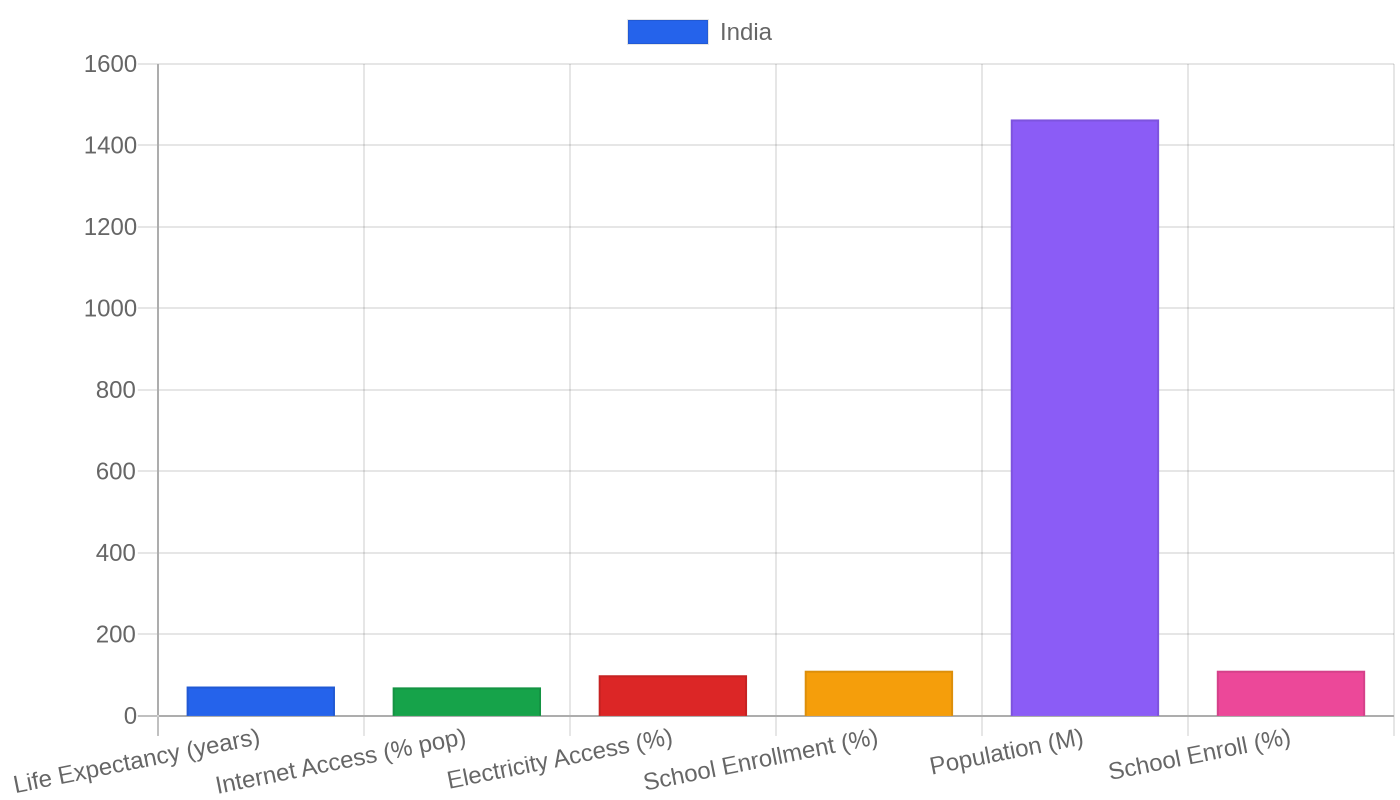
Demographic Dividend in Action: With a population exceeding 1.46 billion and an unemployment rate of just 4.2%, the labor market remains tight despite the sheer scale of the workforce.
Inflationary Pressures Looming: While current CPI inflation sits at a manageable 2.4%, financial experts warn of potential rate hikes by late 2026 due to emerging price risks.
Corporate Conglomerates Dominate: The business landscape is heavily influenced by large conglomerates like the Adani Group, which span across energy, infrastructure, and technology sectors.
Digital Asset Volatility: Recent market trends show significant activity in cryptocurrency, with Bitcoin trading near $84,000, reflecting broader global financial sentiment impacting local markets.
Economic Engine: Scaling New Heights
India’s economic performance in the mid-2020s presents a compelling narrative of rapid expansion driven by its massive demographic base and industrial output. According to World Bank data, the nation’s GDP is projected to reach approximately $3.96 trillion in 2025, fueled by a staggering growth rate of 7.57%.
This velocity is particularly notable given the country’s total population of 1.46 billion people; maintaining such high growth while lifting living standards for over a billion citizens is a formidable macroeconomic challenge that India appears to be navigating successfully. The labor market reflects this dynamism, with unemployment holding steady at a low 4.219%, suggesting strong demand for labor across various sectors. However, the purchasing power of the average citizen tells a more nuanced story.
While GDP per capita (PPP) stands at roughly $11,748, the GNI per capita remains lower at $2,760, indicating that wealth generation is still in early stages of broad distribution. Furthermore, consumer prices are currently stable, with CPI inflation recorded at a modest 2.40%, which provides a favorable environment for domestic consumption.
Yet, this stability masks underlying structural pressures; as the economy scales, the gap between aggregate national wealth and individual income highlights the critical need for inclusive policy frameworks to ensure that this growth translates into tangible quality-of-life improvements for the populace.
Living Standards: The Cost of Daily Life
For residents and expatriates alike, understanding the cost of living in India requires looking beyond headline inflation figures to the daily realities of housing and consumption. While specific regional housing indices are not detailed in the provided datasets, the overall CPI inflation rate of 2.40% suggests that essential goods and services are relatively affordable compared to many developed economies.
This low inflation environment generally supports household budgeting, allowing consumers to maintain their standard of living without severe erosion of purchasing power. However, the disparity between the GDP per capita ($11,748 PPP) and the GNI per capita ($2,760) implies that costs can vary drastically depending on one’s position within the economic hierarchy.
For the middle class, daily expenses may feel manageable, but for those relying solely on average national income, the pressure of basic necessities could be significant. Unlike some regions where rent consumes a majority of income, India’s vast informal sector and diverse urban-rural divide create a fragmented cost structure.
Therefore, while the macro-level data points to price stability, micro-level experiences will depend heavily on geographic location and socioeconomic status, making a one-size-fits-all assessment of “affordability” misleading without granular local context.
Investment Landscape: Giants and New Entrants
The Indian corporate sector is characterized by the dominance of large, diversified conglomerates that drive significant portions of the national economy. At the forefront is the Adani Group, a conglomerate whose influence spans multiple critical industries, setting a benchmark for scale and integration. Other major players include ABG Shipyard in the industrial shipping sector and Aban Offshore, highlighting the country’s strong foothold in energy and heavy industry.
In the technology space, firms like 63 Moons Technologies are gaining prominence, signaling a shift toward specialized tech solutions rather than generic IT services. The presence of companies like Acko General Insurance also indicates a maturing financial services sector, moving beyond traditional banking into niche insurance products.
These entities operate in a competitive environment where industrials, represented by ACC and Action Construction Equipment, play a crucial role in supporting infrastructure development. Investors watching India must therefore look past simple equity valuations and understand the ecosystem of these conglomerates, as they often dictate market trends and supply chain dynamics.
The concentration of power among these few major groups means that investment decisions are closely tied to the strategic moves of these corporate giants, creating both opportunities for high returns and risks associated with systemic interdependence.
Safety, Politics, and Social Fabric
Navigating the social and political terrain of India requires an appreciation of its historical legal foundations and current security metrics. From a political perspective, the nation’s identity is deeply rooted in the Constituent Assembly debates of 1946–1949, where founders championed *jus soli* (birthright citizenship) over *jus sanguinis* (descent-based citizenship).
This democratic principle, enshrined in the 1950 Constitution and later formalized by the Citizenship Act of 1955, underscores a commitment to inclusivity based on territorial presence rather than ethnic lineage. On the safety front, however, data gaps present a challenge for comprehensive risk assessment; both the Crime Index and Safety Index are listed as N/A in current reports.
This absence of standardized safety metrics makes it difficult to draw precise conclusions about personal security levels for travelers or investors. Consequently, stakeholders must rely on qualitative assessments and local intelligence rather than quantitative indices when evaluating risk.
The political landscape remains focused on these foundational democratic principles, ensuring that citizenship debates continue to evolve within a framework that prioritizes birthplace rights, which influences migration policies and social cohesion efforts.
Current Affairs: Market Shifts and Policy Signals
The most immediate developments in India’s economic sphere revolve around monetary policy adjustments and volatile asset markets. Recent analysis from *Livemint* highlights growing concerns among economists regarding inflation risks, with the Reserve Bank of India (RBI) potentially raising the repo rate in October 2026. This anticipated move signals a proactive stance by policymakers to preemptively curb any upward pressure on prices before they become entrenched in the economy.
Simultaneously, global financial trends are rippling through Indian markets, as evidenced by Bitcoin’s recent rebound to trade near $84,000 after briefly surpassing $86,000. As reported by *Economic Times*, expert commentary on this digital asset surge reflects broader investor sentiment and the increasing integration of crypto-assets into mainstream financial discourse.
Market snapshots from *Livemint* further indicate active trading volumes and shifting trends, suggesting that liquidity and investor confidence remain high despite external uncertainties. These concurrent developments—tightening monetary policy amidst booming digital asset values—create a complex operational environment for businesses. Companies must now balance the cost of capital against the allure of high-risk, high-reward alternative investments, making agility in financial strategy more critical than ever.
The Bottom Line
India stands at a pivotal juncture where its impressive 7.57% growth trajectory meets the practical challenges of managing inflation and distributing wealth. Investors should watch closely how the RBI’s potential rate hike in late 2026 impacts corporate borrowing costs, particularly for infrastructure-heavy conglomerates like the Adani Group. For long-term observers, the country’s adherence to democratic citizenship principles and its robust labor market offer a stable foundation for sustained development.
While data gaps in safety indices require caution, the economic momentum and vibrant corporate landscape make India an indispensable player in the global economy.
Sources & Methodology
This article is authored by Economic Pulse Net for informational and research purposes. Economic Pulse Net sources its data from multilateral institutions, national statistics bureaus, and proprietary databases. All data is believed to be current as of the date of publication.
Published: October 04, 2026 | Category: Research — India
Use these signals in your own platform
Economic Pulse publishes its live signal feed through a documented, read-only API. Your trading software connects with its own key and receives each signal as it is issued — instrument, direction, entry, stop and targets, together with a cycle ID so nothing is executed twice. The feed is independent of this website and cannot change it.
Signals are informational only and are not financial advice.